
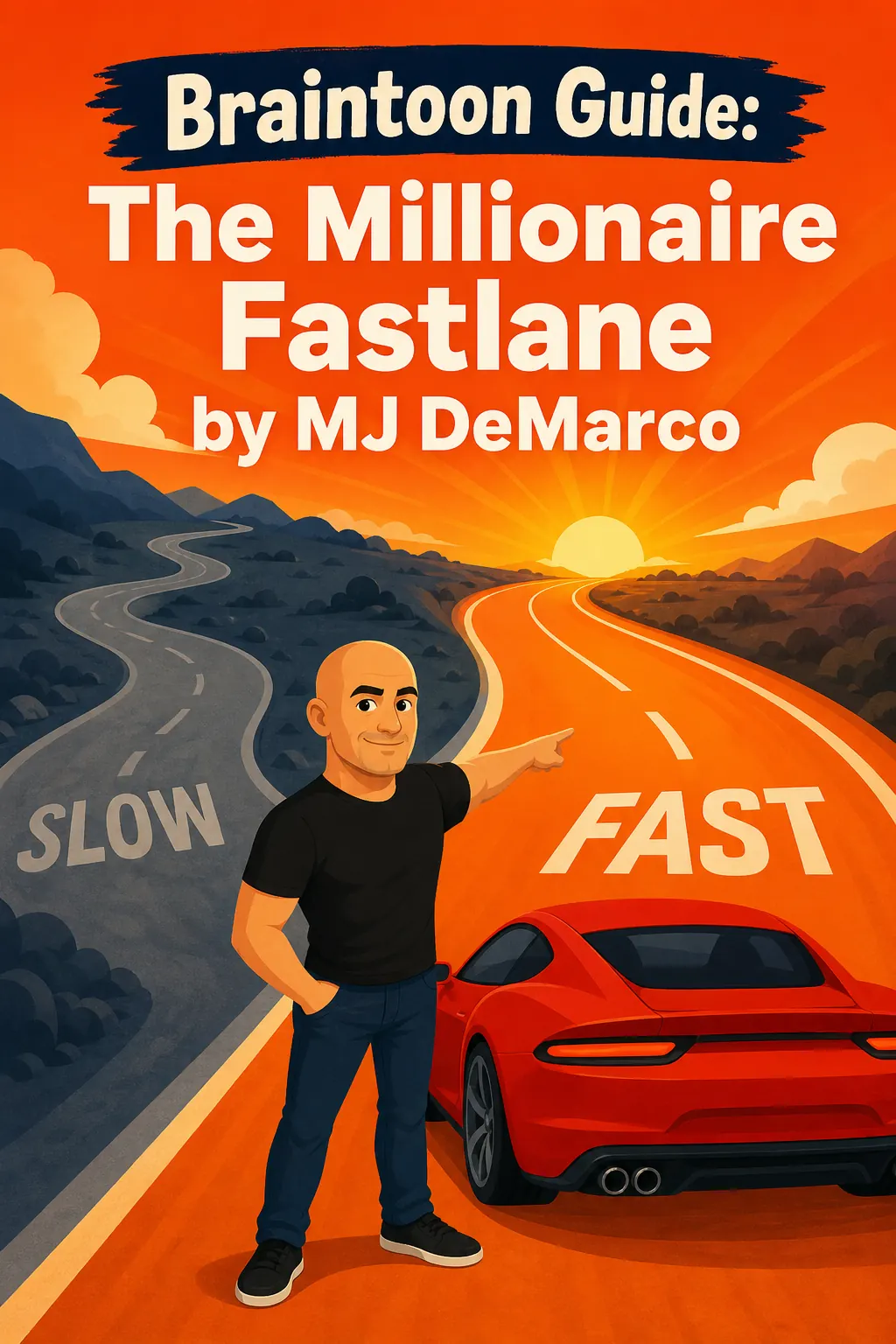









The Millionaire Fastlane cover

The Millionaire Fastlane Summary: 9 best lessons in 10 mins

10 min readMJ DeMarco's book, summarized

Topics will appear here once mapped for this book.

One-sentence summary

This is The Millionaire Fastlane by MJ DeMarco. It's a book that flat out rejects the slow grind to retirement and offers a faster path to real wealth, built through entrepreneurship.

It's 6 a.m., and Marcus Reed is stuck in gridlock outside Hartford. He's gripping the wheel of a leased sedan he can barely afford anymore, watching the brake lights blur ahead of him.

(Continued below)

Reading about The Millionaire Fastlane is one thing.

Watching it is faster, more fun, and you'll actually remember it.

Open in app

Lesson 1: The slow road steals your best years

Back to Marcus. He's 32, a project coordinator at an insurance firm. He has student loans, a fiancée, and a retirement plan that doesn't pay off until he's 67.

His financial advisor smiles and says, just keep maxing the 401k. In thirty-five years, you'll be comfortable. Marcus forces a smile back.

But on the drive home, something cracks. Thirty-five years. His dad worked that long and died at 64, just two years into retirement.

That night, Marcus stumbles onto MJ DeMarco, an entrepreneur who hit financial freedom in his thirties by building an online limousine booking service.

DeMarco's core claim hits hard. The standard path of study, work, save, and retire trades your healthiest decades for a payoff you may never actually get to enjoy.

DeMarco calls it wealth in a wheelchair. Marcus thinks about his dad's unused fishing boat, and feels something shift in his chest.


Lesson 2: Three roadmaps, three destinations

The next weekend, Marcus tallies his finances on a napkin at a diner. Credit card balance, car payment, and almost nothing saved outside his retirement account.

He realizes he's been bouncing between two bad scripts. Splurging when bonuses hit, then guiltily clipping coupons and skipping lunches afterward to make up for it.

DeMarco names these patterns. The Sidewalk spends everything today. The Slowlane sacrifices everything for tomorrow. Both leave you stuck for decades.

The third path, the Fastlane, isn't about luck or lottery tickets. It's about building business systems that create wealth in years, not lifetimes.

Marcus also learns that wealth follows a process, not an event. Big paydays look sudden from the outside, but they sit on top of years of quiet, patient work.

DeMarco compares it to a road trip. You need the right map, a sturdy vehicle, the right roads, and real speed. Take away any one of those, and you don't arrive.

Lesson 3: Quit hitchhiking through your own life

A week later, Marcus's company restructures. His team gets cut from eight people down to four. Same workload, same pay, take it or leave it.

He's furious, but DeMarco's words echo back. Sidewalkers and Slowlaners are basically hitchhikers, letting bosses, markets, and luck decide their financial fate for them.

Marcus realizes that blaming his manager changes nothing. Responsibility admits the problem. Accountability changes the behavior, so the same trap doesn't catch you twice.

He also notices his own lifestyle creep. New TV, upgraded phone, leased car, all of it bought to feel successful in front of coworkers.

DeMarco calls this faux wealth. Buying flash you can't afford actively destroys real wealth, because you're trading your freedom for stuff that needs constant feeding.

So Marcus returns the leased sedan, picks up a used Honda, and cancels two subscriptions. It's painful, but for the first time in years, he feels lighter.

Lesson 4: Why the Slowlane math fails

Marcus's fiancée Priya, a nurse, gently suggests he just go back for an MBA. Higher salary, safer path, predictable raises every year. The traditional answer.

But Marcus runs the numbers the way DeMarco taught him. Job income plus index funds equals slow, uncontrollable, limited leverage. The ceiling is the number of hours in a day.

Even worse, an MBA could mean another sixty thousand dollars in debt, chaining him to a job for another decade just to pay it off.

DeMarco points out that working five days for a two-day weekend is essentially a negative sixty percent return on your time. Think about that ratio.

And those famous financial gurus selling slow-and-steady advice? They got rich selling books and seminars, not by actually following their own coupon-clipping strategies.

Marcus explains all of this to Priya over dinner. She's skeptical, but she agrees to give him six months to try something different.

Lesson 5: Build the machine, don't lift the stones

Marcus's brother-in-law owns a small landscaping crew. He vents constantly about how hard it is to book steady commercial clients in their county.

Marcus listens differently now. He hears DeMarco's signal phrases hiding in the complaints. I hate this. I wish there were. Why does it have to be this way.

DeMarco tells the parable of two nephews. Azur lifts stones by hand his whole life. Chuma spends three years building a machine that lifts them for him.

Chuma retires rich at 26. Azur dies exhausted. The lesson is to build systems that work without you, not just work harder yourself.

Marcus sketches an idea. A simple website that matches commercial property managers with vetted local landscaping crews, taking a small fee on every booking.

The math excites him. Net profit times an industry multiple equals asset value. Even modest monthly profit could mean a business worth hundreds of thousands of dollars.

Lesson 6: Test your road with CENTS

Before going deeper, Marcus runs his idea through DeMarco's five-part filter. It's called CENTS, and it stands for Control, Entry, Need, Time, and Scale. Each one is a commandment.

Control. He owns the site, the brand, and the customer list. He's the driver, not a hitchhiker on someone else's platform like Etsy or Amazon.

Entry. Building a vetted two-sided marketplace is harder than dropshipping, and that difficulty is actually good. It keeps casual competitors from flooding in and crushing margins overnight.

Need. Property managers genuinely struggle to find reliable crews. He's not chasing a passion. He's solving a real, expensive, repeated headache.

Time. Once the site is built, it can take bookings while he sleeps. It's not just a job dressed up as a business.

Scale. He can expand city by city, then state by state. The Law of Effection says the more people you reach, the more wealth you can earn.

Lesson 7: Time, headwinds, and commitment

Three months in, Marcus is exhausted. Friends keep inviting him out. His mother calls the project silly. A coworker laughs at his domain name.

DeMarco calls these headwinds. Naysayers, distractions, and environments that quietly pull you back toward average. So Marcus politely stops sharing details with people who drain him.

He also rethinks time itself. Every dollar he spends has a hidden cost, measured in the hours of future work he'd need to earn it back.

So when he's tempted to finance new furniture, he pictures the extra months it would add before his business could replace his salary. The furniture loses.

DeMarco draws a hard line between being interested and being committed. Interested reads the book. Committed actually files the paperwork and ships the product.

So Marcus forms an LLC, opens a business bank account, and starts cold-emailing property managers. Most ignore him. Three reply. Two say maybe.

Lesson 8: Execution beats the brilliant idea

Six months in, a competitor launches with a slicker website and more funding. Marcus panics. He's ready to give up on the whole thing.

But DeMarco insists that ideas are cheap. Execution is the king on the chess board. A mediocre idea executed brilliantly will beat a brilliant idea barely executed.

So Marcus doubles down on what big competitors do badly. He answers every call personally, fixes complaints within hours, and remembers customers' names and properties.

DeMarco calls this SUCS, or Superior Unexpected Customer Service. Because most companies are genuinely terrible at service, exceeding expectations isn't actually that hard.

Marcus keeps a complaint log. One property manager wants invoicing options. Another wants emergency requests. Each complaint becomes the next feature he builds.

His original business plan is already useless. He pivots from flat fees to subscriptions, exactly the kind of detour DeMarco says reality always forces on you.

Lesson 9: Brand, focus, and the finish line

By year two, Marcus could chase three new ideas. A landscaping supply store, a podcast, even a real estate flip a friend keeps pitching to him.

But DeMarco warns about Tekel Syndrome. Scattered focus produces scattered results. Almost every successful entrepreneur went all in on one thing first, before diversifying.

So Marcus stays monogamous with his marketplace. He sharpens his unique selling proposition. Property managers don't buy software. They buy clean properties and fewer headaches.

He raises prices, which feels terrifying. But DeMarco notes that pricing signals value. Underpricing out of insecurity actively damages the brand he's trying to build.

Marcus finally quits his insurance job when his monthly profit covers his bills twice over. Priya cries. He cries. They go out for tacos to celebrate.

He also commits to real financial literacy. Not blind trust in an advisor, but learning enough himself to evaluate whether the advice he's getting is actually sound.

You've read the summary. Now watch it.

The animated version covers the same ideas — faster, and in a format you'll actually remember.