A detailed summary ofWhy We Sleepby Matthew Walker, PhD
Why We Sleep by Matthew Walker, PhD argues that sleep is the foundation of physical and mental health, and that modern life has quietly stripped it away at enormous cost.
Watch the first minute
0:00 / 1:00
60-second animated preview
Key ideas, illustrated
Two Forces Decide When You Feel Sleepy
Deep Sleep Saves, Dream Sleep Connects
What Short Sleep Costs
Why We Sleep Summary
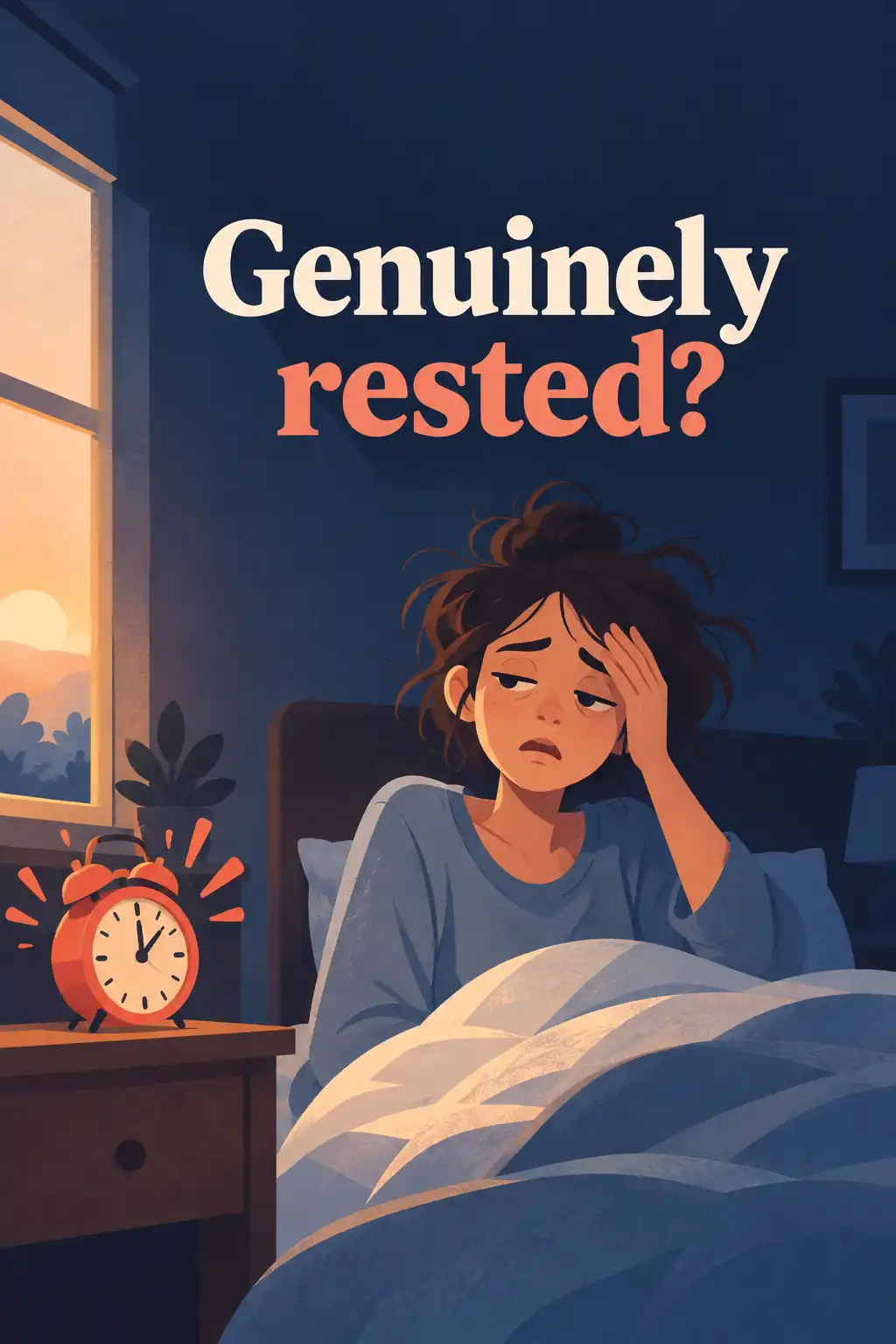
Here's a question most people would struggle to answer honestly: when was the last time you woke up and felt genuinely rested? Not caffeinated. Rested.
Most people can't remember. That's the starting point of Why We Sleep by Matthew Walker. He's a sleep scientist, and his basic argument is that we treat sleep as the first thing to sacrifice, when it may be the most important thing we do for our health.
More important than diet or exercise? That's a big claim.
1. Two forces decide when you feel sleepy
It is, and he knows it. But before he makes the case, he explains the basic machinery. Two things control when you feel awake or sleepy. The first is a twenty-four-hour clock in your brain, the circadian rhythm. The second is a chemical called adenosine that builds up the whole time you're awake. Walker calls it sleep pressure.
So they're separate systems?
Completely separate, which matters. The clock runs on its own schedule, roughly twenty-four hours, actually a little longer, and sunlight resets it each morning. Adenosine is more like a bucket filling up. The longer you're awake, the fuller it gets, and sleep empties it.
Where does caffeine fit in?
Caffeine blocks the receptors that adenosine attaches to. So the bucket keeps filling, but your brain can't read the level. The catch is that caffeine has a half-life of five to seven hours. If you have a coffee at seven, after dinner, half of it is still in your system around midnight or later.
And the crash?
The crash is when caffeine wears off and all the adenosine that built up behind it hits at once. He also offers a simple self-check: if you need caffeine to function before noon, or you could fall back asleep at ten in the morning, you're probably carrying sleep debt.
He also talks about night owls, doesn't he?
Yes. Not everyone's clock is set the same. His figures are roughly forty percent morning types, thirty percent night owls, and the rest in between, and it's largely genetic. His argument is that society punishes owls. Early start times are built for larks, so owls end up chronically short on sleep, and he links that to higher rates of depression, diabetes and heart disease.
So being a night owl isn't laziness.
In his view it's biology, not character.
Watch it come to life
Watch Why We Sleep instead
Explore this summary and the Braintoon library.
2. Deep sleep saves, dream sleep connects
Once you're asleep, is sleep just one thing?
No, and that was a surprise historically. In 1952, researchers watching infants noticed two very different states. One had darting eyes and busy brainwaves, which became known as REM sleep. The other had still eyes and slow waves, called NREM. You cycle between them roughly every ninety minutes.
Do they do different jobs?
Walker's shorthand is: waking is for taking information in, NREM is for reflection, REM is for integration. Deep NREM, with those slow waves sweeping across the brain, moves memories out of short-term storage in the hippocampus into long-term storage in the cortex. He calls it a save button.
And REM?
REM links new memories with old ones and finds connections. We'll come back to that. But there's a practical point about the cycles. Early in the night, cycles are mostly deep NREM. Later, they're mostly REM. So if you sleep six hours instead of eight, you don't lose a quarter of each. You can lose up to ninety percent of your REM.
Because it was all scheduled for the end.
Exactly. Sleep isn't a uniform block you can trim from the end. His lab did a study on this with motor skills. People practised a finger sequence on a keyboard. Those who slept afterward were about twenty percent faster and thirty-five percent more accurate the next day than people who stayed awake for the same stretch.
Without practising more.
Without touching the keyboard. And what sleep fixed was specifically the stumbling points, the spots where fingers tripped. That's why he's so insistent that athletes, surgeons and musicians treat sleep as part of training.
Does sleep before learning matter too?
It does. In his study, a nap before learning gave people about a twenty percent advantage that evening. The mechanism was sleep spindles, brief bursts of activity in lighter NREM that clear the hippocampus so there's room for new information. Older adults make far fewer spindles, which he thinks partly explains why learning gets harder with age.
3. Short sleep wears down the body
You said he puts sleep above diet and exercise. What's the evidence on the body, not just the brain?
He goes system by system. Take the heart. He cites a study of nearly half a million people across eight countries where short sleepers had over forty-five percent higher risk of fatal heart disease. His most vivid example is daylight saving time. In spring, when everyone loses one hour, hospitals see a measurable spike in heart attacks the next day.
From one hour?
From one hour, across a whole population. His explanation is the fight-or-flight nervous system. Sleep loss keeps it switched on, which raises blood pressure and stress hormones and, over time, damages the arteries.
What about blood sugar?
There's a study where healthy people slept four hours a night for six nights. Afterwards they were about forty percent worse at handling glucose, bad enough that a doctor would classify them as pre-diabetic. Their cells had stopped responding properly to insulin.
In less than a week.
And appetite goes the same way. Short sleep lowers leptin, which signals fullness, and raises ghrelin, which drives hunger. People ate roughly three hundred extra calories a day and craved sugary, starchy food. There's a crueller detail too: if you diet while short on sleep, most of the weight you lose is muscle, not fat.
And the immune system?
This is the example I'd keep. Researchers tracked people's sleep for a week, then deliberately exposed them to a cold virus. Those sleeping under five hours got infected nearly half the time. Those sleeping seven or more, about eighteen percent.
That's a big difference in something you can't fake.
Right. He also reports that one night of four hours' sleep cut natural killer cells, the immune cells that attack tumours, by seventy percent. I'd say some of these figures come from small lab studies under extreme conditions, and Walker presents them very confidently. But the direction is consistent across a lot of research.
4. A tired brain can't tell it's tired
What about the brain's own performance day to day?
This is the part I think everyone should know. A researcher named David Dinges had people sleep six hours a night for ten days. By the end, they were as impaired on attention tests as someone who'd been awake for twenty-four hours straight.
Six hours sounds normal to a lot of people.
That's the point. Six hours is what many people assume is fine. And when asked how they felt, they underrated their impairment. Their sense of normal had quietly reset to match their degraded state.
So you literally can't judge it from the inside.
Walker compares it to the drunk driver who insists he's fine. An Australian study found nineteen hours awake produces impairment comparable to being legally drunk. The dangerous version is the microsleep, a few seconds where the brain goes offline. At highway speed that's long enough to drift across a lane.
Can you nap your way out of it?
Partly, and only if you nap before the deficit builds. He's clear that naps and caffeine can keep you crudely alert, but they don't restore memory, learning or emotional control.
Emotional control, how?
His own brain-scanning work found the amygdala, the brain's alarm centre, became about sixty percent more reactive after a night without sleep. The prefrontal cortex, which normally reins it in, loses its grip. So people swing between irritability and oddly reckless highs. He links that to aggression, addiction and worsening depression, and argues sleep loss and mental illness feed each other.
He also connects sleep to Alzheimer's, right?
He does, carefully. Deep sleep is when the brain's cleaning system flushes out proteins like amyloid. Less deep sleep means more buildup, and amyloid damages the very regions that generate deep sleep. A vicious cycle. He frames better sleep as a possible tool for delaying it, not a proven cure.
5. Dreaming as overnight emotional therapy
Let's go back to REM. What are dreams actually doing?
Walker's first answer is emotional healing. During REM, a stress chemical called noradrenaline drops to zero. It's the only time in the whole day that happens. So the brain replays emotional memories in a chemically calm environment, keeps the facts, and gradually strips off the raw feeling.
Like processing something painful until it's just a story you can tell.
That's the idea. In his experiments, people viewed upsetting images twice. Those who slept between viewings reacted much less the second time. Those who stayed awake got no relief. And how far their noradrenaline dropped during REM predicted how much the distress faded.
What about people whose dreams don't help, like with trauma?
That's where it gets interesting. His theory was that in PTSD, noradrenaline stays too high, so REM can't do its job, and nightmares are the brain retrying and failing. Then he met a doctor, Murray Raskind, who had found that a blood pressure drug called prazosin, which lowers noradrenaline, was reducing nightmares in war veterans.
So the drug fit the theory by accident.
He describes it as a chance meeting. It's one line of evidence, but a satisfying fit. There's a second function too. REM recalibrates how we read faces. Sleep-deprived people saw threat everywhere, even in friendly expressions, which matters for anyone making judgement calls about other people.
And creativity?
He woke people from REM and from NREM and gave them anagrams. After REM they solved fifteen to thirty-five percent more. The REM brain skips obvious links and hunts for distant connections. In a maze study, people who napped and dreamed about the maze improved about tenfold compared with people who napped but dreamed of other things.
So the content matters, not just the sleep stage.
That's his claim, and it echoes Rosalind Cartwright's clinical work: people recovering from painful events only got lasting relief if they dreamed about those specific events.
6. Modern life works against sleep
If sleep is this good, why are we so bad at it?
Walker names five culprits: artificial light, indoor temperature, caffeine, alcohol, and fixed working hours. Light is the big one. Evening light delays melatonin, the hormone that tells the brain night has arrived, by two or three hours. Screens are worst because the eye's daytime sensors respond most to blue light. In one study, people read on an iPad for a few hours before bed. Melatonin dropped by over half, and their REM sleep suffered.
Alcohol? People swear by a nightcap.
It's a sedative. It knocks you out, but that's closer to light anaesthesia than sleep, and it fragments the night and suppresses REM. He even reports that drinking a couple of nights after learning something can wipe out part of what you learned.
And temperature?
Your core temperature needs to drop two or three degrees Fahrenheit for you to fall asleep. He suggests a bedroom around sixty-five Fahrenheit, about eighteen Celsius. A hot bath helps, because when you get out, heat rushes off your skin and cools you down.
What about sleeping pills?
He's blunt. Pills sedate rather than produce natural sleep, and he cites research linking regular use to higher mortality, though those are association studies, not proof of cause. His preferred alternative is cognitive behavioural therapy for insomnia: fixed wake times, getting out of bed if you can't sleep, briefly restricting time in bed to build pressure. At the time of writing, the American College of Physicians had just made it the first-line recommendation.
This goes beyond individuals, though.
His biggest fights are with institutions. Most US high schools start before 8:15, which for a teenager's shifted clock is like an adult waking at three in the morning. When Minnesota schools started later, test scores rose and teen car crashes dropped by sixty to seventy percent. And medical residents on thirty-hour shifts made thirty-six percent more serious errors. He traces that tradition to a founding surgeon who, it turned out, was using cocaine.
Closing
So what's the single thing you'd want someone to take from this?
That sleep debt isn't a loan you repay at the weekend. Those six-hour nights add up, and the person least able to see the damage is you. Walker's practical advice is modest: same bedtime and wake time every day, dim the lights in the evening, keep caffeine to the morning, and sleep in a cool, dark room.
The question I'd leave people with is: what in your evening are you treating as free that's actually being paid for in sleep?
And whether seven to nine hours is a luxury, or just the baseline the book argues it is.
Watch it come to life
Watch the animated summary
Explore this summary and the Braintoon library.