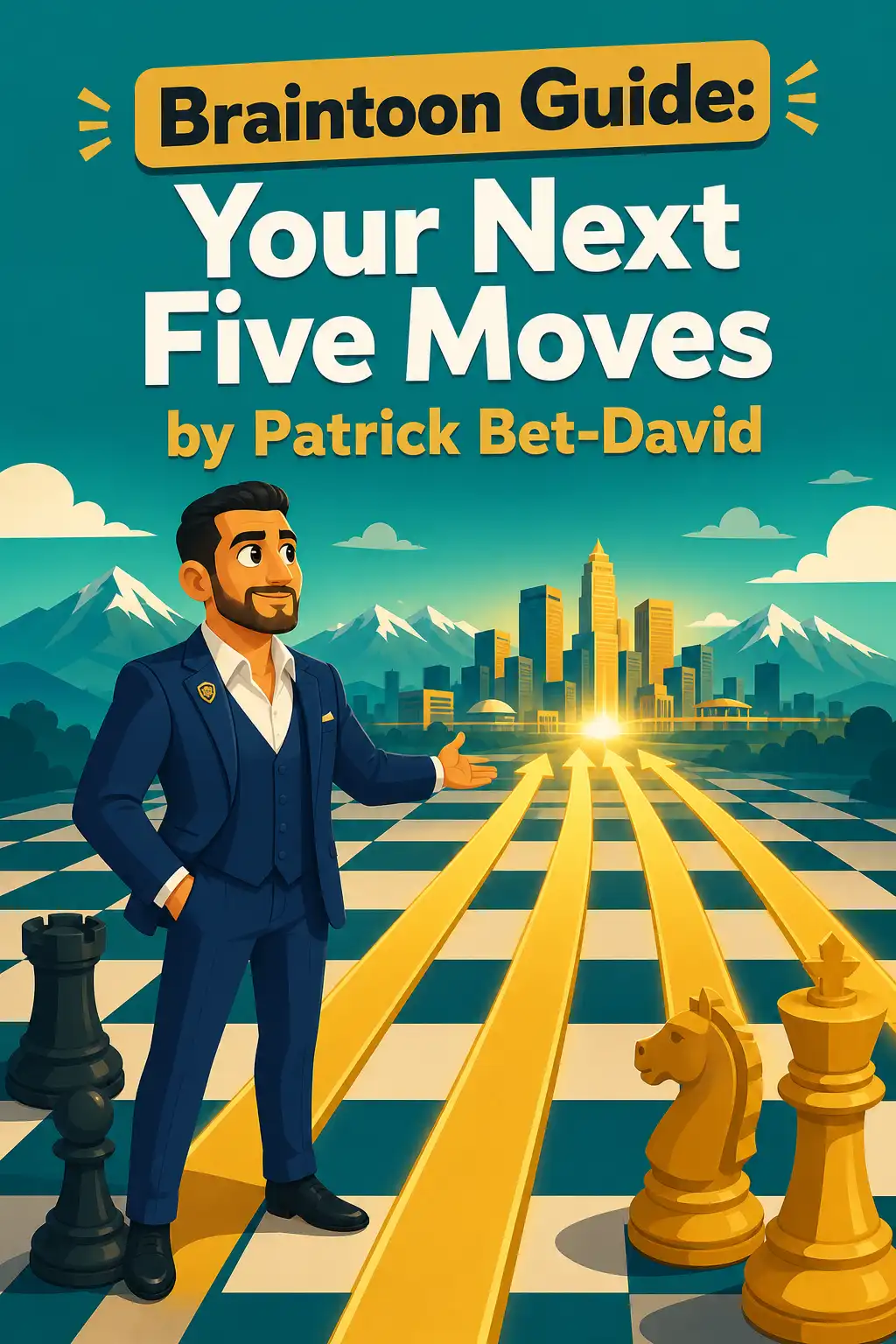

A detailed summary ofYour Next Five Movesby Patrick Bet-David

Your Next Five Moves by Patrick Bet-David teaches you to think strategically in business, planning several moves ahead so you can build, scale, and win with intention instead of just reacting blindly to whatever comes at you.

Your Next Five Moves preview: What if you could see every business problem coming before it hit, the way a chess grandmaster sees checkmate long beforYour Next Five Moves preview: What if you could see every business problem coming before it hit, the way a chess grandmaster sees checkmate long beforYour Next Five Moves preview: Your Next Five Moves by Patrick Bet-David teaches you to think strategically in business, planning several moves ahead sYour Next Five Moves preview: Your Next Five Moves by Patrick Bet-David teaches you to think strategically in business, planning several moves ahead sYour Next Five Moves preview: Lesson 1. Think five moves aheadYour Next Five Moves preview: Patrick Bet-David got the idea for this book while watching a documentary about chess prodigy Magnus Carlsen, who wins bYour Next Five Moves preview: Patrick Bet-David got the idea for this book while watching a documentary about chess prodigy Magnus Carlsen, who wins bYour Next Five Moves preview: Elon Musk's brother once said Elon could see twelve moves ahead in any situation. Most of us? We only think one or two mYour Next Five Moves preview: Elon Musk's brother once said Elon could see twelve moves ahead in any situation. Most of us? We only think one or two mYour Next Five Moves preview: And Bet-David knows struggle. He grew up in Tehran during the Iran-Iraq war, spent two years in a German refugee camp, aYour Next Five Moves preview: And Bet-David knows struggle. He grew up in Tehran during the Iran-Iraq war, spent two years in a German refugee camp, aYour Next Five Moves preview: He barely graduated high school with a 1.8 GPA, skipped college, and racked up credit card debt. Yet somehow he built PH

What if you could see every business

0:00 / 1:00

60-second animated preview

Summary Visuals

Your Next Five Moves: Big Ideas at a Glance

The Five Moves of Strategic Mastery

Process Problems Like a Pro: The ITR Method

The Strategy Quadrant for Scaling

Your Next Five Moves Summary

What if you could see every business problem coming before it hit, the way a chess grandmaster sees checkmate long before the final move is ever played?

1. Think five moves ahead

Patrick Bet-David got the idea for this book while watching a documentary about chess prodigy Magnus Carlsen, who wins by anticipating his opponent's moves long before they ever happen on the board.

Elon Musk's brother once said Elon could see twelve moves ahead in any situation. Most of us? We only think one or two moves ahead, and that's exactly why we struggle so much.

And Bet-David knows struggle. He grew up in Tehran during the Iran-Iraq war, spent two years in a German refugee camp, and finally reached California at age twelve.

He barely graduated high school with a 1.8 GPA, skipped college, and racked up credit card debt. Yet somehow he built PHP Agency into fifteen thousand agents nationwide.

His point? Strategic thinking can be learned by anyone. The book teaches five moves: know yourself, reason well, build a team, scale smart, and master power plays.

To make this real, let's meet Chris, a freelance graphic designer in Denver. He's talented, and he works hard, but his whole business runs on reacting to whatever hits him next.

Your Next Five Moves visual: What if you could see every business problem coming before it hit, the way a chess grandmaster sees checkmate long beforYour Next Five Moves visual: What if you could see every business problem coming before it hit, the way a chess grandmaster sees checkmate long beforYour Next Five Moves visual: Your Next Five Moves by Patrick Bet-David teaches you to think strategically in business, planning several moves ahead sYour Next Five Moves visual: Your Next Five Moves by Patrick Bet-David teaches you to think strategically in business, planning several moves ahead sYour Next Five Moves visual: Lesson 1. Think five moves aheadYour Next Five Moves visual: Patrick Bet-David got the idea for this book while watching a documentary about chess prodigy Magnus Carlsen, who wins b

Next step

Watch Your Next Five Moves instead

Quick setup, then watch this summary in a more engaging visual format.

iOS + Android app20,000+ learnersFree daily summary

2. Decide who you want to be

Before offering anyone advice, Bet-David asks one simple question. Who do you want to be? Every strategy, plan, and action flows from that one honest answer.

In his twenties, he took a struggling Bally Total Fitness gym from 40 percent of its revenue goal to 115 percent. The promised promotion still went to a colleague with more seniority.

He quit on the spot. That night, he wrote down what he truly wanted. A family name that meant something. Merit-based work. And a future that nobody else controlled.

Bet-David says pain makes powerful fuel. Barbara Corcoran turned being dumped and dismissed into a 66 million dollar real estate empire. He even keeps a running list of every put-down he's ever received.

He also urges you to live your future truth. IBM's founder insisted the company act like a great company long before it actually was one. Bet-David declared stars would headline his events, and eventually Kevin Hart did.

The night after losing his client, Chris writes his own answer. He wants to run a respected design studio, lead a small team, and own his schedule.

3. Know yourself and pick your game

Bet-David's friend Shawn cycled through a dozen jobs, always blaming his bosses. Pushed to look inward, Shawn finally admitted he really wanted decent income, family time, and a relaxed pace.

Shawn wasn't failing. He was just chasing the wrong target. Alignment between your values, vision, and effort is the foundation of real fulfillment.

He also describes four levels of why. Survival, status, freedom, and purpose. Most people get stuck in the middle and never reach work driven by real meaning.

Then comes game selection. Poker player Eric Drache was world-class, yet stayed broke because he kept sitting at tables with even better players. Choose games you can actually win.

Bet-David found his blue ocean in financial services, an industry that was ignoring Spanish speakers, women, and millennials. Instead of competing head-on, he went narrow and served the overlooked.

Chris does his own identity audit. His strengths are branding and a deep familiarity with healthcare, since his sister runs a physical therapy clinic he's designed for.

4. Process problems like a pro

Bet-David calls processing issues the single most important entrepreneurial skill. He once suffered panic attacks for eighteen months, largely from endlessly replaying his own decisions.

Great processors start with responsibility. When a business deal went bad for podcaster Joe Rogan, he didn't play the victim. He owned his part and learned from it.

Bet-David learned this the hard way, investing in an apparel company because the founder was charming. He ignored his instincts and paid dearly. Owning that mistake finally stopped the pattern.

His practical tool is called Investment Time Return, or ITR. Before any big decision, calculate the cost, the time required, and the expected return. Then stress-test the absolute worst case.

To find any problem's root, keep asking why. When insurance giant Aegon sued his young company, he listed exactly what he could and couldn't control, settled, and moved forward.

Chris gets his chance when a clinic project blows up over endless revisions. His instinct is to blame the client, but instead he asks what role he actually played.

5. Build the right team

No matter how talented you are, working alone loses to a good team every time. Bet-David's first question for leaders is this. Why would anyone actually choose to work for you?

Before your company has a reputation or benefits, people are buying into you. Leaders attract followers when everyone around them genuinely improves through mentorship, connections, and example.

Every great entrepreneur also needs a consigliere, a trusted adviser. Buffett had Munger. Jobs had Wozniak. Someone who shares your values but challenges you and balances your weaknesses.

Do your due diligence, too. FBI agent Donnie Brasco fooled even the Mafia for six long years. Check references, probe résumé gaps, and use a probationary period before fully committing.

To keep great people, share ownership. Equity earned through vesting, what he calls his golden handcuffs, turns employees into owners. Culture matters too. He once fired his top producer for using unethical methods.

Chris makes his first hire, a junior designer. He checks every reference, sets a three-month trial, and offers a small profit share that grows the longer she stays.

6. Trust is speed

A Boeing 747 needs to reach a certain velocity before it can lift off. Bet-David says businesses work the same way, and trust is what creates that speed.

Trust removes friction from every single interaction. That's why contracts are smart anticipation, not pessimism. Agree on a liability cap, indemnification, and an end date before problems ever appear.

Bet-David once pushed an employee named Danny hard despite his resistance. A decade later, Danny called to say he'd become a bank president, and he credited that demanding style.

He describes four levels of trust. Stranger, Endorsed, Trusted, and Running Mate. As success grows, your circle of truly trusted people actually shrinks, so invest deeply in the right ones.

Borrowing from the love languages idea, Bet-David lists nine motivational languages, things like recognition, challenge, vision, and genuine listening. Learn which one each teammate speaks.

Chris used to work on handshakes. Now every project has a written scope and a clear end date. When a dispute arises, it ends in minutes because everything is documented.

7. Scale with strategy and data

Bet-David maps out four phases every startup passes through. Formulation, survival, momentum, and plateau. Before chasing growth, answer the hard money questions, like whether you even need outside funding.

His Strategy Quadrant splits growth into linear and exponential. Systems and business development produce steady gains. Bold campaigns like Amazon Prime, plus developing leaders, create the real quantum leaps.

But momentum is fragile. Romeo, an entrepreneur Bet-David knew, burned through investor money on a lavish office and collapsed. Greed, gluttony, and gambling kill momentum fast.

Data keeps you honest. In Moneyball, Billy Beane found undervalued baseball players by tracking on-base percentage instead of tradition. Ask yourself, are you measuring the right things?

And codify what you know. Coach Bill Walsh documented his systems so thoroughly that his assistants spread across the entire NFL. Businesses built on systems are worth more than personalities.

Chris builds a simple dashboard he checks every morning. Leads, proposals, and close rate. Then he tries something exponential, offering free brand audits to fifty local clinics.

8. Make power plays and stay paranoid

Here's a sobering fact. Of the original 1955 Fortune 500 companies, only 52 remain on the list today. Business is never peaceful, and complacency kills. Stay alert, stay alive.

Real power means having options. Bet-David tells of Bobby, whose eight-million-dollar company depended on one five-million-dollar client. When that client squeezed him, he had no leverage, and he lost everything.

The rule is simple. If one source is over thirty percent of your revenue, it controls you. Preparation is power too. Former mobster Michael Franzese survived a life-or-death meeting through obsessive rehearsal.

Serve before you ask. Bet-David once drove four hours repeatedly to visit a connected man's imprisoned son. That genuine service later earned him six hundred referrals worth thirty million dollars.

His formula for power is simple. Outwork, outimprove, outstrategize, and outlast everyone. And in any negotiation, be strategic enough to let the other side feel like they've won.

Chris lands his biggest pitch ever, competing against a large agency for a hospital group. He researches their fears, scripts his message, and role-plays the meeting twice.

Your Next Five Moves visual: What if you could see every business problem coming before it hit, the way a chess grandmaster sees checkmate long beforYour Next Five Moves visual: What if you could see every business problem coming before it hit, the way a chess grandmaster sees checkmate long beforYour Next Five Moves visual: Your Next Five Moves by Patrick Bet-David teaches you to think strategically in business, planning several moves ahead sYour Next Five Moves visual: Your Next Five Moves by Patrick Bet-David teaches you to think strategically in business, planning several moves ahead sYour Next Five Moves visual: Lesson 1. Think five moves aheadYour Next Five Moves visual: Patrick Bet-David got the idea for this book while watching a documentary about chess prodigy Magnus Carlsen, who wins b

Next step

Start watching in minutes

Take the short quiz and unlock animated summaries you can watch or listen to daily.

iOS + Android app20,000+ learnersFree daily summary