


A detailed summary ofTiny Habitsby BJ Fogg
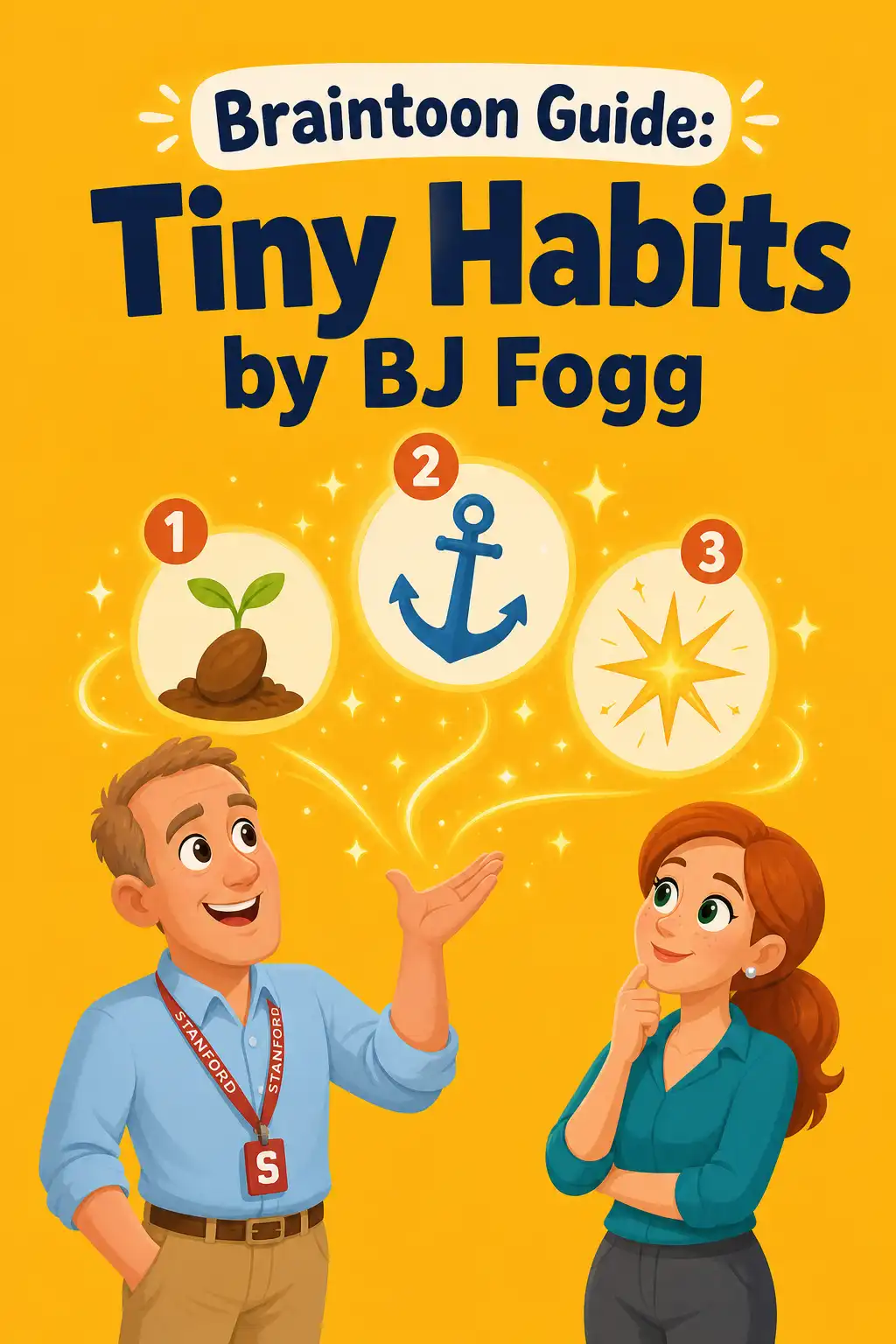
Tiny Habits by Stanford behavior scientist BJ Fogg shows how to create lasting change by starting ridiculously small, anchoring new behaviors to existing routines, and celebrating every tiny win.


What if the reason you keep failing
60-second animated preview
Summary Visuals
The Fogg Behavior Model: B = MAP
How to Build a Tiny Habit
Untangling Bad Habits
Tiny Habits Summary
What if the reason you keep failing to change isn't weak willpower at all, but simply that you've been going about change the wrong way?
1. The problem isn't you
Almost everyone wants to change something. Eat better, move more, sleep more soundly. And yet a frustrating gap stretches between what we say we want and what we actually do. Why?
BJ Fogg, a behavior scientist who runs Stanford's Behavior Design Lab, says that when change fails, we blame our willpower. But that's like blaming yourself for a piece of furniture that came with missing parts.
The design is flawed, not the person. Fogg's answer is the Tiny Habits method, a system he has tested with more than forty thousand people.
He also busts a myth he calls the Information-Action Fallacy. Knowing the facts, on its own, rarely changes behavior. Real change comes from one of three things. An epiphany, a redesigned environment, or tiny habits.
And since you can't exactly schedule an epiphany, Fogg focuses on the other two. Start ridiculously small, attach new behaviors to routines you already do, and skip the self-judgment entirely.
Meet Nicole, an accountant in Salt Lake City, Utah. Every January she vows to get fit and eat better. Every February the plan collapses, and she quietly decides she's just lazy.
2. Behavior needs three things at once
Fogg's Behavior Model says every behavior happens when three things converge at the same moment. Motivation, Ability, and a Prompt. That's MAP. Miss one, and the behavior simply doesn't happen.
Fogg once donated to the Red Cross by text while sitting at the gym. His motivation was high, texting was easy, and the message itself prompted him. All three lined up perfectly.
Motivation and ability also trade off against each other. When motivation is sky-high, you'll push through hard things. When motivation is low, a behavior has to be very easy or it just won't happen.
Fogg's client Katie, a busy executive, couldn't stop scrolling her phone in the morning. The fix? Charge the phone in the kitchen at night. Suddenly it was harder to reach and there was no prompt. The habit dissolved.
When a behavior isn't happening, Fogg says to check for a prompt first, then ask whether it's easy enough, and only tackle motivation last. Most people do the exact opposite.
Nicole tries this out. She'd always planned to walk at lunch, but nothing ever reminded her. No prompt. And her gym was twenty minutes away. Low ability.
3. Stop betting on motivation
Here's a sobering number. Roughly one hundred million people enroll in online courses each year, and fewer than ten percent actually finish. That's the Motivation Wave in action.
Motivation surges feel unstoppable in the moment, then they drop you flat. It also fades through the day and shifts with the seasons. Weight loss programs spike in January and collapse by November.
Fogg's key distinction is this. Aspirations aren't behaviors. Wanting less stress is an aspiration. Losing twelve pounds is an outcome. Neither is something you can actually do right this second.
When a group of bankers wanted their customers to save five hundred dollars, Fogg challenged the team to save it right then and there, in the room. They laughed. You can't do an outcome. You can only do specific behaviors.
So Fogg's method is to clarify the aspiration, brainstorm dozens of possible behaviors, and then sort them by impact and feasibility. The winners, high impact and easy to do, are what he calls Golden Behaviors.
Nicole's aspiration is more energy. She brainstorms freely. Walks, salads, earlier bedtimes, taking the stairs, prepping lunches. Then she asks which ones she'd actually do on her worst day.
4. Make it tiny
Why did Facebook pay a billion dollars for Instagram just eighteen months after launch? Simplicity. Its founders made photo sharing take three clicks. Nothing more.
Most of us default to go big or go home. But Fogg shares the story of Sarika, a project manager with bipolar disorder, who was trapped in a burst-and-bust cycle of overly ambitious routines.
Her breakthrough? Shrinking everything. Three breaths instead of a full meditation. Thirty seconds of stretching. Just turning on the stove burner as her cooking habit. From those seeds, real routines grew naturally.
When a habit feels hard, Fogg checks five links in what he calls the Ability Chain. Time, money, physical effort, mental effort, and routine fit. Then he asks a simple question. What's making this hard?
For Fogg's own flossing struggle, the weak link was physical effort. His teeth are tight together. Thinner floss plus starting with just one tooth finally wired the habit in for good.
Nicole shrinks her lunch walk down to just putting on her sneakers. That's the starter step. On good days she walks ten minutes. On terrible days, sneakers still count.
5. Anchor new habits to old routines
Here's a rule with no exceptions. No behavior happens without a prompt. You can be motivated and able, but without some kind of cue, the habit never fires.
Fogg names three types of prompts. Person Prompts, like your own memory, are unreliable. He once missed a neighbor's dinner because he trusted himself to remember. Context Prompts, like phone notifications, tend to fade with overload.
His favorite is the Action Prompt. An existing behavior that triggers the new one. He calls these Anchors. And the recipe format is simple. After I anchor, I will do my tiny behavior.
Fogg's own famous recipe? After flushing the toilet, he does two push-ups. That odd little pairing stuck for more than seven years, because the anchor happens reliably, every single day.
Precision matters here. Fogg suggests anchoring to what he calls the trailing edge, meaning the very last action of an existing routine. Something like the moment your toothbrush clicks back into its charger.
Nicole writes her own recipes. After I pour my morning coffee, I will fill my water bottle. After I close my laptop at lunch, I will put on my sneakers.
6. Celebrate immediately
Here's Fogg's most surprising claim. Emotions create habits. Not repetition. Not thirty-day streaks. When a behavior produces a genuine good feeling, your brain wires it in fast.
The mechanism is dopamine. When a positive feeling arrives during, or immediately after, a behavior, the brain flags it as worth repeating. Delay the reward, and the wiring fails.
That's why a massage after a two-week streak doesn't actually build habits. It's an incentive, not a reward in the brain's terms. Timing is everything.
So Fogg celebrates instantly. After flossing one tooth, he'd smile in the mirror and say victory. He even coined a word for the feeling this creates. He calls it Shine.
Feel silly celebrating something tiny? Fogg's student Jill did too, until she connected wiping down the counter to a deeper meaning, taking care of her family. Then it started to feel real.
Nicole experiments. A fist pump feels fake, but a quiet nailed it after her sneakers go on lands perfectly. And her brain starts craving the walk.
7. Let habits grow and multiply
Sukumar, a tech professional from Chennai, spent seventeen years failing at fitness. Then he started with two push-ups after brushing his teeth and a five-second plank.
Those tiny seeds grew into a daily one-hour workout, twenty pounds lost, and a transformed sense of identity. Fogg says well-planted habits expand naturally, the way a healthy garden does.
Habits scale in two directions. Some grow, so two push-ups become fifty. Others multiply, meaning one small win seeds related habits nearby, like making the bed right after a positive morning phrase.
Why does this actually work? Tiny successes shrink fear, and when fear drops, hope rises. Suddenly, behaviors that once felt impossible start looking genuinely doable.
Environment matters too. Fogg's SuperFridge, stocked with pre-cut vegetables and ready-to-grab healthy food, helped him and his partner each lose over fifteen percent of their body weight.
Six months in, Nicole's ten-minute walks have stretched into thirty. Her water habit has multiplied into better lunches. She now preps vegetables on Sundays, so healthy choices are effortless during the week.
8. Untangle bad habits and spread the good
Juni, a radio host, developed a serious sugar habit while grieving her mother's death from diabetes complications. Willpower alone never touched it. Behavior Design did.
Fogg says don't try to break a bad habit. Habits are tangled knots, and yanking on them only makes them tighter. You untangle them one small knot at a time.
His Masterplan works like this. First, build positive habits to shift your identity. Then target a specific behavior, removing its prompt first, making it harder to do next, and touching motivation last.
Finally, swap in a replacement that's genuinely easier and more appealing. Juni beat sugar meal by meal, celebrating each small victory along the way, while also addressing her unprocessed grief.
Nicole applies this to her evening snacking. She stops keeping chips in the house at all, removing the prompt, and remaps her after-dinner couch moment to making a cup of tea instead.
And change ripples outward. Like the father who helped his stuck adult son start with just one coffee filter a day, Nicole's husband notices, and soon they're walking together after dinner.