A detailed summary ofMasteryby Robert Greene
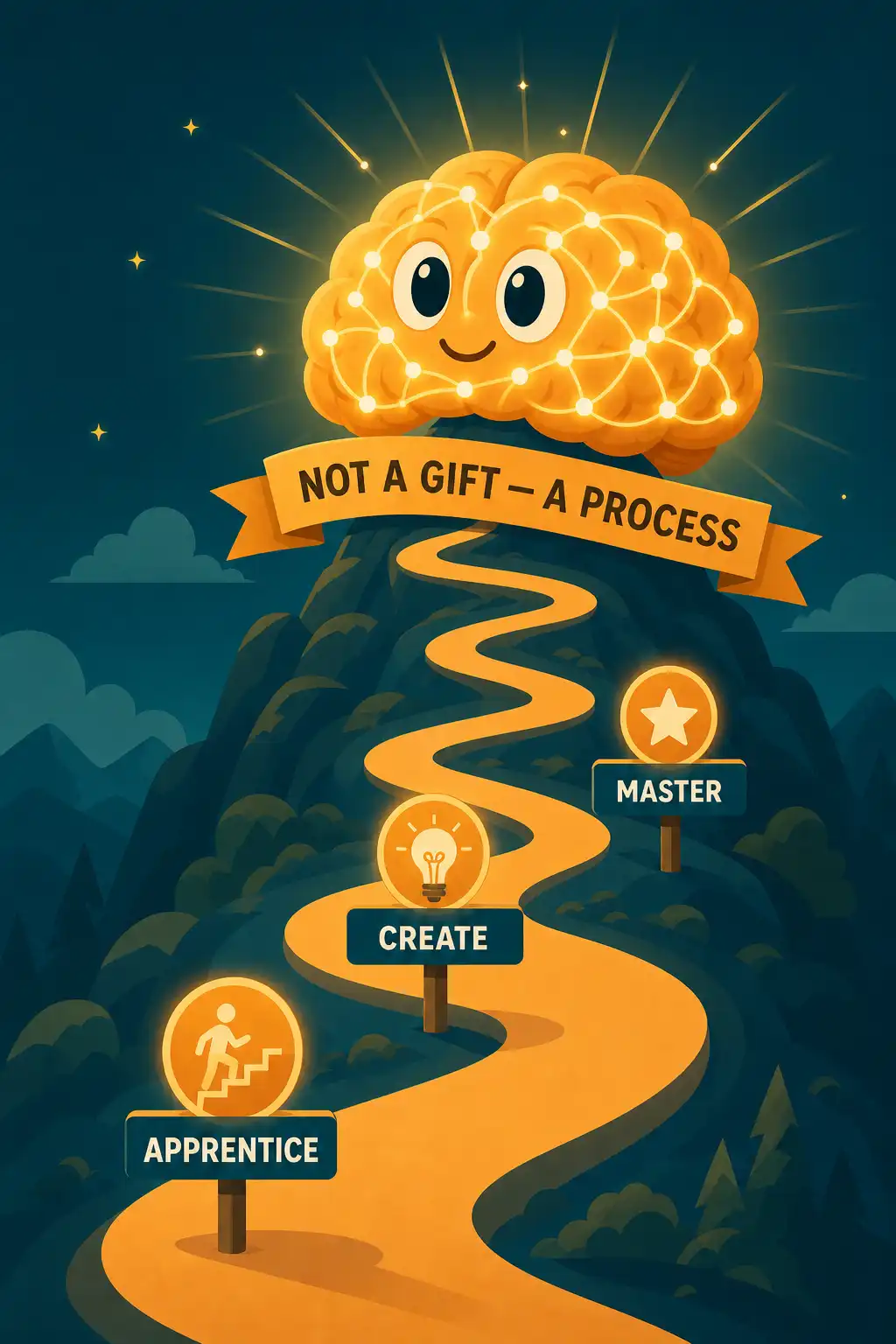
Mastery by Robert Greene argues that world-class skill isn't a genetic gift but a learnable process, and it maps the path that history's greatest minds all followed.
Watch the first minute








Halfway through Saturday's dinner rush
0:00 / 1:00
60-second animated preview
Key ideas, illustrated
The 3 Phases of Mastery
Steal Their Moves
Mastery Summary
Halfway through Saturday's dinner rush, line cook Tyler scrapes another scorched sauce into the trash. He's five years into a cooking career that suddenly feels like it's going nowhere.
1. Find your life's task
After that shift, Tyler sits in his car outside the Asheville restaurant, seriously considering quitting to take his cousin's offer of a steady sales job.
Robert Greene, who studied dozens of historical masters, would say Tyler faces a crossroads we all hit. Drift toward what's safe, or reconnect with a deeper calling.
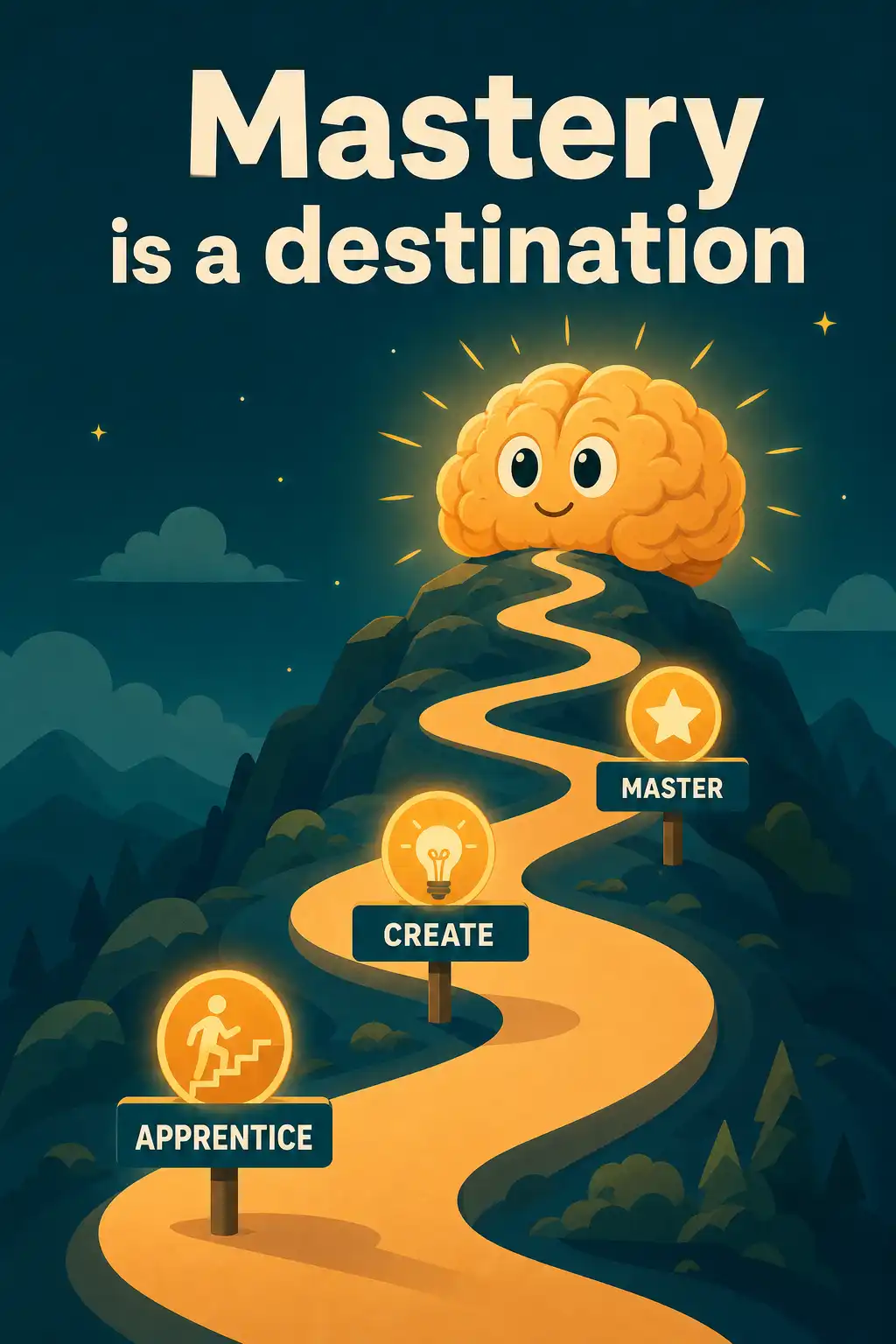
Greene's core idea is that mastery isn't a rare gift. It's a natural destination the human brain is built to reach, through a long, defined process.
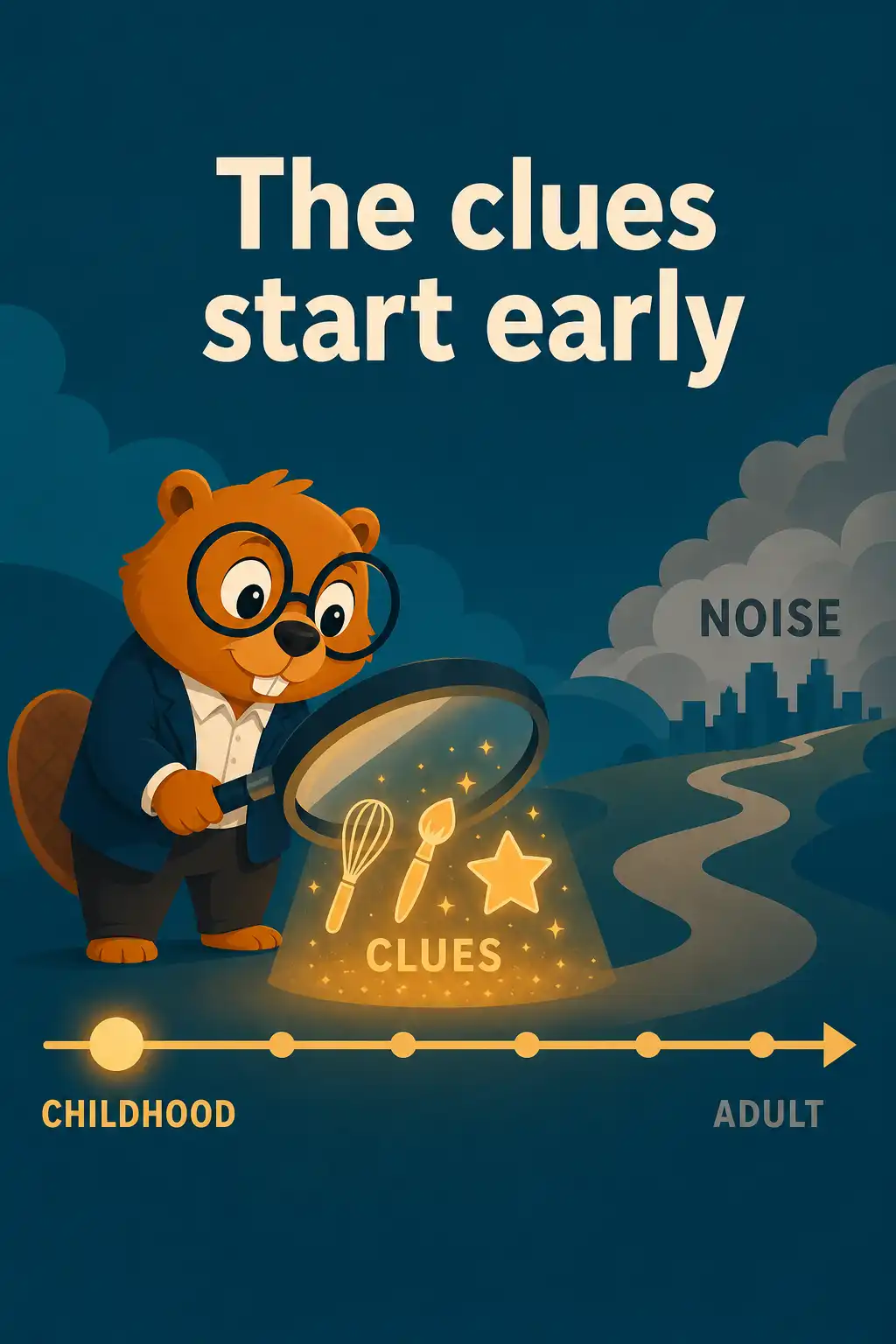
Step one is finding your Life's Task, the work you're uniquely drawn to. Greene says the clues show up in childhood, before the world tells us who to be.
Leonardo da Vinci sketched plants for hours as a boy. Einstein was transfixed by a compass at age five. Those early pulls pointed toward their life's work.
Tyler remembers standing on a stool at his grandmother's stove, mesmerized by how heat transformed simple ingredients. He didn't fall into cooking. Something pulled him here.
Watch it come to life
Watch Mastery instead
Explore this summary and the Braintoon library.
2. Choose learning over money
A month later, Tyler faces a choice. A raise at his current kitchen, or a lower-paying job at Harvest and Stone, the most demanding restaurant in town.
Greene calls this the Apprenticeship Phase, and says its purpose isn't money or titles. It's the transformation of your mind and character. Choose whatever maximizes learning.
He points to Charles Darwin, who nearly declined an unpaid voyage on the HMS Beagle. Those five hard years turned an aimless young man into a brilliant scientist.
So Tyler takes the pay cut. On day one, he resists the urge to show off and impress everyone. That's Greene's first step. Deep Observation.
Instead of talking, he watches. Who really holds power in this kitchen? What are the unwritten rules? Which mistakes get forgiven, and which never do?
Darwin did the same aboard the Beagle, studying the crew as carefully as he studied wildlife, which helped him fit in and focus on the real work.
3. Move toward resistance and pain
Then reality hits. Tyler's knife work is too slow, his sauces inconsistent. The chef assigns him to prep station, the most repetitive job in the kitchen.
Greene would say this is exactly where skill gets built. Deep ability is tacit knowledge, wired into the body through roughly ten thousand hours of focused repetition.
The trap is practicing only what feels good. Greene calls the alternative Resistance Practice. Deliberately attacking your weaknesses, moving toward discomfort instead of away from it.
Basketball player Bill Bradley had no natural gifts, so he invented brutal drills targeting his exact flaws, and he became one of the game's greats.
So Tyler stops avoiding butchery, his weakest skill. He arrives early to break down whole fish, badly at first, then less badly, then cleanly.
When he wants to quit, he remembers Greene's story of fighter pilot Cesar Rodriguez, who nearly washed out of training but tripled his practice hours and trusted the process.
4. Find a mentor, then adapt
One night, Tyler watches head chef Elena taste a broth and instantly name the three things wrong with it. He realizes she sees things he can't.
Greene argues life is too short for pure self-teaching. The right mentor compresses decades of learning by tailoring feedback to exactly where you are.
He tells the story of Michael Faraday, a poor bookbinder's apprentice who sent the famous chemist Humphry Davy a beautifully handwritten booklet of his lecture notes.
Davy hired him as a lab assistant, and Faraday absorbed a whole way of thinking no book could teach, eventually surpassing his mentor entirely.
Tyler makes his own move. He stays late, asks Elena precise questions, and shows her a notebook documenting every technique she's taught the line.
She starts investing in him. But Greene warns against becoming a copy. Pianist Glenn Gould absorbed everything his teacher offered, then reshaped it into something personal.
5. See people as they are
Then Tyler gets blindsided. A sous chef named Derek starts taking credit for his prep work and hinting to Elena that Tyler is unreliable.
Tyler wants to explode. But Greene says emotional battles drain the exact energy mastery requires. The answer is social intelligence. Seeing people as they actually are.
Benjamin Franklin learned this the hard way. A governor promised him funding and delivered nothing. Coworkers sabotaged his printing work. His own assumptions kept blinding him.
Franklin's fix was to stop projecting his feelings onto people and observe them like a novelist studies characters, accepting human nature, including envy and self-interest.
Greene lists seven recurring dark traits to watch for, like envy, rigidity, and passive aggression. Tyler realizes Derek is simply envious, and confrontation would only feed it.
Instead, Tyler follows Greene's advice to speak through your work. He documents his contributions quietly and lets his flawless station make the argument for him.
6. Awaken the dimensional mind
Two years in, Elena hands Tyler a challenge. Design a dish for the spring menu. He freezes. Executing recipes is one thing. Creating is another.
Greene calls this the Creative-Active phase, and insists creativity isn't magic. Mozart's masterpieces came from decades of absorbed musical vocabulary finally set loose, not divine lightning.
The danger is what Greene calls the Conventional Mind, which clings to familiar formulas. Masters keep the curious, open mind of childhood while adding disciplined knowledge.
One tool is Negative Capability, an idea from the poet Keats. Sitting with uncertainty instead of rushing to answers. Einstein held one physics paradox open for ten years.
So Tyler resists his first easy idea and lets the problem stay open, wandering farmers markets, reading about fermentation, sketching flavor combinations in his notebook.
Greene also says to invite serendipity by widening your inputs, the way Pasteur discovered inoculation through an accident his prepared mind was ready to notice.
7. Push through the creative frustration
But the dish stalls. Version after version falls flat, and after weeks Tyler starts to hate it. He's tempted to serve something safe and move on.
Greene says this frustration is a predictable stage in every creative breakthrough, not a failure. The unconscious keeps working when you finally step away.
The composer Wagner, completely stuck on his opera, heard its opening chords in a dream after falling asleep. Letting go released the answer.
Tyler takes two days off, hikes, sleeps. On the drive back, the solution surfaces whole. Strip the dish to three elements and let the ramps lead.
Greene also warns about emotional pitfalls that kill creative work. Impatience that cuts the process short, dependence on praise, and complacency once something finally works.
Tyler catches himself craving Elena's approval and remembers that internal standards, not applause, must guide the work. He judges the dish against his own vision.
8. Fuse intuition with reason
Five years later, Tyler runs his own small restaurant. One evening he tastes a sauce and instantly senses what's wrong, before he can even explain why.
This is what Greene calls mastery. After thousands of hours, the brain's networks become so interconnected that you perceive whole patterns instantly. Intuition, fused with reason.
Marcel Proust spent decades absorbing social life in Paris salons until, writing his great novel, he could feel his fictional world from the inside, as a whole.
But masters don't just trust hunches. Einstein's intuitions about relativity required years of mathematical proof. So Tyler tests his instinct, adjusts, tastes again, and verifies.
Greene's final warning is about the false self, the voice of social pressure insisting mastery is for geniuses, not for you. That voice, he says, lies.
Tyler was never a prodigy. He was a burned-out line cook who followed his inclination with patience and intensity, one uncomfortable step at a time.
Watch it come to life
Watch the animated summary
Explore this summary and the Braintoon library.