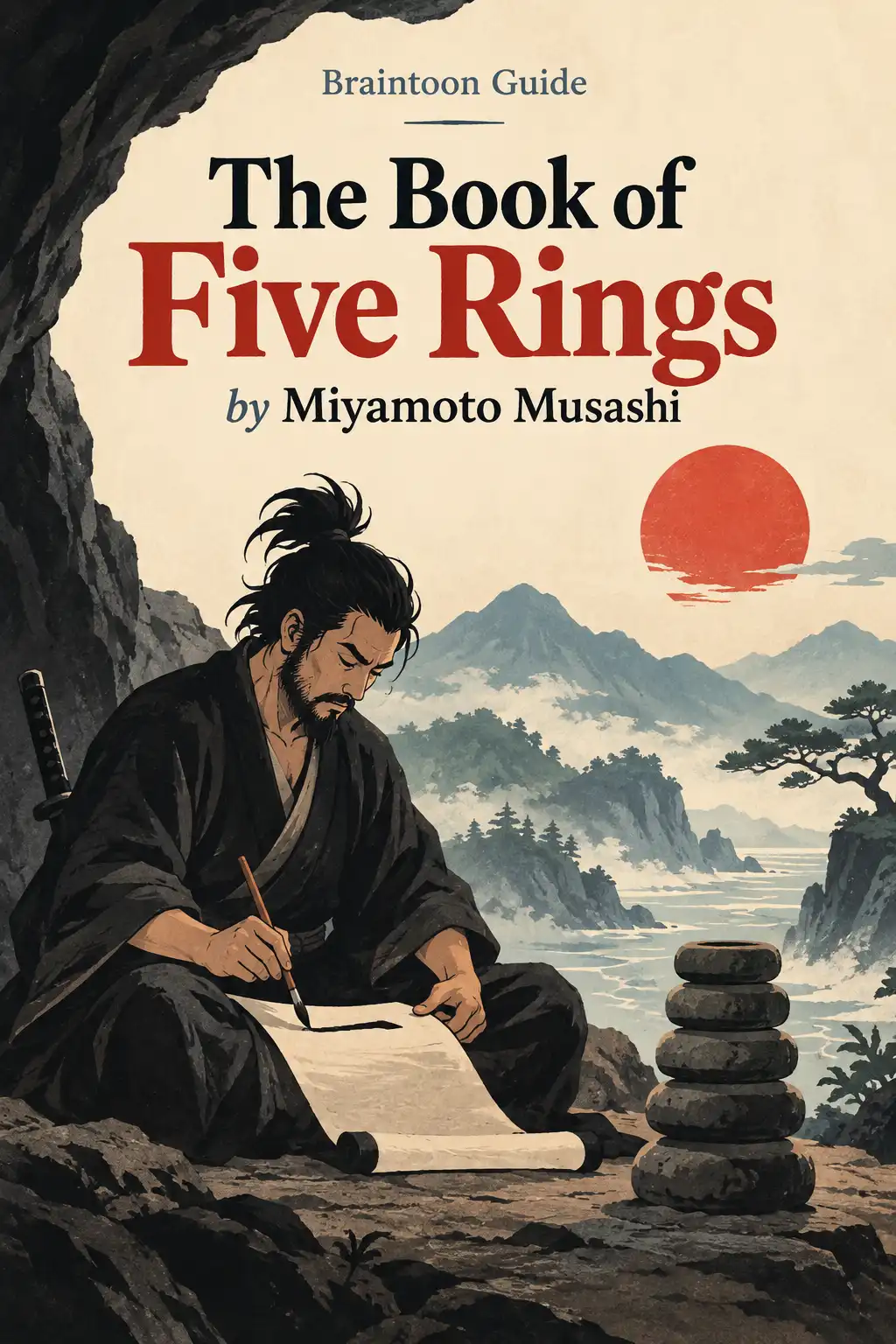
A detailed summary ofThe Book of Five Ringsby Miyamoto Musashi
The Book of Five Rings by Miyamoto Musashi distills a lifetime of undefeated combat into a philosophy of practical mastery built on clear perception, rhythm and relentless training.
Watch the first minute

Here's what I keep wondering.
0:00 / 1:00
60-second animated preview
Key ideas, illustrated
Polish the Flower or Grow the Fruit
Wide Observation, Steady Mind
Three Ways a Fight Opens
The Book of Five Rings Summary
Here's what I keep wondering. Why would a seventeenth-century Japanese swordsman's notes to his students still be read by people who have never held a sword?
Because the sword is almost beside the point. The Book of Five Rings, by Miyamoto Musashi, is really about how to see clearly and act without hesitation when something is at stake. He wrote it in a cave near the end of his life, and he was trying to say what actually works.
1. A swordsman trying to explain his own success
So who was he, before we get into the ideas?
Musashi was born in 1584, during the tail end of Japan's long civil wars. He fought his first duel at thirteen and won. By his late twenties he'd fought around sixty matches against fighters from all kinds of schools and never lost. The most famous one was on a small island in 1612, where tradition says he carved a wooden sword out of an oar on the boat ride over and killed a celebrated opponent with a single blow.
That's an incredible record. But if he never lost, what was there to figure out?
That's exactly the interesting part. He says that after he turned thirty, he looked back and wasn't sure why he'd won. Was he just naturally gifted? Was he following good principles without knowing it? Or were the other schools missing something? That doubt sent him searching for another twenty years.
So the book is the answer he eventually arrived at.
Right. He started writing it in 1643, at sixty, and finished just before he died in 1645. He organized it around five elements from Buddhist thought. Earth is the foundation, his overall view. Water is the mind and the actual swordsmanship, because water takes the shape of any container. Fire is combat itself. Wind is other schools, because the character for wind has a double meaning of style. And Emptiness is what lies beyond technique.
Was he a religious writer, then?
He bowed to the Buddha before writing, but he's explicit that he's not borrowing anyone's authority. He says his understanding came from direct experience, with heaven as his only mirror. One more thing worth knowing: he wrote this for disciples he'd already trained in person. He says some things simply can't be put in writing. So the book is terse, and it assumes you've done the work.

Watch it come to life
Watch The Book of Five Rings instead
Explore this summary and the Braintoon library.
2. The fruit matters more than the flower
What was his complaint about the martial arts of his time?
That technique had become something to buy and sell. He says many schools polished the flower and neglected the fruit. The flower is how a skill looks. The fruit is whether it works when your life depends on it. And he warns that an immature martial art does serious harm, because it gives people confidence they haven't earned.
He must have had a view on what a warrior actually is, then.
He does, and it's not what you'd expect. He says being ready to die isn't what makes a warrior. Monks, farmers, and women can all accept death. What distinguishes the warrior is the practical pursuit of victory, whether one on one or on a battlefield, and skills that function in real situations rather than as performance.
How does he explain what that mastery looks like?
With a carpenter, which I love, because it's so unglamorous. A master carpenter understands the whole project. He knows which timber is straight and strong, which is knotted, and he puts each piece where its qualities fit. He assigns workers to the jobs they can do. And he keeps the whole thing moving. That's the general or the master martial artist, reading people and situations.
And the ordinary fighter?
He's the apprentice. He sharpens his own tools, follows instruction carefully, and gets better through steady, precise work. There's no mystique in it. The chapter ends with nine rules that sound like advice for a craftsman: think honestly, train rigorously, learn all the arts and occupations, weigh advantages and disadvantages, attend to small things, and avoid anything impractical.
Learn all the occupations? That seems broad for a swordsman.
He meant it, though. He was also a painter, a poet, a sculptor. His claim is that understanding how things actually get done, in any field, sharpens the perception you need in a fight.
3. A mind that stays the same under pressure
The Water chapter is about the mind. What does he mean by a water-like mind?
Adaptable, clear, filling whatever space it's in. But his central claim is simpler than that sounds. The mind in combat should be the same as the mind in daily life. Not wound too tight, not slack. Not pulled to one side, not frozen. Calm in the middle of fast, chaotic action.
Is that even possible? Surely a fight feels different from making breakfast.
He'd say that's precisely the problem. If you have one way of being normally and another way for emergencies, the switch itself is a weakness. So he extends it to the body. Face level, eyes steady, back straight, weight forward. And then he says there should be no difference between how you stand every day and how you stand in combat. Make your everyday posture your fighting posture.
So you're not getting ready. You're already ready.
Exactly. And the piece of this chapter people find most useful is about sight. He distinguishes two kinds of vision. Observation, which is wide and takes in the whole scene, and seeing, which is narrow and focused on one thing. He says observation is strong and seeing is weak.
Why would focused seeing be weak? Focus usually sounds like a virtue.
Because what you focus on can fool you. If you stare at an opponent's sword, you miss his feet, his intention, the opening forming on the other side. He wants you aware of the sword without fixing your eyes on it. He even says to perceive a distant opponent as near and a near one as far. Keep the whole picture at an even distance.
That wide gaze, does it hold when things get chaotic?
He says it has to. That's the test of it. And the training he prescribes is relentless. A thousand days of practice to temper yourself, ten thousand to refine yourself. He's not describing a trick you can learn. He's describing a way of being that gets built one step at a time.
4. Reading rhythm and seizing the initiative
Fire is the combat chapter. Where does he start?
With rhythm, which he'd already said runs through everything, from music to a merchant's fortunes. In a fight, there's a rhythm of balance and imbalance, of contact and distance. Victory, he says, comes from reading the opponent's rhythm and imposing one he can't follow.
That's abstract. How does it play out?
Here's his clearest example. He says there are only three ways a fight can open. First, you attack outright. Your body moves with speed and force, but your mind stays calm and fixed on one thing, finishing it. Second, you wait. You show a weak surface to draw the opponent forward, and the instant he relaxes, you strike. Third, you both move at once, and the winner is whoever reads the other's hesitation and fills it.
So the common thread is that even waiting is a form of taking control.
That's it. The initiative is always yours. He has a phrase for the extreme version: pressing down the pillow. It means smothering the opponent's intention before it fully forms. He says if you wait for the first syllable of the word strike, you're already too late. You sense it earlier and close it off.
How do you sense something before it's visible?
Partly through that wide observation from the Water chapter. And partly through what he calls becoming your opponent. He points out that a cornered person feels the whole world closing in and is usually more afraid than he looks. If you can think from inside his position, you know what he's about to do.
What if none of that works and the fight just stalls?
Then he says drop your approach entirely and do something completely different. He calls it letting go of four hands, as in two people grappling uselessly. And he adds a related idea, mountains and seas. If the opponent expects mountains, show him sea. Never repeat yourself enough to become predictable.
5. Every fixed preference is a weakness
The Wind chapter is about other schools. Why spend a whole chapter on rivals?
Because he says you can't understand your own way without understanding others. And what he finds is one pattern repeated. Each school has picked one thing and leaned on it. Extra-long swords. Short swords. Brute force. Speed. Dozens of techniques. Elaborate footwork. Fixed stances.
Take one. What's wrong with a long sword?
Nothing, until the distance closes. His argument is that relying on reach reveals a lack of skill, because the moment an opponent gets inside your range, the long sword becomes a burden. Real ability should work in any situation, not only at a comfortable distance. And the same logic applies to the others. A fighter who depends on strength has nothing when he meets someone stronger.
What about having lots of techniques? That sounds like preparation.
He thinks it clutters the mind. Cutting, thrusting, slicing, that's the whole repertoire. Anything involving twisting or leaping during a strike he calls useless. The body stays composed and upright. The goal is to bend the opponent's will, not to perform.
And stances? He had five of his own.
He did, but he insists they're only starting points for cutting someone down, never positions to hold. His principle is stance-no-stance. A rigid stance is a waiting posture, and waiting gives the initiative away. There's a nice line about speed, too. True skill never looks hurried. Rushing throws off the rhythm just as badly as being slow.
Did he name the schools he was criticizing?
No, and he says why. Opinions vary even within one school, so naming names would be unfair. He also rejects the whole idea of secret inner teachings. In his school, nothing is hidden. Instruction moves from simple to deep as the student is ready, but there are no oaths and no concealed mysteries. That fits the man who distrusted the flower.
6. Emptiness as the result of mastery
The last chapter is called Emptiness. That word carries a lot of baggage. What does he mean by it?
He starts by saying what it isn't. It's not confusion, not ignorance, not a vague feeling of nothingness. He's quite sharp about this. People who mistake mental fog for emptiness are simply lost.
So how do you get to the real thing?
Through mastery. That's his claim, and it's the whole book in one sentence. You know your craft completely, you stay disciplined, you carry no confusion. You sharpen both wide awareness and focused attention until the clouds clear. Then there's nothing left between you and the situation. The hand moves before thought, which he described earlier as one of the most effective strikes there is.
That sounds like the Zen idea of an unmoving mind.
It's very close, and Zen teachers of his day wrote about exactly that. But he arrives at it from the practice floor rather than the meditation hall. He also warns against relying on personal preference or outside systems, whether religion or social law, because every eye has its own distortion. The only reliable foundation is what he calls the straight and truthful mind.
He wrote a short personal code just before he died, too, didn't he?
The Way of Walking Alone, twenty-one points. Don't seek pleasure, don't rely on others, don't covet things, don't envy, don't regret. Respect the gods without depending on them. Never sacrifice honor, even to save your life. It's severe, and it's worth remembering this is one dying man's code for a world of warriors, not a general prescription for a good life.
And he closes the book with those strange final lines.
Good exists within emptiness, evil does not. Wisdom, principle, and the Way exist. The mind itself is emptiness. He doesn't explain them, and I don't think he meant to. They were for people who'd already walked the path with him.
Closing
If someone takes one idea from this, what should it be?
That clarity is earned, not found. Everything in the book, the wide gaze, the steady posture, the refusal to lean on one trick, is a way of removing what gets between you and reality. Musashi's claim is that if you train honestly enough, hesitation disappears on its own.
So the question for anyone listening is simple. Where in your own work are you polishing the flower, and what would it take to grow the fruit instead?
Watch it come to life
Watch the animated summary
Explore this summary and the Braintoon library.