BrainToon
Philosophy comes down to a few big questions: how to live, what to believe and how we know anything at all. You don't need a textbook to start thinking about them.
Our list mixes an ancient classic, a modern book on happiness and freedom, a great novel and several sharper books on belief and knowledge. Meditations is our pick overall, while The Courage to be Disliked is the friendliest place to begin.
Beyond that, follow whichever question grabs you most.
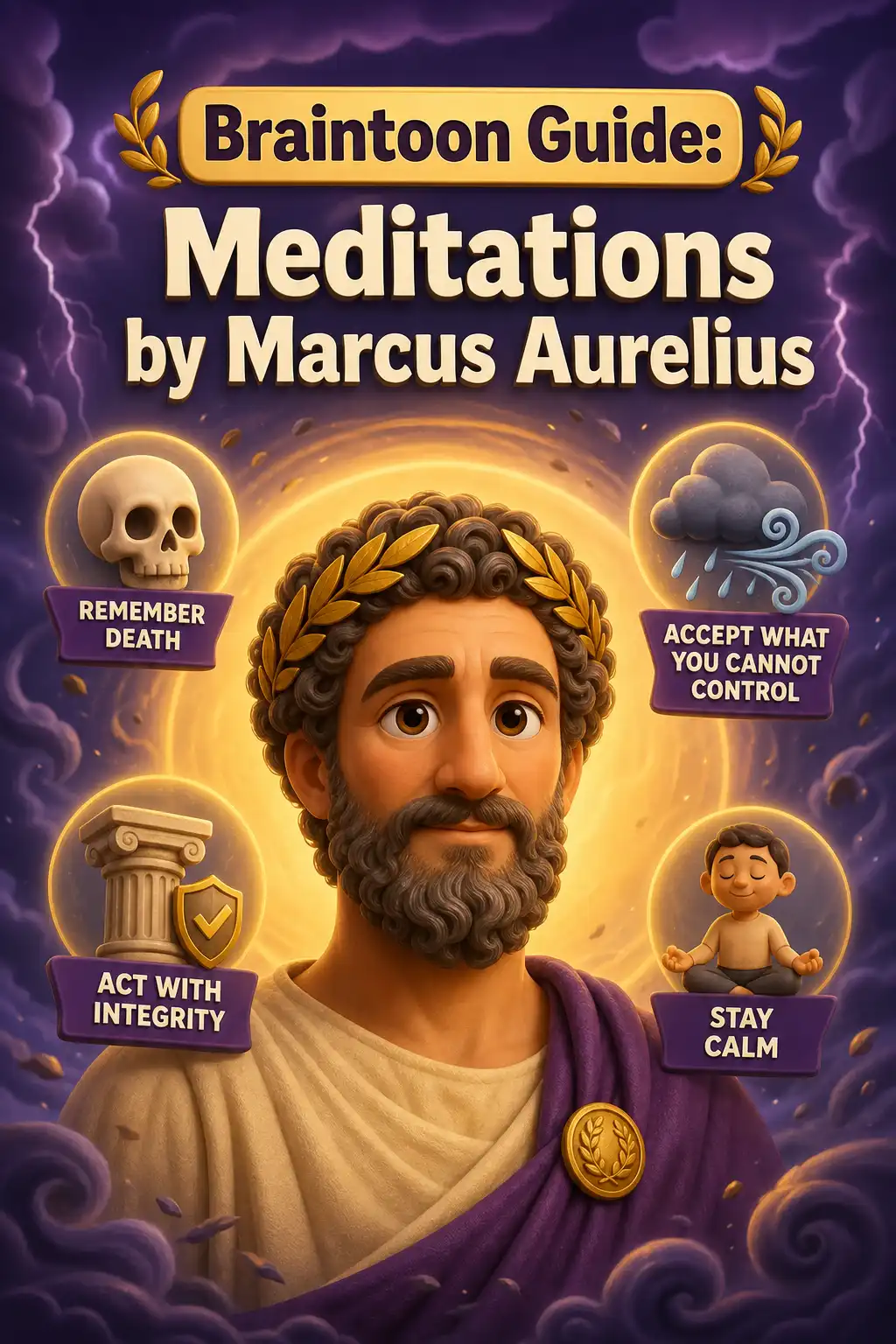
1. Meditations by Marcus Aurelius
Best for:
A Roman emperor's private journal on staying calm, acting with integrity and accepting what you can't control.
11 min animated summary
Inside our summary
- Your judgments hurt you, not events
- Expect difficult people and skip the anger
- What stands in the way becomes the way
If you want one book that shows philosophy as something you practice every day, Meditations is our pick. These are a Roman emperor's private notes, not a lecture written for students.
That gives the ideas an unusual honesty. Marcus keeps returning to a few core points: our judgments hurt us more than events do, difficult people are to be expected rather than resented, and an obstacle can become the way forward.
It suits Stoicism beginners and anyone who wants steadier footing under stress. Its lessons on remembering death, letting go of applause and accepting what happens give you plenty to reflect on.
What you won't get is a step-by-step argument. Marcus is talking to himself, so expect reminders rather than proofs. For many readers, that's exactly why it works: the ideas are short enough to carry around and come back to.

2. The Courage to be Disliked by Ichiro Kishimi and Fumitake Koga
Best for:
An approachable look at happiness, freedom and approval, drawn from Alfred Adler's psychology.
11 min animated summary
Inside our summary
- Inferiority is a story, not a fact
- Separate your tasks from theirs
- Stop chasing recognition
If philosophy has always sounded abstract, this is where we'd start. Kishimi and Koga draw on Alfred Adler's psychology to tackle questions that feel personal right away: why we feel inferior, why we chase approval and how far happiness is up to us.
Their answers are bold. The authors argue that inferiority is a story rather than a fact, that you can separate your own tasks from other people's, and that giving up the hunt for recognition opens the way to a freer life.
That makes it especially useful for people-pleasers and for anyone curious about freedom and responsibility in everyday life.
It leans on psychology more than on the history of philosophy. If you'd like a classic source alongside it, Meditations shares its interest in how much depends on the way we interpret what happens to us.

3. The Brothers Karamazov by Fyodor Dostoyevsky
Best for:
Dostoyevsky's great novel of faith, guilt and a murder that tears a family apart.
13 min animated summary
Inside our summary
- A Family Built on Neglect
- Ivan's Rebellion Against God
- Zosima's Legacy and Alyosha's Crisis of Faith
Some of philosophy's hardest questions land with the most force inside a story. That's why this is our pick for philosophy told through fiction.
Dostoyevsky builds a family drama around a murder, then uses it to explore faith, guilt and moral responsibility. For many readers, the heart of the book is the clash of worldviews: Ivan's rebellion against God set against Zosima's legacy and Alyosha's own crisis of faith.
It suits novel lovers and anyone wrestling with doubt, or with how to make sense of evil and suffering. Instead of neat conclusions, you watch characters live out their beliefs under real pressure.
The original is a big, demanding novel. A summary is a sensible way to follow the story and its central arguments before deciding whether to take on the full book.
4. The Black Swan by Nassim Nicholas Taleb
Best for:
Taleb's case that rare, unpredictable events shape history and that our minds are built to miss them.
13 min animated summary
Inside our summary
- Why the past misleads us
- The evidence you never see
- Why forecasts fail so badly
Philosophy asks how to live, but it also asks how we know anything at all. The Black Swan takes that old question somewhere practical.
Taleb writes as a former trader who bet on rare events. He argues that unpredictable, high-impact surprises shape history far more than we admit, and that both our minds and our models are built to miss them.
His real target is overconfidence. He looks at why the past can mislead us, why the evidence we never see matters and why forecasts fail so badly.
Pick this if you're skeptical of predictions, or if your work involves planning or investing. The final lesson turns to Taleb's advice on positioning yourself for surprises rather than trying to predict them.
It's a forceful book that suits readers who enjoy having their assumptions challenged.
5. The True Believer by Eric Hoffer
Best for:
Why ordinary people join mass movements and how fanaticism rises, spreads and burns out.
12 min animated summary
Inside our summary
- Movements run on hope, not misery
- The wish to escape yourself
- Every movement needs a devil
Why do ordinary people give up their own judgment for a cause? Hoffer's answer is unsettling, and it's our pick for understanding fanaticism.
He argues that mass movements share a family resemblance whatever their goals, and that they run on hope rather than misery. One of his most striking ideas is that many followers are driven by a wish to escape themselves.
From there he looks at who becomes a true believer, how movements manufacture self-sacrifice and why every movement needs a devil. He also traces the roles of men of words, fanatics and men of action, then turns to how movements end and what protects us.
It suits readers interested in politics, society and the psychology of belief. Because Hoffer looks for patterns across movements rather than focusing on one cause, his ideas are easy to test against what you see around you.
6. Mere Christianity by C.S. Lewis
Best for:
C.S. Lewis's case for Christianity, beginning with our everyday sense of right and wrong.
11 min animated summary
Inside our summary
- The instinct for fairness and right
- Morality is more than instinct
- More than a moral teacher
If you're wondering where morality comes from, Lewis offers one of the best-known answers. He starts with something almost everyone recognizes: our instinct for fairness and our sense that some things are simply right or wrong.
Lewis argues that morality is more than instinct and that it points beyond us. From there he builds toward the basics of the Christian message, including his claim that Jesus was more than a moral teacher, and ends with the idea of deep inner change.
It's a strong choice for faith seekers and for anyone who wants Christian belief explained clearly from the ground up.
Be aware that it makes the case for one view. The opening moral argument will interest a wide range of readers, while the later sections focus on faith itself, so skeptical readers may find those less persuasive.
7. How to Read a Book by Mortimer J. Adler
Best for:
Adler's practical method for reading actively, so even difficult books leave you sharper.
11 min animated summary
Inside our summary
- The four levels of reading
- Find the skeleton and terms
- Disagree without being a jerk
This isn't a philosophy book, but it can make every other philosophy book easier. Adler treats reading as an active sport and shows how to get real understanding from difficult texts.
His approach is practical: inspect a book before committing to it, ask four key questions, work out what kind of book it is, and find its skeleton and key terms. He also covers how to disagree fairly and how to compare several books on the same topic.
It suits self-taught learners and anyone who has opened a classic and stalled a few pages in. Adler's closing advice, to read books that stretch you, fits naturally with the more demanding picks on this list.
It works best as a companion, not a replacement. Use it alongside a book you genuinely want to understand.
A suggested reading order
There's no required order. If you're new to philosophy, The Courage to be Disliked is an easy way in, and Meditations adds a classic voice on similar themes. If you plan to tackle the longer originals, such as The Brothers Karamazov, How to Read a Book can help you get more from them.
How we chose these books
We chose from the summaries currently available on BrainToon, looking for books that really examine how to live, what's true or how we know things. That meant leaving out strategy guides, wealth advice and books that are mainly meditation practice, even when they touch on life philosophy. Where two titles covered similar ground, we kept the one that fit this topic most clearly. BrainToon's library doesn't yet include core works such as Plato's Republic or a general introduction like Bertrand Russell's The Problems of Philosophy, so this list isn't a survey of philosophy's history. It's a set of good entry points into its biggest questions.