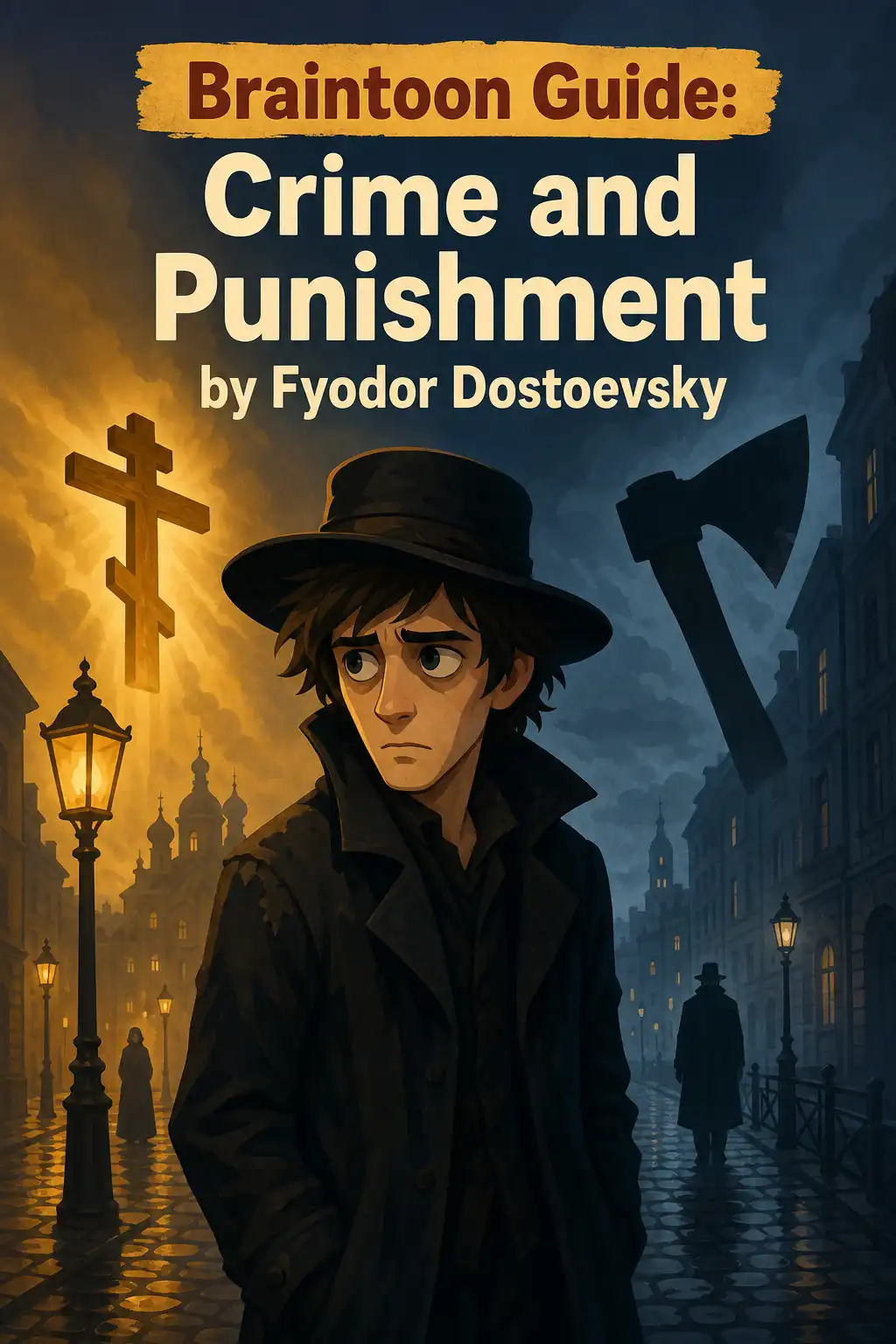





Crime and Punishment cover

Crime and Punishment Summary: 10 best parts in 10 mins

10 min readFyodor Dostoevsky's book, summarized

One-sentence summary

Crime and Punishment by Fyodor Dostoevsky follows Raskolnikov as guilt, pride, and faith collide, asking whether any human being can stand above moral law.

A poor student in a sweltering St. Petersburg slum convinces himself that murdering a pawnbroker might just prove he is something more than ordinary.

(Continued below)

Reading about Crime and Punishment is one thing.

Watching it is faster, more fun, and you'll actually remember it.

Open in app

Part 1: A Mind on the Edge

We meet Raskolnikov, a former law student living in a coffin-sized room in St. Petersburg, crushed by poverty and isolation.

He sneaks past his landlady, to whom he owes rent, and visits Alyona Ivanovna, a cold elderly pawnbroker, to pawn an old silver watch.

While he is there, he secretly studies her keys and her routine. He is rehearsing something terrible, though he will not name it even to himself.

The central question lands fast. Why is this proud, intelligent young man brooding over an act of violence against a stranger?

In a tavern he meets Marmeladov, a hopeless drunk whose gentle daughter Sonia has turned to prostitution to feed the starving family.

Raskolnikov sees a household drowning in shame and tenderness mixed together, and he quietly leaves his last coins on their windowsill.

Part 2: The Letter and the Theory

A letter from his mother changes everything. His sister Dounia is engaging herself to Luzhin, a stingy older official who quite openly fancies controlling a poor wife.

Raskolnikov sees immediately that Dounia is sacrificing herself to rescue him from poverty, just as Sonia sacrificed herself for her family.

That parallel enrages him. The women he loves are being consumed by a world he feels powerless to fight by any ordinary means.

Out on the street he saves a drunk young girl from a predator, then bitterly gives up, sensing the world will swallow her anyway.

Then comes the dream of a peasant beating a small horse to death while a crowd laughs and the child Raskolnikov sobs.

He wakes shaken, briefly certain he cannot kill. But a chance bit of overheard talk tells him Lizaveta, the pawnbroker's sister, will be away tomorrow evening.

Part 3: The Axe Falls

Inside Alyona's flat, Raskolnikov pretends to hand her a pledge, then strikes her with the axe and kills her with a second blow.

He rifles through her belongings for keys and jewelry, but then Lizaveta, the gentle sister, walks in unexpectedly. Frozen with terror, she cannot even cry out.

He kills her too. The theory that murder could be precise and rational shatters instantly against this second unplanned, innocent death.

He nearly gets caught when visitors find the door latched from inside, but he hides in a freshly painted empty flat and slips out.

He returns the axe unnoticed and collapses on his sofa. The crime is done, but something inside him has cracked open.

From this moment on, the real story is not whether he will be caught. It is whether he can survive being himself.

Part 4: Fever and Suspicion

Raskolnikov sinks into feverish delirium. He hides the stolen items behind wallpaper, then under a stone, never able to feel truly safe.

A police summons over his unpaid rent terrifies him, but at the station he overhears talk of the murder and nearly faints from panic.

His warm-hearted friend Razumihin tracks him down and nurses him through days of illness, bringing food, clothes, and stubborn loyalty.

The doctor Zossimov suspects a fixed idea is tormenting him, and indeed the murder case is the one topic that fully grips Raskolnikov.

Luzhin arrives, pompous and patronizing. Raskolnikov insults him openly, defending Dounia and exposing the cold contract beneath the engagement.

Then, in a reckless tavern moment, Raskolnikov toys with the police clerk Zametov and whispers that he himself is the killer.

Part 5: Sonia and Confession's Pull

Raskolnikov rescues the dying Marmeladov in the street and brings him home, where Sonia arrives just in time for her father's last breath.

He leaves money for the family and feels, briefly, that helping others has handed him his life back. Then his mother and sister appear.

Overwhelmed, he faints. Awake again, he forces Dounia to break with Luzhin, choosing pride over her supposed security.

Sonia arrives shyly. He introduces her formally to his mother and sister, deliberately honoring this young woman whom the world has labeled shameful.

This is the turning point of his moral world. He has begun to see Sonia as the only person who might understand him.

Razumihin, meanwhile, falls quietly in love with Dounia, beginning to anchor the family even as Raskolnikov drifts further away from them.

Part 6: Porfiry's Net

Raskolnikov visits the investigator Porfiry Petrovitch, who casually steers the conversation toward an article Raskolnikov once wrote about extraordinary men.

In it, Raskolnikov argued that great figures like Napoleon have an inner right to break the law for higher purposes.

Porfiry asks gently whether he counts himself among those extraordinary men. The theory that justified murder is now hanging out in the open air.

A stranger later passes Raskolnikov on the street and calls him a murderer, sending him into nightmares and shaking his self-control.

Then Svidrigaïlov, the man who once harassed Dounia, appears in his room, charming and unsettling, hinting at dark visions and strange offers.

Two opposite forces now squeeze Raskolnikov. Porfiry circles him with patient psychology. Svidrigaïlov mirrors him as a man already past every moral line.

Part 7: Sonia Hears the Truth

After Dounia rejects Luzhin publicly, Luzhin's pride collapses. He plots revenge by planting a hundred-rouble note in Sonia's pocket.

At Katerina Ivanovna's chaotic funeral dinner, Luzhin accuses Sonia of theft, but Lebeziatnikov saw him plant it, and Raskolnikov exposes his motive.

Stripped of his mask, Luzhin slinks away, but the family is evicted, and Katerina Ivanovna spirals toward madness in the streets.

Raskolnikov goes to Sonia's tiny room and asks her to read aloud the story of Lazarus rising from the dead.

Then he confesses. He killed the pawnbroker, he says, to test whether he could cross a line ordinary people cannot.

Sonia does not flinch with disgust. She pulls him close and tells him to go kiss the earth and confess publicly.

Part 8: Svidrigaïlov's Mirror

Svidrigaïlov has been listening through the wall the whole time. He now holds Raskolnikov's secret, and he quickly turns it against Dounia.

He lures her to his rooms, reveals her brother's crime, and offers to save him in exchange for her love.

Dounia pulls out a revolver and fires. The bullet grazes him. When she finally drops the gun, he sees that she will never love him.

Something quietly breaks in him. He hands her the key and lets her go. He has glimpsed the emptiness his freedom led to.

That night he gives away money to Sonia and to his young fiancée's family, then checks into a shabby hotel.

At dawn he tells a guard he is leaving for America, raises the revolver to his temple, and pulls the trigger.

Part 9: Kissing the Earth

Porfiry visits Raskolnikov one last time, calmly and almost kindly. He admits he has no court-ready proof, but he knows Raskolnikov is the killer.

He urges Raskolnikov to confess voluntarily, promising a lighter sentence, and quietly insists that suffering can still give a life meaning.

Raskolnikov says goodbye to his mother, weeping at her feet without telling her why, then parts from Dounia on the street.

He returns to Sonia, who places a wooden cross around his neck and prays. He still does not fully believe, but he goes.

In the crowded Haymarket he kneels and kisses the ground. People laugh. He sees Sonia watching from a distance and continues on.

At the police office, he hears that Svidrigaïlov has shot himself. The news jolts him. He turns back and quietly confesses everything.

Part 10: A New Life Begins

Raskolnikov is sentenced to eight years in a Siberian prison. His mother, unable to face the truth, drifts into a gentle madness and dies.

Dounia marries Razumihin, who plans one day to move the family near Siberia so they can all be together again.

Sonia follows Raskolnikov east, visiting him, working nearby, and becoming quietly beloved among the other prisoners for her steady kindness.

At first he stays proud and unrepentant, still half believing his theory. Then a feverish dream of a plague destroying civilization finally shakes that pride.

One morning by the river, he sees Sonia and suddenly weeps at her feet. Something finally cracks open. He loves, and he lets himself be loved.

He picks up her New Testament, and for the first time the long, slow work of becoming a new person begins.

You've read the summary. Now watch it.

The animated version covers the same ideas — faster, and in a format you'll actually remember.

More books like Crime and Punishment