







Good to Great cover

Book summary: Good to Great by Jim Collins

10 min read8 key lessonsText + animated summary

What if the biggest reason you’re not truly great is that you’re already pretty good—and comfortable staying there?

One-sentence summary

Good to Great, Jim Collins’s bestselling management study, explains how ordinary organizations make the leap to exceptional performance—and how they keep it going for years.

Reading about Good to Great is one thing.

Watching it is faster, more fun, and you'll actually remember it.

Lesson 1: The research bet — can greatness be built, not just luck?

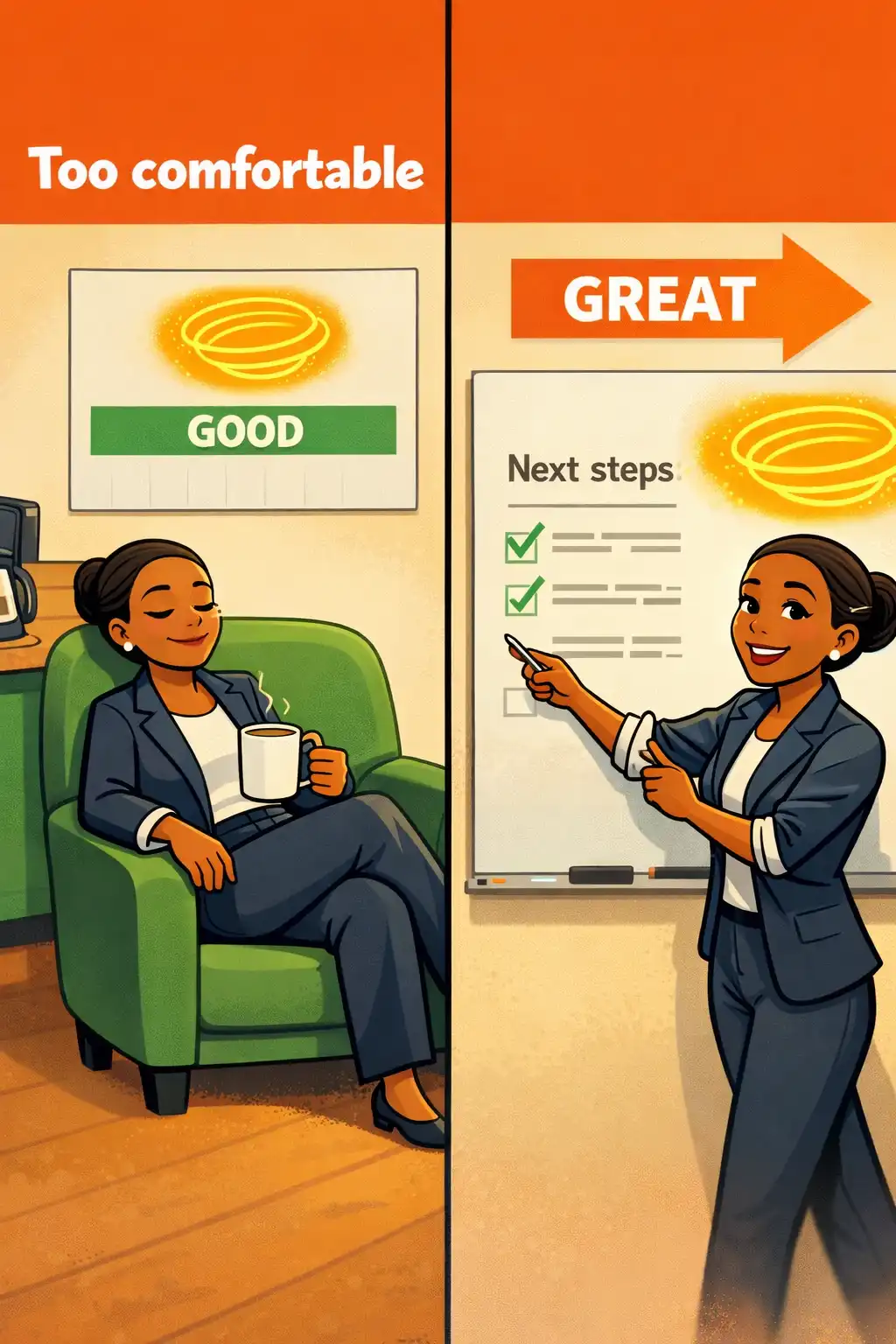
Picture a team at the office saying, “We’re doing fine,” while a quieter voice asks, “But are we truly great, or just comfortable?”

Jim Collins starts with a blunt idea: “good is the enemy of great,” because “good” convinces us to stop improving.

The project began when a colleague challenged Collins with a simple question: can greatness be deliberately built, or is it mostly luck?

So Collins led a five‑year study, combing Fortune 500 histories from 1965 to 1995 with a research team, hunting for clear patterns.

They identified eleven “good‑to‑great” companies with sustained results, plus comparison firms that stayed average or spiked briefly and then faded.

Collins stresses that the lessons came from data, not hype, and they point to a framework of disciplined people, disciplined thought, and disciplined action.

Lesson 2: Level 5 leadership — humble and relentless

Imagine a leader who rarely raises their voice, yet the whole company starts moving with serious purpose because the standards are unmistakably clear.

Jim Collins calls this “Level 5 leadership,” a rare mix of personal humility and ferocious professional will to win.

His signature example is Darwin E. Smith, a quiet in‑house lawyer who became CEO of Kimberly‑Clark, the paper products company behind Kleenex.

Smith made a gutsy move, selling the paper mills and betting on consumer brands like Kleenex and Huggies, even as critics called it foolish.

Collins contrasts that with celebrity‑style CEOs, like Lee Iacocca at Chrysler, who drew attention but didn’t build enduring, self‑sustaining results.

Level 5 leaders “look out the window” to credit others for wins and “in the mirror” to own failures.

Lesson 3: First who, then what — build the team before the plan

Think about planning a road trip without picking your passengers, only to discover halfway that nobody works well together.

Jim Collins flips the usual logic: get the right people on the bus—and the wrong people off—then decide where to drive.

Why first, because with the right team, changing direction is easier, as people adapt without drama or excuses.

Collins points to Wells Fargo, a major American bank, which built a deep talent bench before U.S. deregulation reshaped banking.

When the industry changed, Wells Fargo moved fast, while competitors with weaker managers froze and waited for instructions.

The practical rules are simple: when in doubt, don’t hire, fix wrong seats fast, and put your best people on the biggest opportunities.

Lesson 4: Face the brutal facts — truth before strategy

Picture two store owners seeing fewer customers each month, but only one is willing to admit the business model is broken.

Collins compares A&P and Kroger, two old U.S. grocery chains, facing the same market shift toward bigger, modern superstores.

A&P defended comforting myths and shut down experiments, while Kroger confronted reality and rebuilt its entire system.

Jim Collins says breakthroughs begin when leaders create a climate where truth is consistently heard, not filtered or punished.

He gives four tools: lead with questions, debate without coercion, do autopsies without blame, and build red‑flag signals that make bad news impossible to ignore.

Then comes the Stockdale Paradox, named after Admiral Jim Stockdale, a Vietnam prisoner of war who survived by facing brutal reality.

Lesson 5: The Hedgehog Concept — simplify to amplify

Imagine a fox chasing ten clever plans, while a hedgehog wins by doing one simple thing, again and again, every day.

Jim Collins borrows Isaiah Berlin’s metaphor and translates it into business, arguing that great companies get simple on purpose.

The Hedgehog Concept sits at the intersection of three circles: what you can be the best at, what drives your economic engine, and what you are deeply passionate about.

This is not a slogan you invent for a poster, Collins says, but an understanding you earn through evidence, iteration, and debate.

Walgreens, a U.S. drugstore chain, focused on being the most convenient pharmacy and measured success as profit per customer visit.

That clarity led to clustered locations, drive‑through pharmacies, and consistent investment choices, while rivals chased scattered side businesses.

Lesson 6: A culture of discipline — freedom within a framework

Think of a sports team where nobody needs yelling, because everyone already knows the standards and plays their role every day.

Jim Collins says great organizations pair freedom with responsibility, avoiding bureaucracy by hiring disciplined people who act within clear constraints.

He warns about the disciplinarian syndrome, where one forceful leader imposes order, but the company collapses when that person leaves.

Real discipline shows up in systems that outlast personalities, like clear accountability and everyday follow‑through, not dramatic speeches.

Collins even celebrates “rinsing your cottage cheese,” a metaphor for obsessive attention to small details that reveal waste and improve performance.

A key practice is the “stop‑doing list,” cutting work that doesn’t fit the Hedgehog Concept so focus becomes real and resources are freed.

Lesson 7: Technology accelerates, it doesn’t save — tools follow strategy

Picture someone buying every new gadget, hoping it will fix their messy life, but nothing changes because habits stay messy.

Jim Collins found that technology rarely causes greatness; it mostly speeds up momentum that already exists.

He contrasts drugstore.com, a hyped online retailer that crashed, with Walgreens, which moved carefully from crawl to walk to run.

Collins offers a simple test: does this technology directly fit your Hedgehog Concept and your economic engine metric?

If it fits, become a pioneer in applying it, and if not, settle for parity or ignore it without fear.

The warning is the technology trap, where leaders chase tools out of panic, creating lurching strategy and weaker execution.

Lesson 8: Push the flywheel — small wins compound into momentum

Imagine trying to shove a massive flywheel, and at first it barely moves, even though you’re pushing hard.

Jim Collins says good‑to‑great change often feels slow inside the company, because it is built from many consistent, disciplined pushes.

Circuit City, an electronics retailer, refined its warehouse‑superstore model for years before outsiders suddenly called it an “overnight success.”

When results stack up, alignment follows naturally, because people believe what they can see, not what they’re told to chant.

Collins contrasts this with the doom loop, where leaders chase big programs, constant reorganizations, or headline acquisitions to force a breakthrough instead of doing the quiet work.

Even big moves, like acquisitions, work best as accelerators after the flywheel is turning, not as substitutes for discipline.

You've read the summary. Now watch it.

The animated version covers the same ideas — faster, and in a format you'll actually remember.