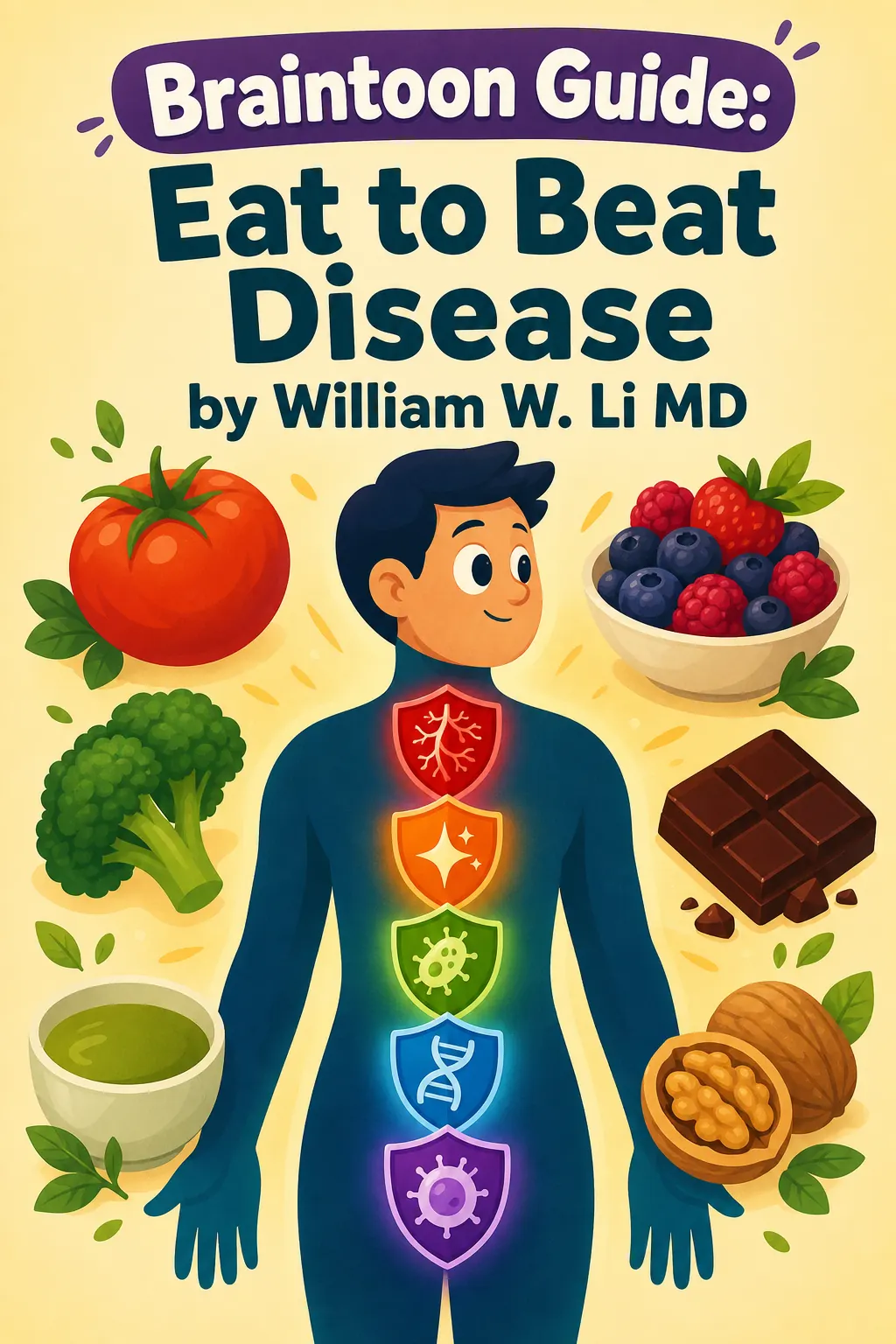

Eat to Beat Disease cover

Eat to Beat Disease Summary: 9 best lessons in 10 mins

10 min readWilliam W. Li MD's book, summarized

One-sentence summary

Eat to Beat Disease by William W. Li MD shows how everyday foods can activate your body's five built-in defenses against illness.

Yvonne stares at her dad's hospital bracelet, gripping a vending machine coffee, terrified the same heart disease is quietly building inside her too.

(Continued below)

Reading about Eat to Beat Disease is one thing.

Watching it is faster, more fun, and you'll actually remember it.

Open in app

Lesson 1: Your body already defends itself

Yvonne is a 38-year-old elementary school librarian in Cleveland. She's driving home from the hospital, wondering if her dad's heart attack is her future too.

She's been googling diets for hours and feels completely lost. Keto, vegan, paleo. Everyone's shouting something different, and her doctor barely mentioned food at all.

That gap is exactly what Dr. William Li noticed too. Most physicians get almost no nutrition training, even as chronic disease keeps climbing.

Li spent decades studying what diseases share in common, not what makes them different. His big idea is that your body has five built-in defenses.

These are angiogenesis, regeneration, the microbiome, DNA protection, and immunity. Together they quietly fight illness from before birth all the way through old age.

And here's the part that gives Yvonne hope. Food, the kind sold at any ordinary grocery store, can strengthen every single one of these systems.

Lesson 2: Starve disease, feed health

The next morning, Yvonne reads something startling. Nearly everyone carries tiny microscopic cancers in their body, and those cancers stay harmless unless they grow their own blood vessels.

That process is called angiogenesis. Your body grows and prunes about 60,000 miles of blood vessels, balancing supply so healthy tissues thrive and tumors stay starved.

When the balance tips, trouble follows. Too many vessels feed cancer and worsen obesity. Too few starve nerves and slow down healing after an injury.

Li explains that certain foods naturally help keep this balance steady. Soy, tomatoes cooked in olive oil, green tea, berries, and even modest amounts of cheese.

One striking study found that **women eating more soy had a significantly lower breast cancer recurrence rate**. Soy doesn't fuel cancer. It actually fights it.

Yvonne starts simple. She swaps her afternoon soda for green tea, and adds tomato sauce, simmered in olive oil, to her weeknight pasta.

Lesson 3: Regenerate with everyday foods

A few weeks in, Yvonne notices her dad is recovering slowly. His doctor mentions stem cells, the body's tiny repair crew that rebuilds tissue after damage.

Li explains that stem cells regenerate everything. Your gut lining every few days, your skin every two weeks, your skeleton roughly every decade. Without them, you'd collapse within days.

But aging, smoking, diabetes, and high blood sugar all shrink your stem cell reserves. That's why healing slows down as people get older.

The good news is that certain foods recruit more stem cells into circulation. Dark chocolate with high cocoa flavanols doubled them in one study of heart patients.

Black tea raised stem cell levels by 56 percent in people with high blood pressure. Beer polyphenols boosted them eightfold. Even moderate red wine showed real benefits.

Yvonne packs walnuts into her lunch and brews black tea in the mornings. She tells her dad about the cocoa research, and they share squares of dark chocolate after dinner.

Lesson 4: Feed your inner ecosystem

Yvonne's stomach has been off for years. Her doctor shrugs. But Li's chapter on the microbiome makes her sit up straight at the kitchen table.

You're hosting around 39 trillion bacteria, roughly matching your own cells. They shape your mood, your immunity, your metabolism, and how well your body resists serious diseases.

A diverse microbiome is like a healthy coral reef. Diversity itself is a signal of health. Boring, processed diets shrink that diversity and let harmful bacteria take over.

Li highlights one tiny bacterium called Akkermansia. Cancer patients who carried it responded far better to immunotherapy than patients who didn't have it.

Pomegranate juice raised Akkermansia levels by 71 percent in responders. Cranberry juice helps too. So do kimchi, sauerkraut, yogurt, and aged cheeses.

Yvonne starts adding a spoonful of sauerkraut to dinner and sips pomegranate juice on weekends. Within a few weeks, her digestion feels noticeably calmer.

Lesson 5: Protect your genetic code

Yvonne's sister mentions a family history of breast cancer. Suddenly the abstract idea of DNA damage feels personal, and very close to home.

Li explains that your DNA absorbs over 10,000 damaging hits every single day from pollution, UV light, and normal cell activity. Yet repair enzymes fix nearly all of it.

Certain foods actively help that repair. Kiwifruit cut DNA damage by around 60 percent. Orange juice reduced it by 19 percent within just two hours of drinking it.

Other foods flip helpful genes on through epigenetics. Broccoli sprouts, coffee, turmeric, and soy can quietly activate tumor suppressor genes already sitting inside your cells.

Then there are telomeres, the tiny caps protecting the ends of your chromosomes. Longer telomeres mean slower aging. Coffee, nuts, and vegetables all help preserve them.

Meanwhile, processed meats and sugary sodas shorten telomeres so dramatically that one daily soda equals about 4.6 years of extra cellular aging.

Lesson 6: Tune your immune system

Cold season hits her school hard. Yvonne misses three days, frustrated. Li's chapter on immunity reveals how food can dial that defense up or down.

White button mushrooms, eaten daily for a week, raised antibodies in saliva by 55 percent. Aged garlic cut sick days at work by 58 percent.

Broccoli sprouts dramatically boosted virus-fighting cells. Cranberry juice tripled the potency of certain immune cells and reduced cold symptoms by 16 percent.

But sometimes immunity gets too loud. That's autoimmune disease, where the body attacks itself, causing conditions like lupus, rheumatoid arthritis, or multiple sclerosis.

Foods rich in vitamin C lowered active lupus risk by 74 percent. Green tea's EGCG calmed inflammation and cut lupus disease activity in half during one trial.

Yvonne adds sautéed mushrooms to her omelets and brews green tea after lunch. Her colleague with rheumatoid arthritis starts swapping notes with her at recess.

Lesson 7: Use the 5x5x5 plan

Yvonne's notebook is overflowing with foods. She's overwhelmed, until she finds Li's framework, called 5x5x5, designed to make all of this manageable.

Five defense systems. Five foods a day that support them. Five eating occasions: breakfast, lunch, dinner, snack, and dessert. That's it. No food group is banned.

The trick is addition, not subtraction. She builds a personal preferred food list from over 200 evidence-backed options, checking only the ones she actually enjoys eating.

She snaps a photo of her list and keeps it on her phone for grocery runs, school cafeteria days, and dinners out with her sister.

Li also suggests stopping when she's about 80 percent full, occasionally skipping a meal, and eating slowly without scrolling through her phone during dinner.

She invites her dad over weekly. They cook together, share meals, and swap stories. Long-lived communities around the world share meals like this on purpose.

Lesson 8: Cook smart at home

Yvonne realizes her kitchen needs an upgrade. Li argues that home cooking gives you full control over ingredients, which restaurants and packaged foods simply cannot match.

She tosses her scratched nonstick pan, which can release toxic fumes when overheated, and replaces it with a sturdy cast iron skillet she'll use for years.

She switches to a French press because paper coffee filters trap many of the beneficial bioactives in coffee. She also stores leftovers in glass instead of plastic.

Her pantry fills with cold-pressed extra virgin olive oil, dried beans, whole grains, tinned sardines, dark chocolate, and small jars of bold spices.

Li suggests steaming, blanching, stir-frying, and braising over grilling meat, which can create carcinogens. A quick olive oil marinade reduces that risk when she does grill.

She keeps broccoli stems and mushroom stems in soups, leaves tomato skins on for the lycopene, and reheats food in the oven instead of the microwave.

Lesson 9: Think in food doses

Six months in, Yvonne returns to the cardiologist with her dad. The numbers look better. She asks the doctor exactly how much of each food matters.

Li answers this with the idea of food doses. Just like medicines, foods have specific quantities tied to measurable health benefits in real research.

Two cups of green tea daily reduces colorectal cancer risk. Three to four tablespoons of olive oil protect against breast and colorectal cancer. Specific, not vague.

Li even found that 15 out of 16 dietary compounds outperformed at least one cancer drug at slowing harmful angiogenesis in his laboratory tests.

He's careful though. Food isn't a replacement for medicine. People with serious conditions should always consult their doctor before making big dietary changes.

And more isn't always better. The principle of hormesis says moderate amounts help, while extremes can actually harm. Balance matters more than maximizing any single food.

You've read the summary. Now watch it.

The animated version covers the same ideas — faster, and in a format you'll actually remember.

More books like Eat to Beat Disease