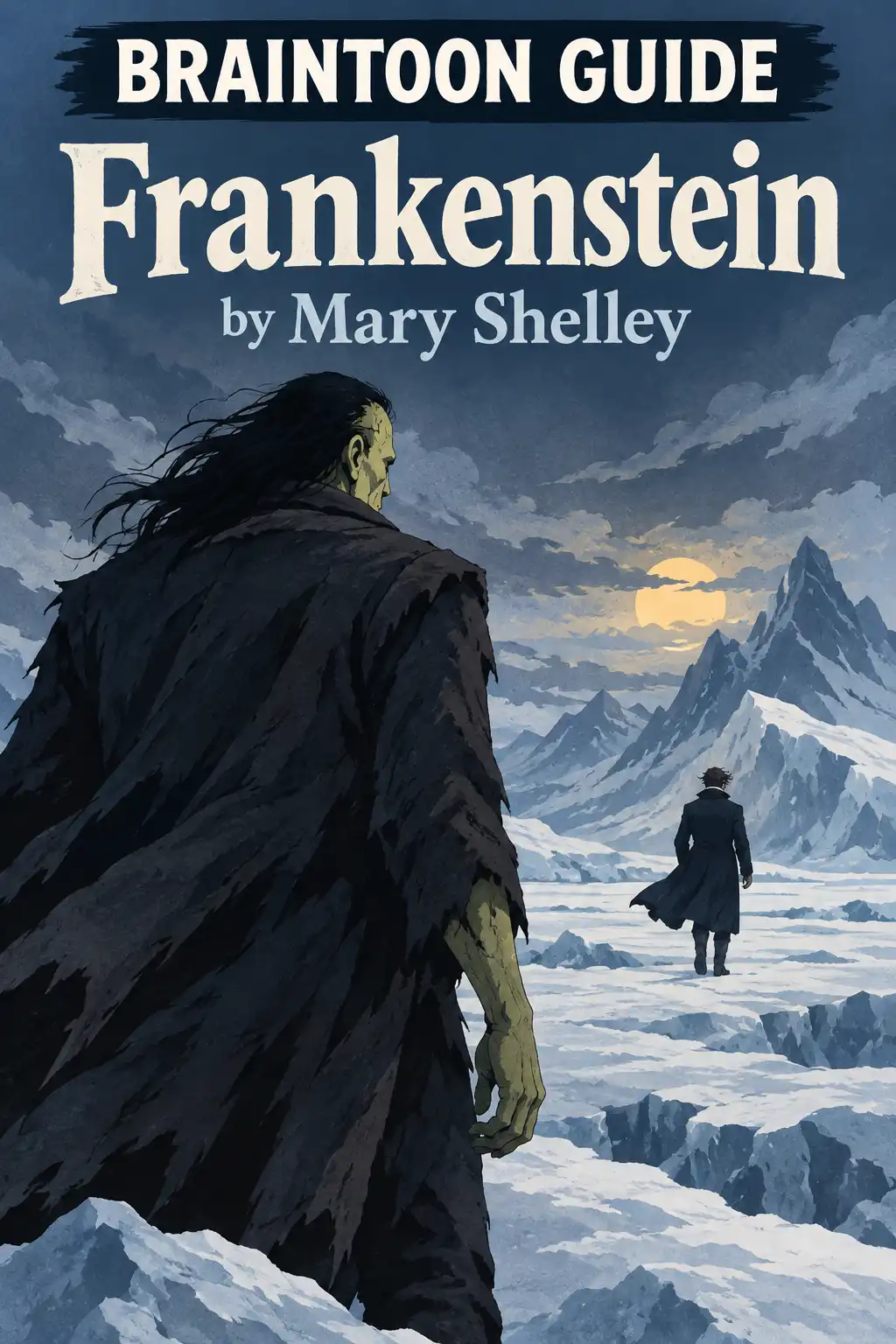
A detailed summary ofFrankensteinby Mary Shelley

Frankenstein cover

Loading summary

Share this with a friend or colleague

Email

Frankenstein by Mary Shelley follows a scientist who creates a living being and abandons it in horror, setting off a chain of grief and revenge that asks what a creator owes to what he makes.

Watch full summaryOpen in app

More books like Frankenstein

Browse all books

Explore related topics

Frankenstein Summary

Most people think they know this story. Mad scientist, lumbering monster, a bolt of lightning. But the actual book is something quite different, isn't it?

It really is. We're talking about Frankenstein by Mary Shelley, first published in 1818. The question at its heart isn't really whether science can create life. It's what you owe the thing you've made. And almost nobody in this book answers that well.

Including the scientist himself.

Especially him.

1. A warning told from a frozen ship

So where does it actually start? I assumed we'd open in a laboratory.

No, we open with letters. An English explorer named Robert Walton is writing to his sister. He's sailing for the North Pole, he's spent six years preparing, and he's convinced he'll make history. But underneath that he keeps admitting he's lonely. He has no real friend to share any of it with.

That's an odd confession for an adventurer.

It matters later. His ship gets trapped in ice, and the crew sees something strange: a gigantic figure driving a dog sledge across the ice. The next morning they find a second sledge with a half-dead European man on it. That's Victor Frankenstein. And when Walton tells him he'd give his life for knowledge, Victor breaks down in tears and says, don't. Hear my story first.

So the whole novel is a cautionary tale told to someone who's about to make the same mistake.

That's the frame. Victor then tells his life: a loving family in Geneva, an adopted sister named Elizabeth, a best friend named Henry Clerval. At thirteen he finds a book by an old alchemist, and his father dismisses it as rubbish without explaining why. Victor says that if his father had just explained, he might have let it go. Instead he reads everything, dreams of conquering death, and goes off to university at Ingolstadt.

The father not explaining. That's a tiny detail, but it sounds like it's doing a lot of work.

It's Victor's own emphasis, so take it with some caution. But one reading is that the book keeps showing small failures of guidance. At Ingolstadt a professor named Waldman gives a lecture about what modern science can do, and Victor says something stirred in him. Two years later, he believes he's found the secret of life.

2. The night the creature opens its eyes

And then he builds a person.

Eight feet tall, because the small parts are easier to work with at that scale. He gathers material from dissecting rooms and slaughterhouses, cuts off contact with his family, and works through the nights. Then on a rainy November night, around one in the morning, he sees a dull yellow eye open.

And he's triumphant?

He's revolted. He says he'd chosen the features to be beautiful, but together they're hideous, with yellow skin stretched over the muscles and black lips. He runs to his bedroom and falls asleep. He dreams of Elizabeth, and when he kisses her she turns into his dead mother's corpse. He wakes up and the creature is standing by the bed, grinning, one hand stretched out toward him.

Wait. He spends two years building this thing and his response to it working is to go to bed?

And then to run again. He spends the night pacing a courtyard, and by sheer chance meets Clerval arriving in town. When they get back the creature is gone, and Victor collapses into a nervous fever that lasts months. Notice what the creature actually does in that scene. It reaches out and makes some inarticulate sounds. Victor reads that as menace.

I've always heard this as a story about science going too far. But what you're describing sounds more like a parent walking out on a newborn.

Both readings live in the book. Shelley's own preface talks about overreaching ambition. But she also gives Victor the exact language of a frightened parent. He never names the creature, never feeds it, never teaches it a word. Everything that follows, you could argue, grows from that one empty bed.

3. A silence that kills an innocent woman

So what does follow? He's recovered, he's back with his friend. Does he go looking for it?

He tries to forget it. He switches to studying languages with Clerval. Then a letter comes from his father: his little brother William has been strangled in the fields outside Geneva. Victor rushes home, and the night he arrives there's a thunderstorm. In a lightning flash he sees a huge figure near the trees, and he's instantly certain. The creature killed William.

Does he tell anyone?

No. He reasons that a story about a man-made creature would sound like madness, and he's probably right about that. But his silence has a cost. A young woman named Justine, who'd lived with the family almost as a daughter, has been arrested. A portrait William was wearing was found in her pocket. She can't explain it. At the trial, Elizabeth stands up and defends her character, and the crowd turns hostile.

And Victor just sits there.

He sits there knowing who did it. Justine is convicted, and then they learn she confessed. When they visit her cell she explains that her priest threatened her with damnation until she signed a false confession. She's executed the next morning. Afterward Victor calls himself the true murderer and says William and Justine are only the first.

It's strange. He calls himself the true murderer, but only privately. He never says it where it could matter.

That's where another novel, Crime and Punishment, makes a useful contrast. Raskolnikov actually commits murder, and his guilt keeps pulling him toward confession until he admits everything. Victor carries guilt for deaths he didn't cause with his own hands, and he turns it into silence.

He could have at least tried. Even if nobody believed him.

That's a fair reaction, and the book half invites it. But remember who's telling us this. Victor is narrating to Walton, so every excuse and every bit of self-blame is his own framing. He condemns himself, which is sympathetic, but he also presents every alternative as impossible.

So we're hearing a self-portrait, not a report.

4. The creature tells his own story

And that's exactly why the next part is so striking. Victor goes up into the Alps to escape his grief, and on a glacier the creature comes bounding toward him. Victor screams threats. The creature answers calmly, in full sentences: you made me, you owe me something, hear me before you judge me.

He can talk? Properly?

Beautifully. He leads Victor to a hut and tells his own story, and for several chapters the book belongs to him. He describes his first days: light and sound all at once, not knowing what any of it was, weeping in the forest without knowing why. He burns his hand learning what fire is. He walks into a village and people throw stones.

That's the opposite of a monster movie.

He hides in a hovel attached to a cottage and watches the family inside: a blind old man, his son Felix, his daughter Agatha. He'd been stealing their food until he realised they were poor, so he stops, and instead gathers firewood for them at night. When a foreign woman named Safie arrives and Felix teaches her French, the creature learns alongside her. He finds books, including Paradise Lost, and says he sees himself sometimes as Adam, alone, and sometimes as Satan, envious of everyone else's happiness.

Does he ever try to meet them?

He works out that the blind father can't judge his face, so he waits until the others are out and knocks. And it goes well. The old man is kind, offers to help. Then the family comes home. Agatha faints, Safie runs, Felix beats him with a stick. The creature says he could have torn Felix apart but couldn't bring himself to lift a hand.

That's heartbreaking. The one time he's actually heard, he's accepted.

There's an echo of this in another novel, Gaston Leroux's The Phantom of the Opera. Erik, the masked genius hidden under the Paris Opera, is undone when Christine tears off his mask and sees his face. His heartbreak snaps into fury.

So in both stories, the face ends up delivering the whole verdict.

And the book won't let you rest there. He burns the cottage. He saves a girl from drowning and gets shot for it. Then near Geneva he meets a small boy, hopes a child might be too young to fear him, and the boy screams that he's a Frankenstein. The creature strangles him and plants the portrait on a sleeping Justine.

So all that sympathy runs straight into a child murder.

5. A promise made and then broken

Which is what makes his demand so hard to answer. He asks Victor to build him a female companion. He says his cruelty comes from total loneliness, and promises that the two of them will vanish into the wilds of South America and never trouble anyone again.

He's read Paradise Lost and compared himself to Adam. Isn't this basically asking for what Adam got?

Very much. In Genesis (the first book of the Bible), God sees that the man is alone and shapes a woman for him. The creature is asking Victor to play that part, and whether Victor will is the whole question.

And Victor says yes?

After refusing, then wavering, then admitting there's some justice in it. He agrees, and then stalls for months. He travels to England with Clerval, and finally ends up alone in a hut on a remote Orkney island, building a second body with none of the old excitement, only dread. One night he starts thinking it through. What if she's worse than him? What if she refuses the bargain? What if they have children?

Those sound like reasonable worries, honestly.

They are. Then he looks up and the creature is grinning at the window, and Victor tears the half-made body to pieces in front of him. The creature howls and leaves, then comes back to say one sentence: I will be with you on your wedding night. Soon after, Clerval is found strangled on an Irish beach, and Victor is jailed for it before being cleared.

And he still goes ahead with the wedding?

He marries Elizabeth. He carries pistols and a dagger, because he's convinced the threat is against his own life. On the wedding night, at an inn by the lake, he sends Elizabeth to their room so she won't see a fight. Then he hears a scream.

He assumed it was about him. That blind spot is almost unbelievable.

Many readers stop at that moment. Everything the creature has done so far has been aimed at the people Victor loves, and Victor still can't imagine the threat landing anywhere but himself. Elizabeth is dead on the bed, the creature points at her from the window and jumps into the lake. Victor's father dies of grief within days.

6. Two deaths in the ice

So that's how he ends up on the ice. He's chasing it.

Across Europe, into Russia, and finally onto the frozen sea. The creature leaves messages carved in trees, sometimes telling him where to find food, sometimes mocking him. It seems to want Victor kept alive. Victor nearly catches up, the ice splits, and he's left drifting, which is where Walton's ship finds him.

And we're back in the letters.

Walton's crew is trapped and dying, and they demand he turn south when the ice breaks. Victor gets up from his sickbed and gives a stirring speech about glory and courage. The men listen, think it over, and still want to go home. Walton agrees. When the ice breaks, Victor tries to continue north alone and collapses.

So Walton is the only one in the whole book who actually turns back.

That's one of the strongest readings of the ending. Walton learns the thing Victor never could. Victor's last words are telling, too. He says he was right to destroy the female, and still thinks the creature must die, but admits he may be too clouded by passion to judge fairly. Then he tells Walton to seek peace and avoid ambition, and dies.

Does the creature come?

That night Walton finds him crouched over the coffin, grieving. He calls Victor his last victim. He says he had once dreamed of being good and loved, that rejection drove him past the point of return, but he owns every murder and says he hates himself more than anyone else could. Then he announces he'll go to the furthest north and burn himself so nothing remains to inspire another like him. He leaps onto a raft of ice and drifts into the dark.

We never actually see him die.

No. We only hear the intention. Shelley leaves him, like so much else, unresolved.

Closing

I came in thinking the monster was the monster. Now I'm not sure which of them deserves the word more.

That's probably the tension the whole book is built on. Both of them end the story alone, each one certain the other ruined his life, and each one at least partly right. And the person left holding both their accounts is a lonely explorer who decides to go home.

So the question isn't really whether Victor should have built it.

It's what would have happened if he'd stayed in the room that first night. Shelley never tells us. She just makes it very hard to stop wondering.