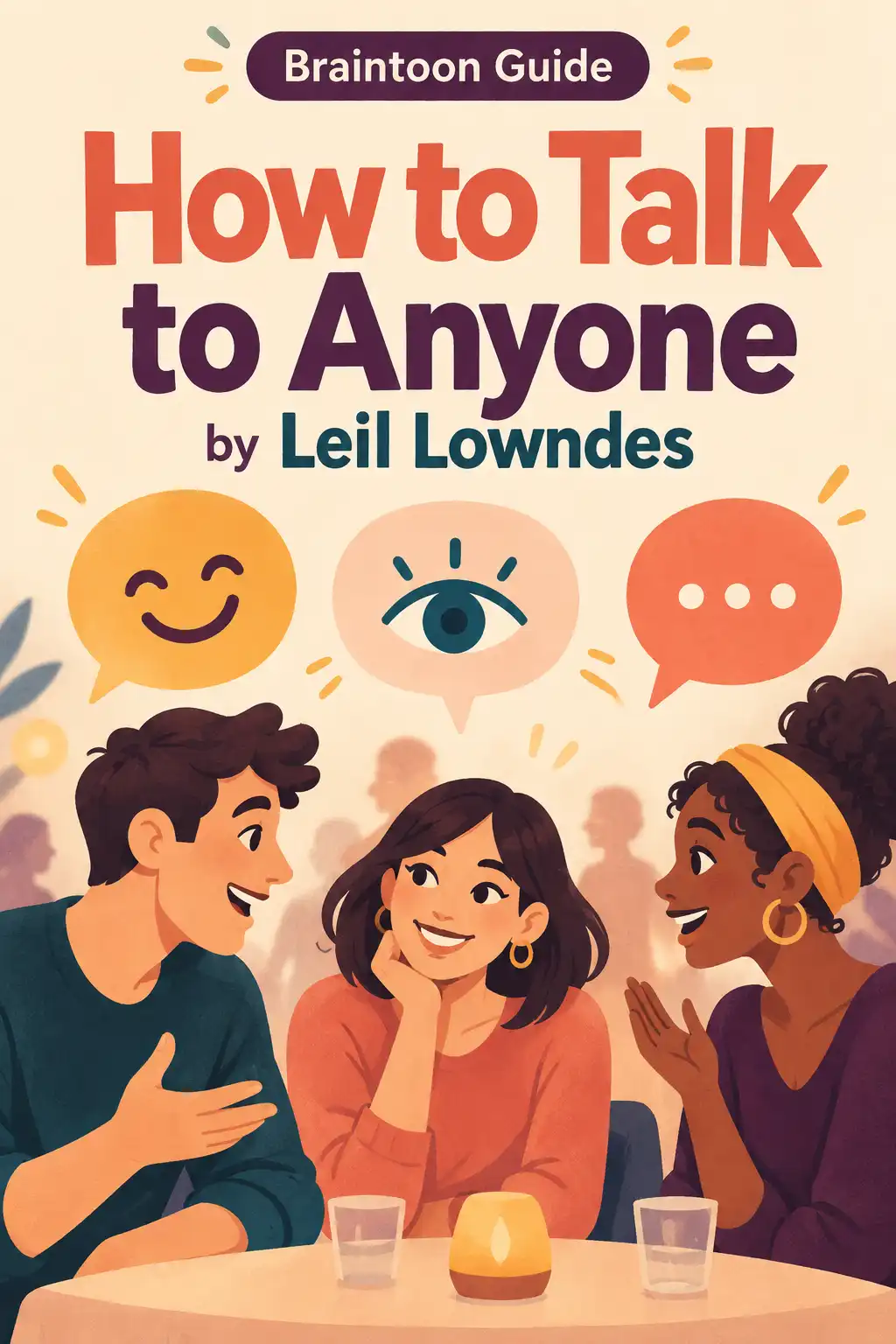
A detailed summary ofHow to Talk to Anyoneby Leil Lowndes
How to Talk to Anyone by Leil Lowndes argues that success comes less from brains or looks than from small, learnable communication habits that put other people at ease.
Watch the first minute

0:00 / 1:00
60-second animated preview
Key ideas, illustrated
From First Glance to Real Conversation
Seeming Alike, Sounding Like an Insider
Praise That Lands, Not Flatters
How to Talk to Anyone Summary
Have you ever watched someone walk into a room and just win it? They're not the smartest person there, not the best looking, but everyone wants to talk to them. What are they actually doing?
That's the question Leil Lowndes sets out to answer in How to Talk to Anyone. Her claim is that it isn't charisma you're born with. It's a set of small habits, and she breaks them into ninety-two specific techniques.
Ninety-two. That's a lot.
It is. But they cluster into a handful of big ideas, and those are what I want to walk through.
1. You've made an impression before you speak
So where does she start? What's the first cluster?
The moment before you say anything. Lowndes leans on the idea that a huge share of what people conclude about you is settled before a word comes out, from how you stand, how you look at them, when you smile. She tells a story about a caricature artist who could read someone's whole personality just from posture and expression.
That's a little unnerving.
It is, but she turns it into something useful. Take her technique called the Flooding Smile. Most of us, when someone walks up, flash a grin instantly. She says don't. Pause for a split second, actually take the person in, and then let the smile spread slowly.
Why would the delay matter?
Because an instant smile reads as automatic, the one you give everyone. A smile that arrives a beat late looks like it was caused by them specifically. It feels earned. Her argument is that the slow smile carries more credibility, and people register the difference without knowing why.
So it's not fake, it's just slower.
Right, and that's the pattern through the whole first section. She has one called Sticky Eyes, where you let your gaze linger a moment after the other person stops talking, as if your eyes are held by warm taffy. And a posture trick she calls Hang by Your Teeth, where you imagine biting a strap hanging from every doorframe you walk through, so your head lifts and your shoulders go back dozens of times a day.
Does she admit any of this can go wrong?
She does. There's a stronger version of the eye contact, Epoxy Eyes, where in a group you watch your target rather than the speaker. She warns it can come off as intrusive or arrogant if you're not careful. The point isn't intensity for its own sake. It's signalling that you're genuinely paying attention to the person.
And the mental tricks?
The one I find most practical is Hello Old Friend. Before you meet a stranger, you imagine they're a dear friend you haven't seen in years. Your face, your voice, your posture all warm up on their own. And she suggests that warmth tends to come back to you.


Watch it come to life
Watch How to Talk to Anyone instead
Explore this summary and the Braintoon library.
2. Small talk works when you match the mood
Okay, so the first impression is set. Then comes the part a lot of people dread. Small talk.
And she's sympathetic about it. She points out that executives who run boardrooms can feel completely lost at a cocktail party. Her first move is something she calls Make a Mood Match. Before you say a word, read the other person's energy, their pace, their volume, and briefly match it.
What does that look like in practice?
Her own example is a party where she just wanted slow, light conversation, and a group of very smart guests kept hitting her with rapid technical explanations. They were trying to be impressive. To her it felt almost aggressive, because the pace was so wrong.
So the content was fine, the energy was off.
Exactly, and that leads to her bigger claim about openers. People agonise over the perfect first line, and she says the words barely matter. She calls this Prosaic with Passion. An ordinary, even dull remark delivered warmly works better than something clever, because familiar comments signal that you're alike, and that lowers people's guard.
Is there anything that doesn't work?
Complaints and negativity. She's firm that a first impression built on a gripe sticks. Beyond that, almost anything goes.
What about when they ask where you're from, or what you do?
This is where she has two rules with great names. Never the Naked City and Never the Naked Job. If you say 'Cleveland' and stop, you've handed the other person nothing. Add one interesting fact about the place. Same with your job. Don't just say 'I'm an accountant.' Give a short, concrete example of what you actually did this week.
So you're feeding them material.
That's the whole idea. Small talk fails when one person has to carry it. Every answer should leave a handle the other person can grab.
3. Keep the spotlight on the other person
Once the conversation is going, how do you keep it from dying?
Her answer, over and over, is to keep the attention on them. She calls it the Swiveling Spotlight. You imagine a spotlight between you, and your job is to swing it toward the other person as much as possible. She says people walk away from those conversations calling them wonderful, even if they did almost all the talking.
That feels a bit one-sided.
It can, and she does say you take your turn. But her observation is that most of us swing the light back to ourselves far too fast. One technique for staying on them is Be a Word Detective. People drop hints about what they'd rather talk about. If someone mentions their plants while talking about the rain, the plants are the real topic.
And if your mind just goes blank?
Then you parrot. This is the one I'd actually try tonight. You repeat the last two or three words someone said, with a curious, rising tone. Someone says, 'and then the deal fell apart,' and you say, 'fell apart?' That's it.
That seems almost too simple.
It does, but think about what it does. It takes zero cleverness from you, it proves you were listening, and it invites them to go a level deeper. Lowndes says people often reveal what they really felt on that second pass, things they hadn't quite said the first time.
Does she have a limit on how much you share about yourself?
Yes, and remember this was written in the late nineties, before openness about flaws became fashionable. She says don't lead with embarrassing stories early on. It might be charming from someone established, but for most of us it just makes a new acquaintance wonder what else is there. Keep it positive at the start, and save the complicated chapters for when there's trust.
4. Sound like an insider in any crowd
What about when you're the outsider? Everyone's talking about their industry and you don't speak the language.
She knows that feeling, and she has a slightly odd prescription. Scramble Therapy. One weekend out of every four, do something completely outside your routine. Go bowling, try bird watching, take a resort scuba dive.
Just once?
Just once. Her claim is that a single exposure gives you most of the vocabulary and, more importantly, the insider questions. She did a one-day resort dive in Bermuda and says she could talk to divers for years afterward, because she knew what to ask.
So it's about the questions more than the knowledge.
That's really the heart of it. She has a term, Jobbledygook, for the jargon of someone else's work. You don't memorise the field. You learn the two or three questions insiders ask each other. Her contrast is asking an astronaut how they go to the bathroom in space, which marks you as a tourist, versus a question an astronaut would actually get from a colleague.
How do you find those questions before an event?
Call a friend who knows that world and ask what the burning issues are right now. She calls it Bare Their Hot Button. Every profession has pressures outsiders never hear about. Or pick up a trade magazine once. It's a small investment for sounding plugged in.
She says this saves money too?
She does, and it's a nice concrete payoff. Before a big purchase, visit a couple of competitors and pick up the trade words. Then when you talk to the actual vendor, you sound like someone who can't be overcharged. She describes a house painter who admits that when a customer uses the right terms, he thinks twice before padding the price.
So the vocabulary is a kind of armor.
Armor and invitation at once. It tells people you've made the effort to enter their world, and that's flattering.
5. People warm to those who seem alike
You said earlier that ordinary remarks work because they signal we're alike. Does she go deeper on that?
A whole section. Her foundation is that people are most comfortable with those who seem similar, and she cites a study where people were simply told a partner shared their beliefs and liked them far more, even though it wasn't true.
That's a strong bias to lean on. Is she worried about manipulation?
She frames it as using a natural tendency ethically, to build rapport rather than to deceive. The techniques themselves are pretty gentle. The one that stuck with me is Echoing. Use the exact word the other person uses for the things in their life, not your own substitute.
Give me an example.
She tells about a friend who referred to someone's ski chalet as a cabin. To the friend, same thing. To the owner, a quiet insult. Or someone calls their workplace a firm, an agency, a station, a house. Match it. It tells them you understand their world without having to say so.
That's a tiny detail to carry so much weight.
It is, and that's the pattern. Another is Potent Imaging. When you reach for an analogy, draw it from their world. If they sail, talk about catching the wind. If they garden, talk about things taking root. The image lands harder because it's theirs, not yours.
And she has something about saying we early?
The Premature We. Using we, us, and our a little sooner than feels natural. It skips a stage of getting acquainted and puts you on the same side. Related to that is Instant History. If something funny happened the first time you met, bring it back later as a little shorthand. Old friends have inside jokes. You can start one on day one.
She also wants us to replace the uh huh?
Right. Swap the half-conscious grunts for full sentences. 'I can see why that bothered you.' It costs a few more words and it makes someone feel genuinely heard.
6. Praise that lands instead of flatters
Compliments feel like the obvious tool. Why does she treat them so carefully?
Because, she argues, clumsy praise does real damage. It reads as flattery with an angle, and people get suspicious. Skilled praise, in her view, can start friendships and close deals. The difference is sincerity, timing, and wording.
So what counts as skilled?
Her favourite is Grapevine Glory. Instead of complimenting someone to their face, say something genuinely admiring about them to a person close to them. It almost always gets back.
Why is that better than just telling them?
Because overheard praise is believable. If I tell you your work is brilliant, part of you wonders what I want. If you hear from a colleague that I said it when you weren't there, there's no angle. She extends this with Carrier Pigeon Kudos. Whenever you hear something kind about someone, pass it on. You get warmth from the recipient just for carrying the message.
And when you do praise someone directly?
Make it specific, personal, and rare. She calls it the Killer Compliment. One real quality, said sincerely, ideally in private and at the end of the conversation. Don't repeat it often or it loses value. For daily life she suggests Little Strokes instead, a quick 'well done' that costs nothing and means more than people realise.
What about receiving compliments? I'm terrible at it.
Most people are. We deflect, and that quietly punishes the giver. Her move is Boomeranging. Reflect the good feeling back. 'That's kind of you to notice.' You keep the compliment and you reward them for offering it.
And the Tombstone Game?
That's for close relationships. Ask someone what they'd most want remembered about them. Then wait a few weeks and give that quality back as a compliment. Her claim is that praise matching someone's deepest self-image lands with unusual power.
Closing
Stepping back, what ties all of this together?
Almost every technique is about the other person. Where you point your eyes, which word you echo, where the spotlight sits. Lowndes ends the book with an idea she calls the great scorecard in the sky, an invisible tally between any two people of who has given more lately. The people who rise, she argues, keep that balance in mind and give deference where it's owed. Her last word is that character is destiny, and character is just these small moves repeated until they're who you are.
So for someone listening right now?
Pick one. The slow smile, the parrot, echoing someone's word for their own life. Try it in your next conversation and notice what comes back.
Watch it come to life
Watch the animated summary
Explore this summary and the Braintoon library.