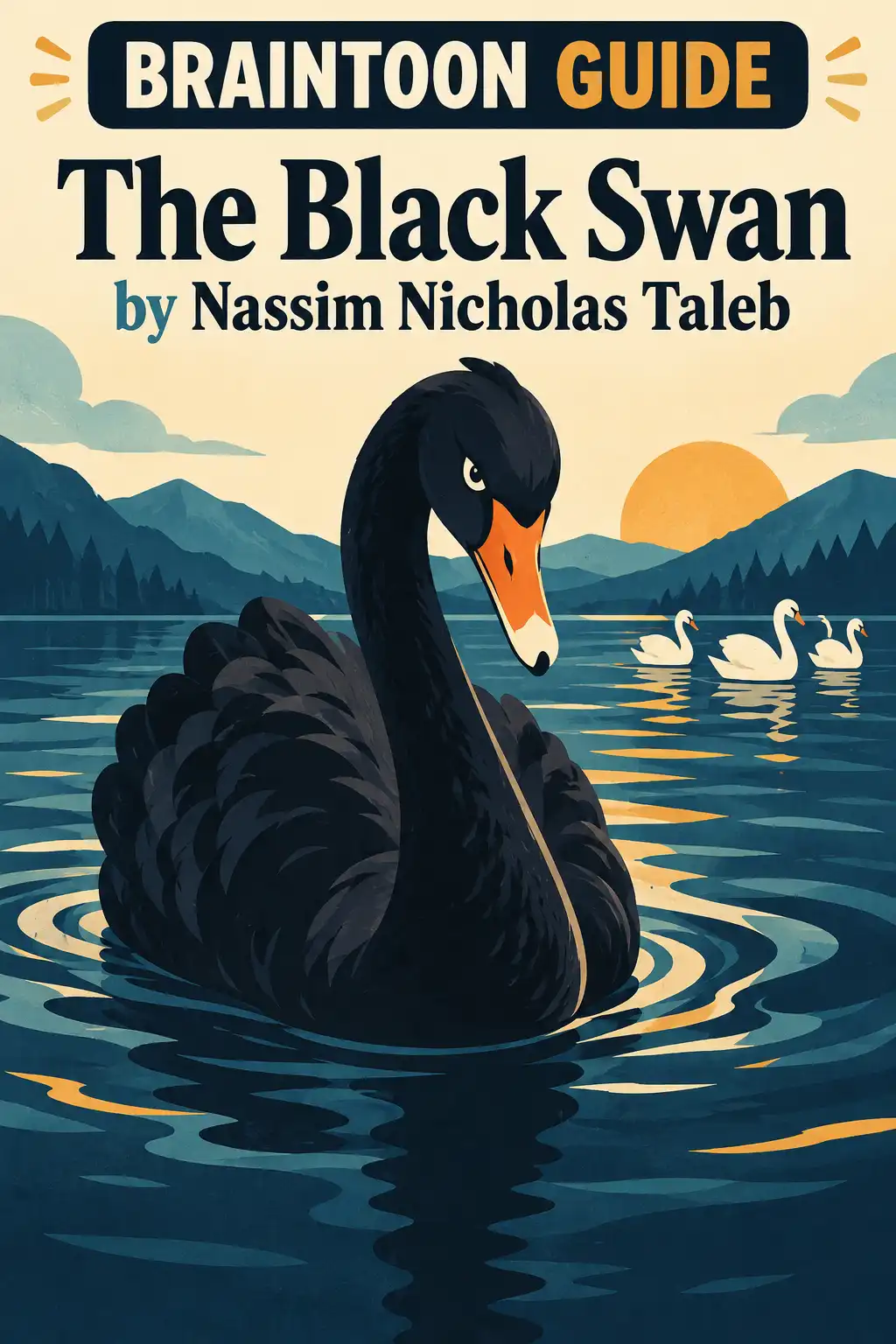
A detailed summary ofThe Black Swanby Nassim Nicholas Taleb

The Black Swan cover

Loading summary

Share this with a friend or colleague

Email

The Black Swan by Nassim Nicholas Taleb argues that rare, unpredictable, high-impact events shape history far more than we admit, and that our minds and our models are built to miss them. Taleb writes as a former trader who bet on such events.

Watch full summaryOpen in app

More books like The Black Swan

Browse all books

Explore related topics

The Black Swan Summary

Here's something I've noticed. Every time something huge happens, a crash, a war, a new technology, there's a line of people on TV explaining why it was obvious. But nobody said so the day before. Why is that?

That gap is exactly what Nassim Nicholas Taleb takes apart in The Black Swan. His claim is that the events that really shape the world are the ones nobody saw coming, and that we're wired to pretend otherwise.

1. What makes an event a Black Swan

So why swans? What's the bird got to do with it?

For centuries Europeans believed all swans were white. Every swan anyone had ever seen was white, millions of sightings. Then explorers reached Australia and found black ones. One sighting wiped out a belief built on a mountain of evidence.

So the point is you can never be sure.

Partly. But Taleb gives the term a tighter definition. A Black Swan has three qualities. It's an outlier, nothing in your past experience pointed to it. It has enormous impact. And afterwards, people construct explanations that make it look predictable all along.

That third one is the part I find a bit uncomfortable. It's basically accusing all of us of lying to ourselves.

He'd say it's not lying, it's how the mind works. Once you know how something turned out, you can't unknow it, so the past rearranges itself into a straight line pointing at the outcome. Taleb's first Black Swan was personal. He grew up in Lebanon, which had been seen as a stable, cosmopolitan place for a thousand years. Then a civil war broke out almost overnight and lasted nearly seventeen years. Afterwards everyone explained it as inevitable.

And the people living through it?

They packed light, expecting to be back in days. His grandfather was a government minister, and Taleb noticed he understood events no better than his driver did. The only difference was that the driver knew he didn't understand.

Okay, that line lands. The humble guy was closer to the truth.

That's the posture the whole book pushes you toward. What you don't know matters more than what you do.

2. Two kinds of randomness

But surely not everything is unpredictable. I can predict roughly how tall the next person I meet will be.

Right, and Taleb agrees. That's the central framework of the book. He splits the world into two imaginary countries, Mediocristan and Extremistan.

Those are the names?

Those are the names. In Mediocristan, no single observation can change the overall picture much. Take a thousand people and add the heaviest person on earth. The average weight barely moves. Height, weight, calorie intake, they all live there.

And Extremistan is where one case blows up the average.

Take those same thousand people and add Bill Gates. Now his wealth is more than everyone else's combined. Wealth, book sales, city sizes, war casualties, anything social or informational tends to live in Extremistan. And that's where Black Swans happen.

Why the split, though? What makes wealth different from weight?

Taleb ties it to what he calls scalability. A dentist can only see so many patients a day, so income is capped and predictable. A writer does the same work whether one person reads the book or a hundred million. When the same effort can reach everyone, you get a few winners taking nearly everything and most people getting almost nothing.

So the practical question for anything I'm looking at is just, which country am I in?

That's the first thing to ask. If you're in Mediocristan, averages and past experience are useful. If you're in Extremistan, the average is a kind of fiction, and the one rare event is the whole story. The mistake he keeps pointing to is using Mediocristan tools, like the bell curve, on Extremistan problems.

3. Why the past misleads us

Let's go back to the hindsight part. Even if events are rare, I'd think more data makes you safer, not less.

Taleb has a story for exactly that belief, borrowed from Bertrand Russell. Picture a turkey. Every day a farmer feeds it. Day after day the evidence piles up that humans are kind and life is good. Its confidence grows with every meal. And its confidence peaks the day before Thanksgiving.

Oh. So the data was building the danger.

The data was fine. The conclusion drawn from it was fatal. The turkey's past contained nothing about Thanksgiving, so no amount of past could have revealed it. Taleb says this is the situation of banks that look conservative for decades and then lose everything in one event. He was writing before 2008, and the pattern was already visible in earlier collapses.

Isn't that a little unfair, though? The turkey couldn't have known.

That's actually the point. A Black Swan depends on who you are. To the turkey it's a shock. To the butcher, it's a routine day. So the question isn't whether a surprise is possible. It's whether you're the turkey or the butcher in a given situation.

How do you tell?

He takes a rule from the philosopher Karl Popper. Confirmations can never prove you right. A thousand white swans don't prove all swans are white. One black swan disproves it. So instead of collecting reassurance, look for the thing that would prove you wrong.

That's harder than it sounds. I naturally go looking for evidence I'm right.

Everybody does. Taleb calls one version the round-trip fallacy, confusing no evidence of a danger with evidence of no danger. Those are very different sentences, and we swap them constantly.

4. The evidence you never see

Here's where I push back a bit. Surely success leaves clues. If I study people who made it, I learn something.

Taleb would ask you where the people who didn't make it are. He tells an old story from Cicero. A man named Diagoras is shown paintings of sailors who prayed during a storm and survived. Proof that prayer works. Diagoras asks, where are the paintings of the ones who prayed and drowned?

They can't paint anything. They're dead.

That's what he calls silent evidence. The failures don't write books, give interviews, or show up in your data. So when you study millionaires and find they were bold risk-takers, you miss that the bankrupt were bold risk-takers too. The trait was shared. Luck sorted them.

I don't love that. It makes effort feel pointless.

He's not saying effort doesn't matter. He's saying the visible sample lies about how much it matters. Take a thousand people investing at random. After ten years a handful will have a perfect record by pure chance, and they'll look like geniuses. The rest vanished quietly.

And then we build a story about the genius.

That's the second half of the trap, which he calls the narrative fallacy. The brain compresses events into stories with causes, because stories are easier to remember than a pile of facts. But the compression leaves out exactly the random, unexpected parts. He even cites research suggesting the brain's left hemisphere invents reasons for actions when none exist.

That connects to another book, Thinking Fast and Slow. Daniel Kahneman describes the fast, automatic part of the mind, which he calls System 1, as craving causal stories. It would rather invent a reason for a pattern than accept that things just happen randomly. His example is the basketball 'hot hand,' which research found is largely people imposing order on random streaks.

Which fits Taleb's point. The story-making isn't a choice we make. It's the default setting, and it quietly edits out the chance.

So what do I do with that? Stop reading biographies?

Read them as entertainment. When you want to learn, prefer experiments over stories, and treat any tidy 'because' with suspicion. Sometimes the honest answer is simply, it was chance.

5. Why forecasts fail so badly

Okay, but there are people whose job is forecasting. They must be better than me.

Taleb's evidence says often they're not. Start with a simple experiment. Ask people to give a range for some number they don't know, wide enough that they're ninety-eight percent sure the true answer falls inside. The error rate should be two percent. With groups like Harvard MBA students it came out around forty-five percent.

So people set their ranges far too narrow.

He calls that epistemic arrogance. We think we know more than we do. Then there's Philip Tetlock's study, nearly three hundred experts, tens of thousands of political and economic predictions. Credentials barely mattered. Famous experts did worse than obscure ones.

Worse? That's backwards.

Tetlock found the confident ones with one big theory, the hedgehogs, made great television and bad predictions. Foxes, who juggled many ideas and changed their minds, did better and got less airtime. And when experts missed, they had excuses ready. The event was an outlier, they were almost right, nobody could have known.

To be fair, some of those excuses might be true.

Sometimes. But Taleb's deeper point is that it's not just overconfidence, the world itself resists forecasting. The big technologies, the computer, the internet, the laser, were all unplanned. And to predict a discovery you'd have to already know what will be discovered, which means you'd have made it. Future knowledge is unavailable by definition.

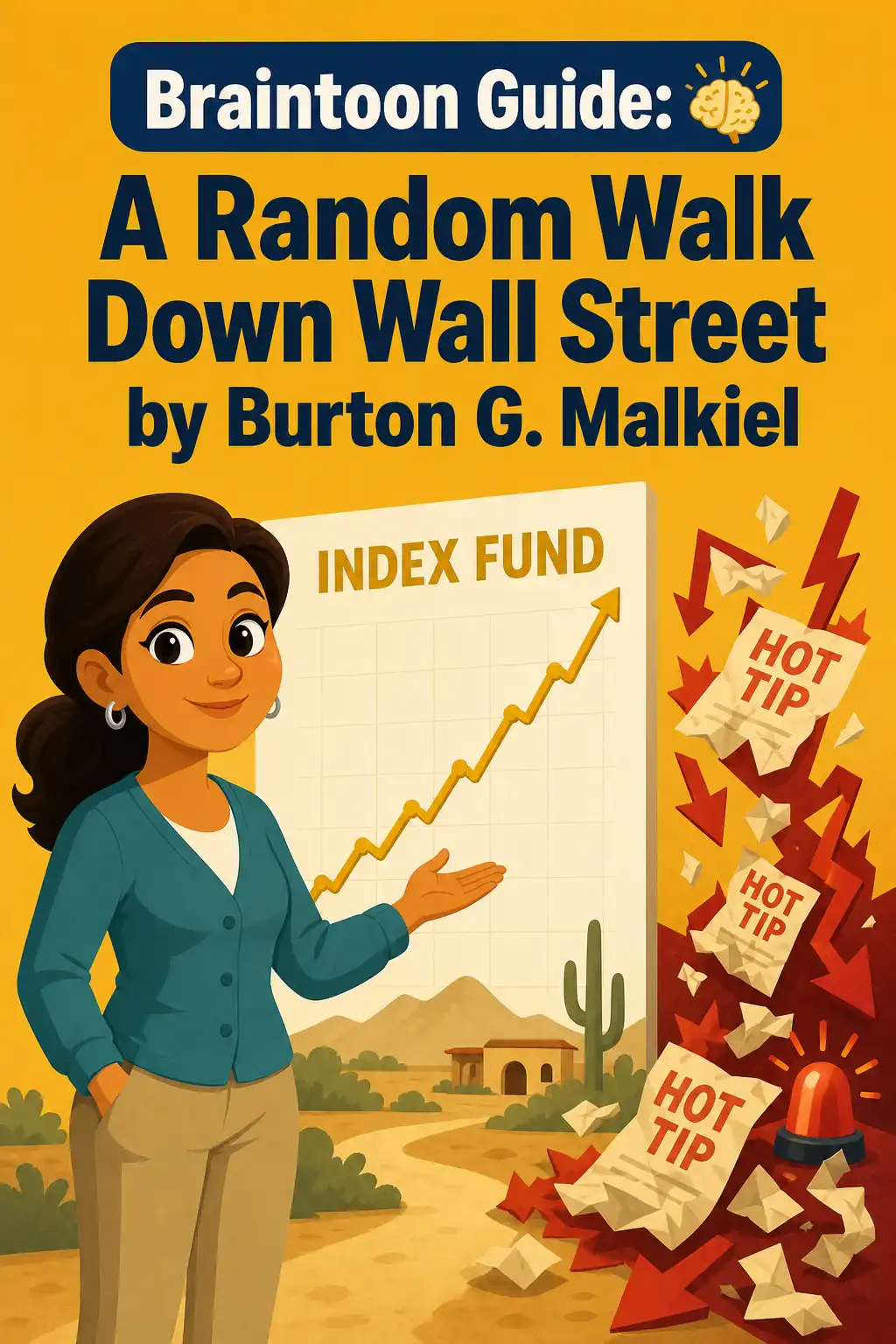
In his book A Random Walk Down Wall Street, Burton Malkiel reports a similar result for markets. He checked forecasts from nineteen major Wall Street firms, and they did no better than assuming last year's trend would continue. But his advice is different. Ordinary investors should stop guessing and hold low-cost index funds.

So the two authors share the distrust of forecasters but act on it differently. Malkiel says ride the market patiently. Taleb says arrange your exposure so the rare event works for you.

He does separate real expertise from fake, though?

Yes. Surgeons and chess masters have measurable skill, because the feedback is quick and clear. Economists and stock forecasters, people dealing with an uncertain future, show little advantage over a simple rule like 'tomorrow looks like today.' Those are exactly the fields where Black Swans live.

6. Position yourself for the surprise

So if nobody can predict these things, what am I supposed to actually do?

Taleb's answer is stop trying to predict and start managing exposure. The key idea is asymmetry. You can't know the probability of a rare event, but you can usually tell the size of the consequences, and whether a surprise in that area would help you or hurt you.

Give me something concrete.

His barbell strategy. Put most of what you have, the large majority, in things that are extremely safe. Put the small remainder in highly speculative bets where the upside is enormous and the loss is capped at what you put in. Nothing in the middle.

That's counterintuitive. I'd have assumed medium risk is the sensible place.

He thinks medium risk is the trap, because it feels safe while being exposed to exactly the kind of event that ruins you. With the barbell, the worst case is small and known. The best case is open-ended.

Taleb pushes this further in a later book, Antifragile. He separates being robust, which means taking a hit and staying the same, from gaining when things are disorderly. One tool he describes is optionality, having the right but not the obligation to act. His example is Thales, who cheaply reserved olive presses before a harvest. Being wrong cost little, and being right paid enormously.

So the barbell isn't only protection. It's a structure where you don't need to predict. You just need to recognize the good outcome when it shows up.

This can't only be about money.

It isn't. The same shape applies to a career or a life. Take jobs and projects where the downside is bounded and the upside is open. Go to parties, live in cities, collect open-ended opportunities, because positive Black Swans find people who are exposed to lots of chances. Then be very conservative wherever ruin is possible. His own rule is, be aggressive when losses are small, cautious when a loss could end the game.

And presumably accept a lot of small failures along the way.

That's the hard part. He describes a trader who bleeds small losses for years waiting for a rare big win. It's psychologically brutal, because the daily evidence keeps saying you're losing. You have to judge yourself over years, not days.

Closing

What strikes me is how much of this is about posture rather than prediction. Admit you don't know, then arrange things so being wrong doesn't destroy you.

That's the whole book in a sentence. So the question to take away is this. Look at the biggest things in your life, your savings, your job, your plans, and ask for each one, if a surprise arrived tomorrow, would it be the kind that helps me or the kind that ends me? And then ask what you'd change to tilt that balance.

Be the butcher, not the turkey.

Or at least know which one you are.