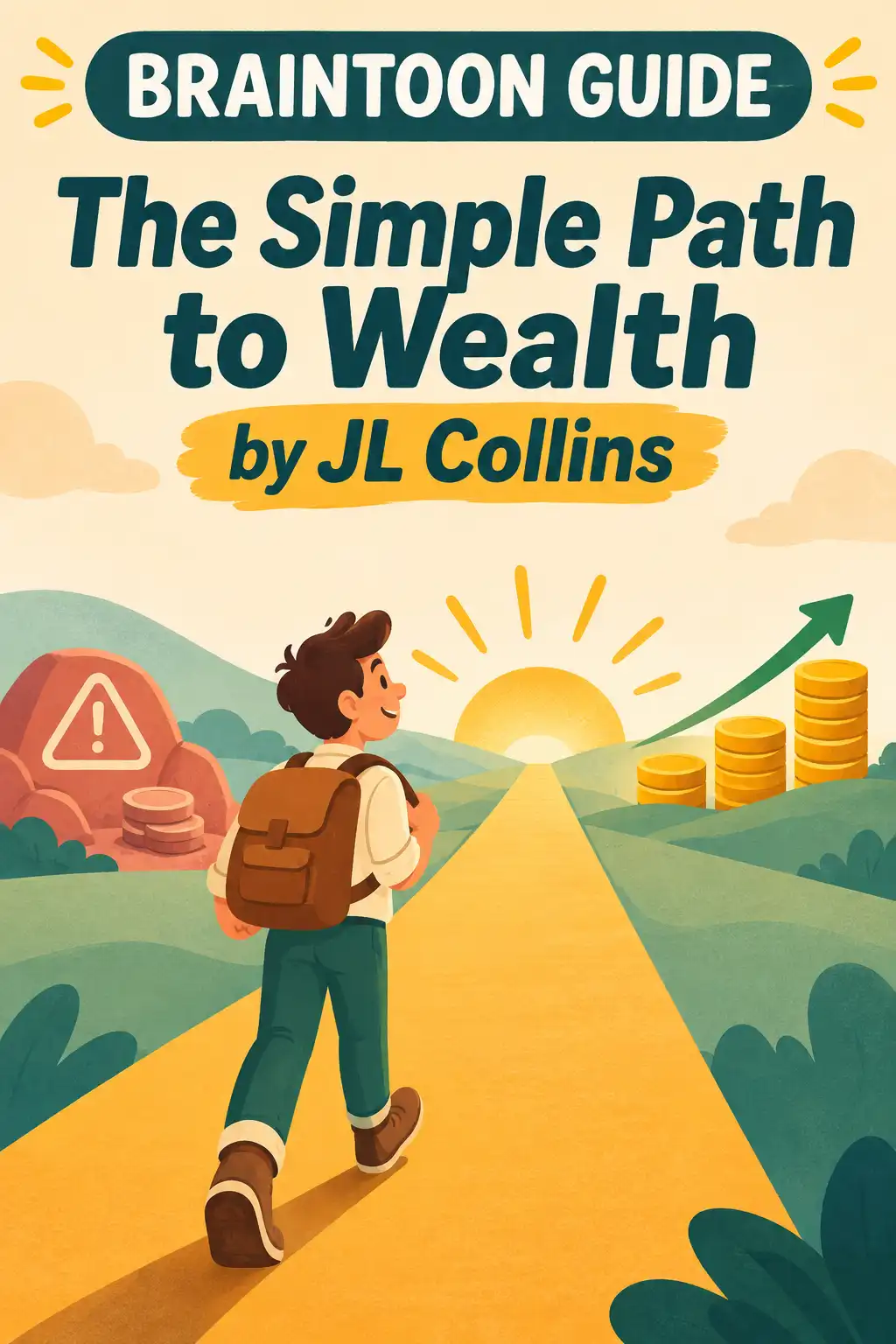
A detailed summary ofThe Simple Path to Wealthby JL Collins

Summary byBrainToonLast updated

The Simple Path to Wealth cover

Loading summary

Share this with a friend or colleague

Email

The Simple Path to Wealth by JL Collins distills decades of investing experience into a plan simple enough to run on autopilot. It argues that avoiding debt, saving aggressively and holding low-cost index funds is the surest road to financial freedom.

Watch full summary

More books like The Simple Path to Wealth

Browse all books

Explore related learning pathways

Browse all topics

The Simple Path to Wealth Summary

Learner

Most of us know we should be investing, but the whole thing feels like a maze. Fees, funds, advisors, market crashes. Is there a version that doesn't take over your life?

BrainToon

That's exactly the question JL Collins set out to answer in The Simple Path to Wealth. It started as letters to his daughter, who told him she cared about money but didn't want to spend her life thinking about it. His answer fits on an index card.

Learner

Okay, I want to see the index card.

Part 1Spend less, invest the gap, avoid debt

BrainToon

Spend less than you earn. Invest the difference. Avoid debt. That's the core. Everything else in the book is about how to do those three things without getting tricked along the way.

Learner

That sounds almost too simple. If it were that easy, wouldn't everyone be wealthy?

BrainToon

Collins would say the hard part isn't knowing the rules, it's living them. And the number that matters most isn't your income. It's the gap between what you earn and what you spend.

Learner

So a bigger paycheck doesn't automatically help.

BrainToon

Not if spending rises with it. He gives an example: someone earning twenty-five thousand a year who lives on half and invests the rest could reach financial independence in roughly eleven and a half years. That's not a high earner. That's a high saver.

Learner

Half your income, though. That's a lot to give up.

BrainToon

Not everyone accepts that trade. That connects to another book, The Millionaire Fastlane, where MJ DeMarco rejects the slow save-and-invest grind and argues for building a business instead. He still attacks flashy spending, though.

Learner

So both want people out of the decades-long grind. They just disagree on the route. Collins bets on the spending gap.

BrainToon

Collins would agree it's a lot, and he'd say it's a choice about what you actually want. There's a little parable in the book. A well-dressed minister pities a monk for living on rice and beans. The monk replies that if the minister could live on rice and beans, he wouldn't need to serve the king.

Learner

Oh, that's a bit of a gut punch. The expensive lifestyle is what keeps you chained to the job.

BrainToon

Right. Keeping your wants small is as powerful as growing your pile. And he warns that marketing works constantly to blur the line between wants and needs, so you have to question it on purpose.

The Simple Path to Wealth Summary: Collins's whole plan fits on an index card. Widen the gap, avoid debt, own the market cheaply, hold through crashes, and aim for the freedom to say no.

Part 2Why debt is the biggest obstacle

Learner

The third rule was avoid debt. But most people treat some debt as normal, even smart. Mortgages, student loans, that kind of thing.

BrainToon

Collins is blunt here. He calls debt the single greatest obstacle to building wealth. He tells a story about his own first credit card, spending freely and paying almost nothing back, until someone pointed out the eighteen percent interest quietly growing in the fine print.

Learner

But a mortgage isn't a credit card. Isn't that good debt?

BrainToon

He's skeptical of the whole idea. He says mortgages tempt people to buy far more house than they need, with taxes, insurance and maintenance piled on top. And he's hardest on student loans. When he went to college in the early seventies, a full year cost about twelve hundred dollars. Four decades later, his daughter's version of the same kind of state school cost forty thousand a year.

Learner

And he blames the loans themselves for that?

BrainToon

That's his claim. Easy borrowing let prices inflate. Whether that's the whole story is debatable, but his bigger point stands either way: student loans usually can't be erased in bankruptcy, so they can follow you for life.

Learner

Okay, say someone's already in debt. What then?

BrainToon

He gives a simple cutoff. Under three percent interest, you're probably better off investing. Three to five, either choice is reasonable. Above five, pay it off as fast as you can. List every debt, cut spending hard, and attack the highest rate first while paying minimums on the rest.

Learner

No fancy tricks.

BrainToon

None. Same gap between earning and spending, just pointed at the debt instead of the market.

Pay Off Debt or Invest?: Collins's rule of thumb is simple. The higher the interest rate, the more urgently the spending gap should go toward debt instead of the market.

Part 3Money buys freedom, not just things

Learner

Something that caught my ear earlier: he never said the goal was retirement.

BrainToon

No. The goal was options. He calls it F-You Money. Enough cushion that you can say no, walk away, or negotiate from strength. At twenty-five he had about five thousand dollars saved. His employer refused him unpaid leave, so he resigned. His boss came back with a compromise.

Learner

Five thousand dollars gave him that? That doesn't seem like much.

BrainToon

It wasn't the amount. It was that he could afford to mean it. Years later he was laid off after September eleventh and spent three years unemployed. His young daughter asked if they were poor, and because of the cushion he could honestly tell her they were fine.

Learner

So money is really about the freedom to choose.

BrainToon

That's his view. And he wants you to see each dollar differently. He asks what a hundred-dollar bill really is. Spend it, and it's gone. Invest it, and it earns. Reinvest the earnings, and they earn too.

Learner

This is the compounding idea.

BrainToon

Yes, and the flip side is opportunity cost. Even paying cash for a twenty-thousand-dollar car costs more than the sticker, because that money can no longer earn. At eight percent, that's sixteen hundred dollars lost in the first year alone, and the losses keep compounding.

Learner

Hmm. I'd normally think paying cash means I got off clean.

BrainToon

Most people do. He points to Mike Tyson, who earned around three hundred million dollars and still went bankrupt. If you only see money as something to buy things with, no amount is ever enough.

Part 4Crashes are normal and recovery follows

Learner

Investing the difference sounds fine until the market drops forty percent. That's where I'd panic.

BrainToon

Collins did panic, once. In 1987, Black Monday, the market fell over twenty-two percent in a single day. He held on for a few months, then lost his nerve and sold near the bottom. By the time he bought back in, prices were already above their old highs.

Learner

So the mistake wasn't the crash. It was reacting to it.

BrainToon

Exactly. Over his forty years in the market he lived through 1974, the inflation of the late seventies, 1987, the dot-com bust, 2008. Each one felt like the end. None of them was. The Dow was at 616 in 1974 and over seventeen thousand by the end of 2014.

Learner

That's a long stretch to stay patient through.

BrainToon

It is, and he doesn't pretend it's smooth. But he gives two reasons the market trends up. First, it's self-cleansing. A broad fund like Vanguard's total market index holds thousands of companies. Failing ones drop out and get replaced. A stock can only fall to zero, but it can rise without a ceiling.

Learner

So the losers are capped and the winners aren't.

BrainToon

Right. Second, you own real businesses full of people working hard to grow. He borrows Warren Buffett's way of thinking: you're not holding numbers on a screen, you're holding a slice of actual companies. When the price drops, your ownership hasn't changed.

Learner

What about timing it, though? Wait for the drop, then buy?

BrainToon

He says that requires being right twice, at the top and at the bottom, over and over. Nobody does it reliably. The real question isn't when to invest. It's whether you can watch your wealth get cut in half and keep buying anyway.

Part 5Index funds beat the experts

Learner

Okay, so own everything and hold. But surely a good professional could do better than just buying the whole market?

BrainToon

That's the intuition Collins spent years fighting in himself. He admits that rejecting index funds for too long was one of the biggest obstacles to his own wealth. The data turned him. A Vanguard study followed 1,540 actively managed funds over fifteen years. Only eighteen percent survived and beat the index.

Learner

Eighteen percent. So most of them either lost or just disappeared.

BrainToon

And a thirty-year academic study found only about 0.6 percent showed genuine skill. Meanwhile every one of them charged fees whether they won or lost. Fund companies also quietly close the duds and launch new ones, which makes the track records look better than they are.

BrainToon

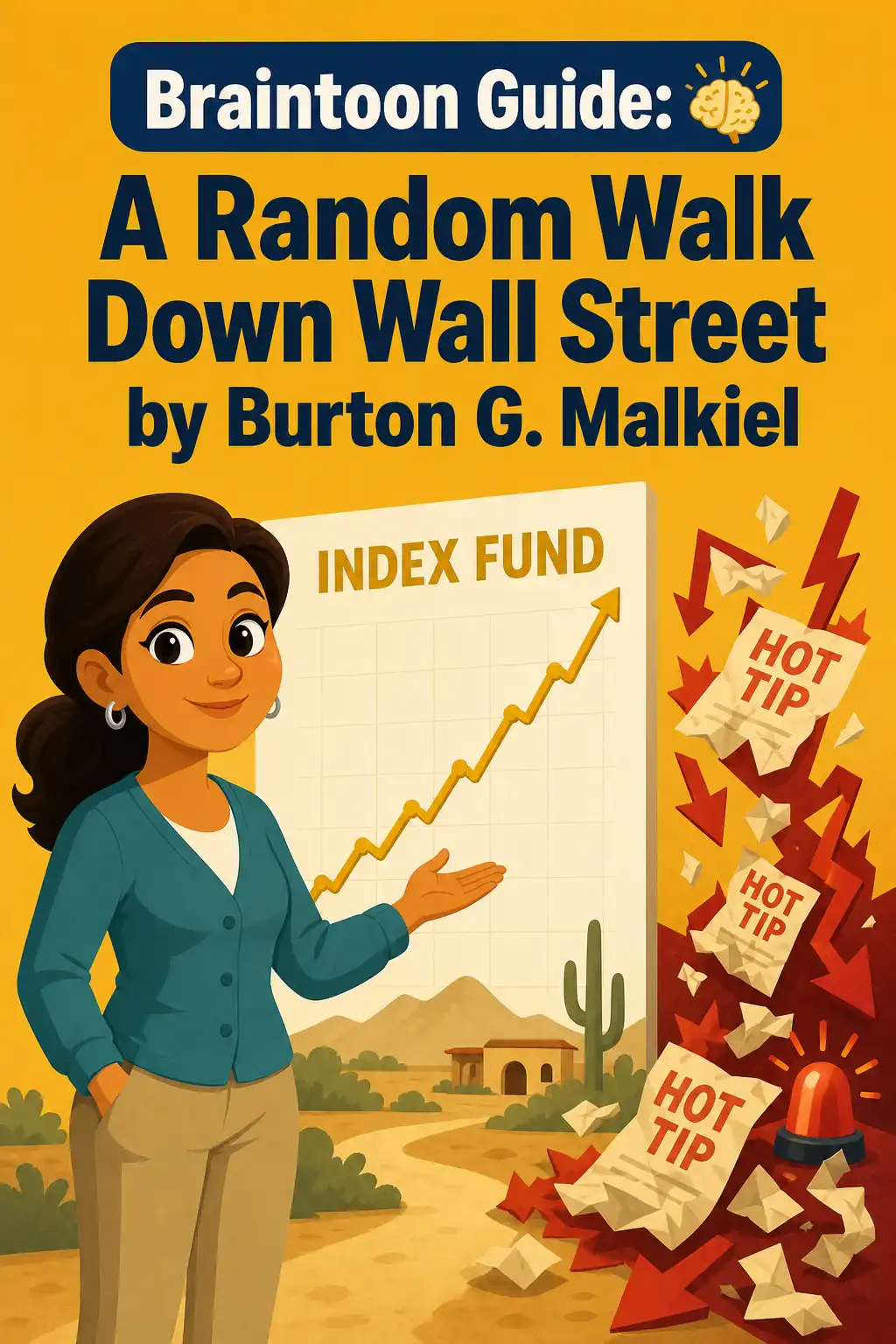
In the book A Random Walk Down Wall Street, Burton Malkiel explains this with coins. Flip enough of them and a few people will get ten heads in a row by luck. Then we crown them geniuses.

Learner

So a winning record can just be luck, but the fees get charged every year either way.

Learner

I think a lot of people hear index fund and think average. Who wants average?

BrainToon

He takes that head-on. Over long periods, average puts you in the top tier, because almost everyone else is paying fees and making mistakes. He says a whole industry profits from convincing you that you can beat the market, so the message never stops.

Learner

And advisors?

BrainToon

Same problem. An advisor charging one or two percent a year sounds small, but it compounds against you for decades. His line is that nobody will care for your money as well as you will.

Learner

So what does the simple path actually hold?

BrainToon

Three tools. A total stock market index fund for growth. A total bond index fund to smooth the ride. And some cash. While you're earning, he suggests all stocks. In his own semi-retirement he held roughly seventy-five percent stocks, twenty percent bonds, five percent cash.

Learner

That's it?

BrainToon

That's it. A couple of hours of rebalancing a year.

Why Index Funds Win: Most professionals don't beat the market once fees are counted. Collins's answer is three low-cost tools and a couple of hours of rebalancing a year.

Part 6The four percent rule and flexibility

Learner

How do you know when you've got enough to stop?

BrainToon

Collins uses the four percent rule. When your investments are about twenty-five times your annual spending, withdrawing four percent a year covers your costs. It comes from a 1998 study at Trinity University that tested withdrawal rates across dozens of thirty-year periods.

Learner

And four percent held up?

BrainToon

For a fifty-fifty stock and bond mix, adjusted for inflation, it survived ninety-six percent of the time. It failed only for people who started in 1965 and 1966. But Collins says the media missed the bigger story. Most of the time the portfolio didn't just survive. It grew enormously. Retirees were leaving huge sums behind.

Learner

So the rule is actually cautious.

BrainToon

Usually. Two warnings, though. The numbers assume stocks. Bond-heavy portfolios did far worse. And they assume low costs. A researcher he quotes says that ninety-six percent drops to eighty-four with one percent fees, and sixty-five with two.

Learner

That ties right back to the fee argument.

BrainToon

It does. The other warning is about autopilot. He says don't set a four percent withdrawal and forget it. If markets fall hard, spend less. If they surge, maybe spend a little more. He checks his own portfolio once a year, or whenever the market moves twenty percent either way.

BrainToon

That flexibility fits a theme from another book, The Black Swan. Nassim Nicholas Taleb argues that rare, high-impact events shape outcomes more than models built on past data admit.

Learner

And the four percent rule rests on historical periods. So being willing to cut spending protects you if the future throws something the past didn't.

Learner

Does he actually follow four percent himself?

BrainToon

At the time of writing he was a bit above five, because of college tuition and travel. He was comfortable with that because he could cut back if needed. The real security, he says, isn't the rule. It's the flexibility.

The 4% Rule, Used Flexibly: Twenty-five times your spending is the target. Collins says the rule's real strength comes from low costs and a willingness to adjust.

Closing

Learner

So if I boil it all down: live on less than you make, put the rest in a broad index fund, don't borrow, and don't flinch when it drops.

BrainToon

That's the whole path. And he's honest that it carries risk. Stocks are volatile, and four percent occasionally falls short. But he'd point out that cash isn't safe either. Inflation quietly eats it. In his view, fear is the real obstacle, not the market.

Learner

So the question for anyone listening isn't really which fund to pick.

BrainToon

No. It's this: what would you do differently tomorrow if you knew you could afford to say no? Collins thinks that answer is worth more than any return.