A detailed summary ofStop Overthinkingby Nick Trenton
Stop Overthinking by Nick Trenton is a practical guide to breaking anxious thought spirals, managing everyday stress, and pulling your attention back to the present moment, where life actually happens.
Watch the first minute








At one in the morning
0:00 / 1:00
60-second animated preview
Key ideas, illustrated
The Four A's of Stress Relief
The In-the-Moment Calm Toolkit
Put Your Thoughts on Trial
Stop Overthinking Summary
At one in the morning, Lauren, a paralegal in Minneapolis, is lying wide awake. She's replaying a two-line email from her boss, and with every reread she becomes more certain it means she's in trouble.
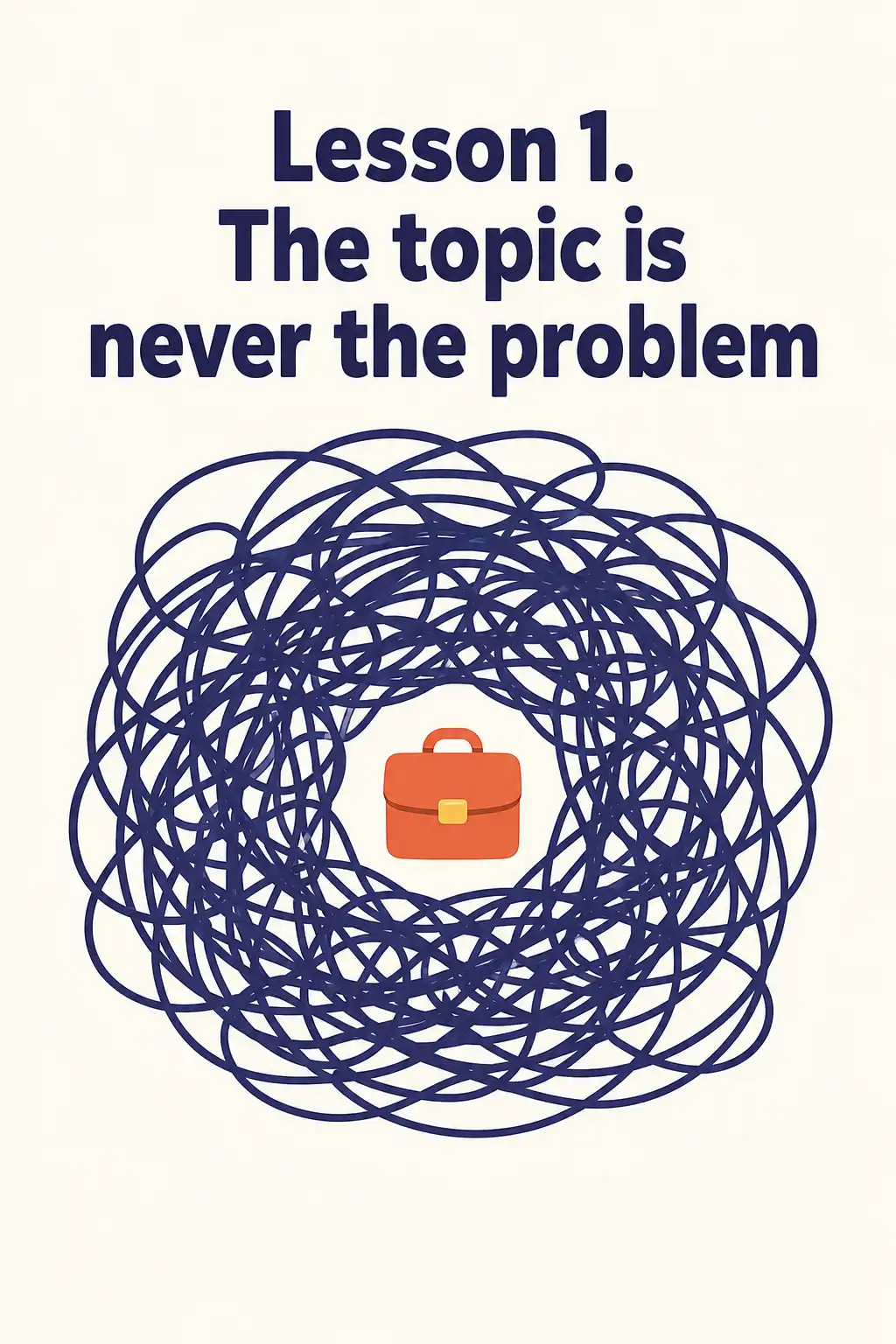
1. The topic is never the problem
The next morning, Lauren learns the truth. Her boss just wanted a file. Relief washes over her for about an hour. And then, quietly, her mind finds a brand-new worry to chew on.
That loop is exactly what author Nick Trenton, who writes about psychology and stress, describes. He opens with the story of James, a man who spots a suspicious mole and spirals for an hour, solving absolutely nothing.
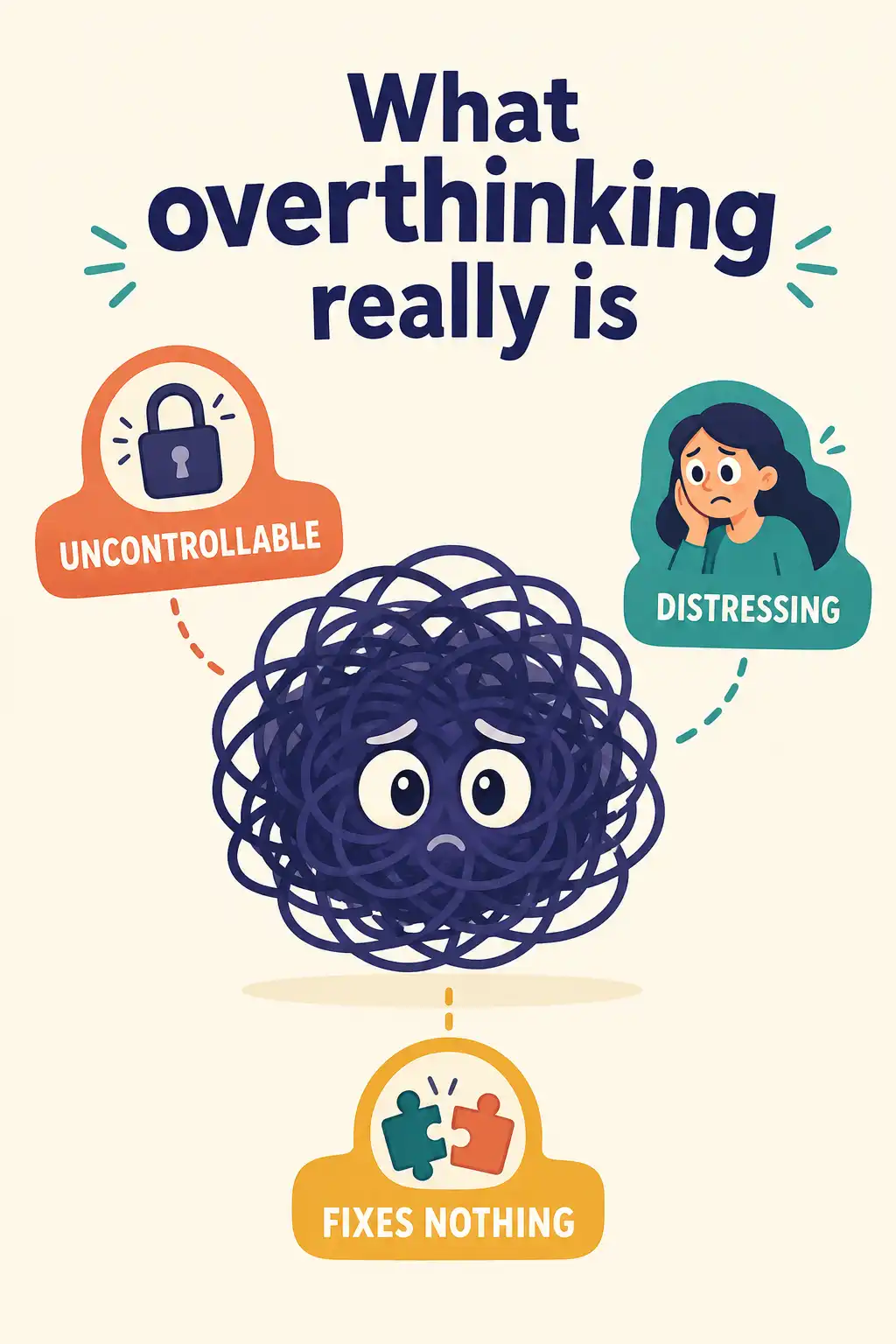
Trenton's point is that overthinking isn't just thinking a lot. It's mental activity that feels uncontrollable, causes real distress, and never actually fixes the problem it claims to be working on.
Here's the key insight. The topic of your worry is never the real problem. Thoughts are symptoms, and anxiety is the root. Resolve one worry, and another simply takes its place.
So where does that anxiety come from? Research suggests genetics explain only about a quarter of it. The rest comes from environment, experience, and behavior, which means it's largely within your influence.
Trenton calls mental models the secret ingredient. Two people can face the exact same event and feel completely different, purely because of how each one interprets what it means.
Watch it come to life
Watch Stop Overthinking instead
Explore this summary and the Braintoon library.
2. Awareness and the four A's
A friend tells Lauren to just relax, so she books a massage. Five minutes in, her mind is racing through every open case. Sound familiar? Trenton describes a character named Angie, a chronic worrier with the exact same problem.
The lesson is that avoiding your thoughts doesn't work. What overthinkers actually need is awareness, which is calm, neutral noticing. It's not the anxious, judgmental self-examination they usually run from.
For handling stress itself, Trenton shares the four A's, a framework from the Mayo Clinic. The first is avoid. Many stressors are voluntary, and simply saying no removes them entirely.
If you can't avoid it, alter it. Speak up, negotiate, communicate directly, and reshape the situation into something more manageable instead of silently absorbing it.
If you can't change it, accept it. That doesn't mean pretending you're fine. It means validating your feelings and releasing the energy you've been spending on blame and resentment.
And if the stressor is ongoing, adapt. Adjust your expectations, practice gratitude, and build a sturdier personal philosophy so the same pressure lands on you more lightly.
3. Put your worries on paper
Some worries survive the four A's, though. For those, Trenton points to writing. Decades of research on expressive writing show that journaling about difficult feelings can improve wellbeing and reduce anxiety symptoms.
He compares the overthinking mind to an excitable greyhound. Chaining it down only works temporarily. Journaling lets it run until it tires itself out and finally becomes teachable.
So Lauren starts a stress diary. Whenever her mood shifts, she logs the time, a stress rating from one to ten, any physical symptoms, and what might have caused it.
After two weeks, a pattern jumps out. Her worst spikes come after afternoons of back-to-back deadlines, and every single time she checks work email in bed at night.
That specificity matters. Knowing that late-night email checks wreck her sleep is far more useful than a vague sense that work is stressful, because it points to a real, actionable fix.
One caution from Trenton, though. Perfectionists shouldn't let the journal itself become another source of anxiety. Messy, honest entries beat beautiful ones. Lauren keeps hers short and moves on.
4. Ground yourself in the present
Then comes a real test. An hour before a court filing deadline, Lauren feels panic rising, the kind no journal can catch in time. She needs something immediate.
Trenton's tool is the 5-4-3-2-1 technique. Name five things you can see, four you can touch, three you can hear, two you can smell, and one you can taste.
Why does it work? Your brain can only do one thing at a time, and your senses only exist in the present. Anchoring to them interrupts the worry loop mid-spiral.
Trenton also borrows from narrative therapy. Instead of saying I am an overthinker, say I'm experiencing overthinking right now. That small shift separates who you are from what you're struggling with.
He even suggests naming your inner critic. Lauren calls hers The Prosecutor, and somehow, hearing its accusations as a character's voice makes them much easier to dismiss.
The filing goes out on time. Afterward, Lauren deconstructs the chaos into one story with clear steps, focusing on the single most important concern instead of everything at once.
5. Manage your time, not just your mind
But Lauren notices something important. Much of her stress isn't in her head at all. It's in her calendar. Trenton describes a woman named Susie, who tried to meditate away an impossible schedule. It just doesn't work.
When stress comes from poor time management, relaxation can't fix it. Research suggests that time management's biggest benefit isn't productivity at all. It's wellbeing and life satisfaction.
Trenton's first rule surprises Lauren. Rest and relationships aren't rewards you earn after the work is done. They deserve dedicated, protected space in the schedule itself.
He describes six time management personalities, and Lauren recognizes herself immediately. She's the time martyr, saying yes to every single request until she's frazzled and resentful.
The fix is the Eisenhower method. Label every task as important and urgent, important but not urgent, urgent but unimportant, or neither. Then do, schedule, delegate, or drop accordingly.
Lauren sorts her week. Discovery documents get done now, training prep gets scheduled, routine copying gets delegated, and two pointless recurring meetings get dropped entirely.
6. Practice relaxation like a skill
Even a well-planned life gets ambushed. When a major case is suddenly reassigned to Lauren's desk, Trenton's next lesson kicks in. Relaxation is a skill you practice, not a mood you wait for.
First, autogenic training, developed by Johannes Schultz in the 1920s. You repeat calming phrases like my right arm is heavy, guiding your nervous system toward calm from the inside out.
Second, visualization. Just imagining biting into a lemon makes your mouth water, proving the mind can move the body. Lauren builds a vivid lakeside scene, complete with sounds, smells, and warmth.
Third, progressive muscle relaxation. Tense each muscle group as hard as you can, then release completely. Counterintuitively, muscles relax more deeply after being tensed first.
All three techniques share one principle. They pull conscious attention out of anxious thought and back into the body, in the present moment, where anxiety can't survive long.
Trenton adds one more trick: worry postponement. Ask two questions. Is this a genuine problem, and can I act on it right now? If yes, act. If not, schedule the worry for later.
7. Put your thoughts on trial
One Tuesday, Lauren's boss walks past without saying hello. Instantly the old story starts. She hates my work, I'm getting fired. But this time, Lauren catches it happening.
This is where Trenton brings in cognitive behavioral therapy. Its core idea is that events don't cause our suffering. Our interpretations of events do, and interpretations can be changed.
First, learn to spot cognitive distortions. Lauren finds hers everywhere. Mind reading, assuming she knows what her boss thinks. Catastrophizing, leaping straight to being fired. And all-or-nothing thinking, always and never.
She starts a dysfunctional thought record, logging the situation, the automatic thought, the emotion it produced, and then deliberately generating alternative explanations for what happened.
Then comes restructuring, which Trenton describes as acting like a scientist toward your own mind. What's the actual evidence? In his example, a character named Mike's panic drops from eighty percent to thirty using this method.
Lauren runs a behavioral experiment. She simply asks her boss for feedback. The verdict? Her work is strong, and her boss was distracted that day by a sick kid at home.
8. Become someone who declines the spiral
Months later, Lauren's promotion review is approaching, exactly the kind of event that once fueled weeks of spiraling. Trenton's final lesson isn't a technique. It's five attitudes that make calm permanent.
Focus on what you can control, an idea borrowed from Stoic philosophers like Epictetus. His dichotomy of control teaches that peace of mind comes from investing energy only in what's actually up to you.
Focus on what you can do, because action clarifies while abstract worry paralyzes. Focus on what you have, since gratitude primes your brain to spot solutions.
Stay present, because anxiety only lives in old regrets and imagined catastrophes. And focus on needs over wants, since wants are endless but needs are simple and honest.
When old anger or fear flares up, Lauren uses opposite action. She fully acknowledges the feeling, then deliberately acts calm for just ten minutes. Usually, the emotion loosens its grip.
And when rumination knocks, she remembers Trenton's image of a boring friend retelling the same old story. She politely declines, saying come back when you have something new.
Watch it come to life
Watch the animated summary
Explore this summary and the Braintoon library.