A detailed summary ofUnreasonable Hospitalityby Will Guidara
Unreasonable Hospitality by Will Guidara argues that genuine, personal care for the people you serve, pursued as seriously as technical excellence, is the most powerful edge any business can have.
Watch the first minute

0:00 / 1:00
60-second animated preview
Key ideas, illustrated
Service vs. Hospitality
The Rule of 95/5
The Hot Dog Test
Unreasonable Hospitality Summary
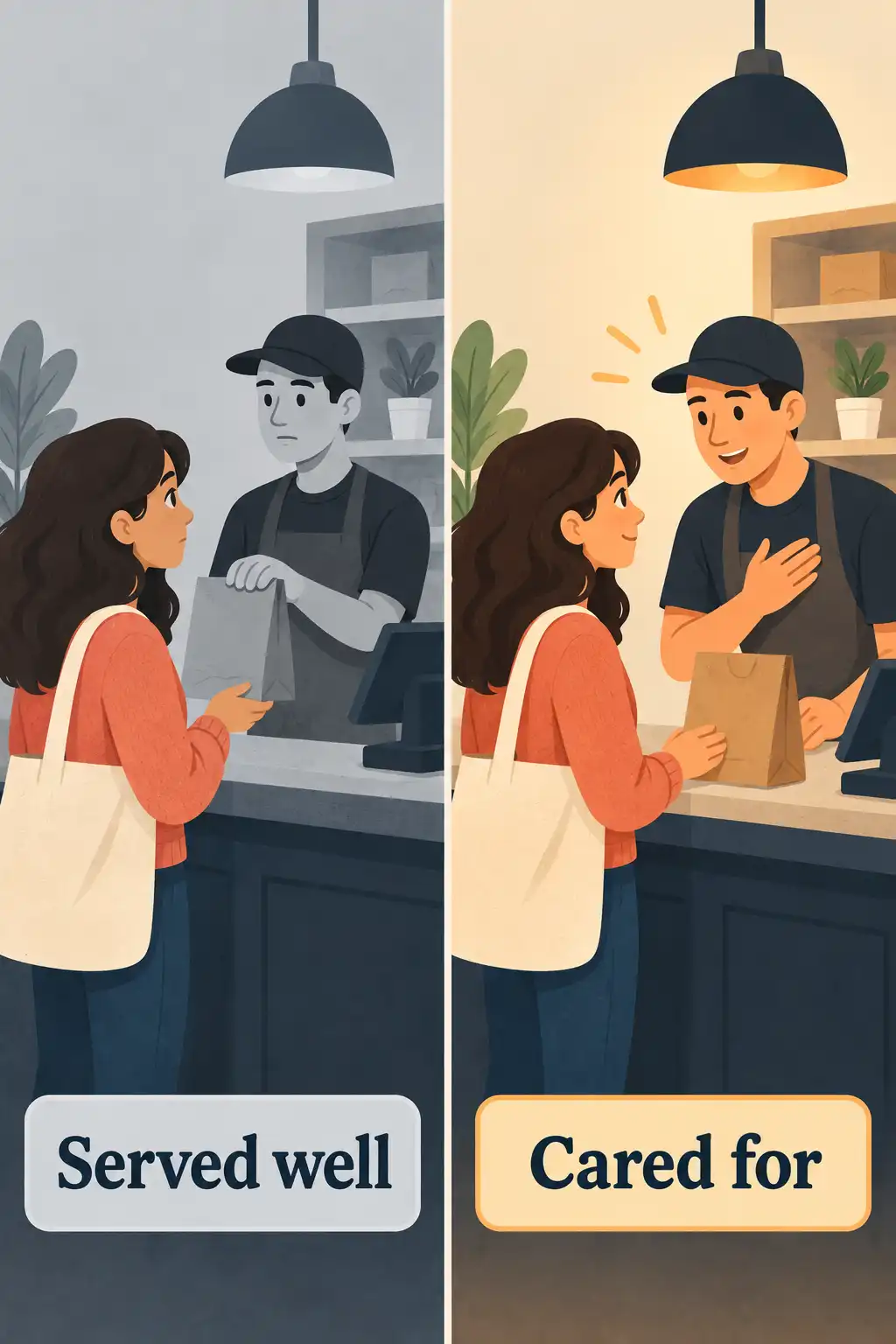
Here's a question: when was the last time a business made you feel genuinely cared for? Not served well. Cared for. That's the heart of Unreasonable Hospitality by Will Guidara, who ran the New York restaurant Eleven Madison Park.
And his claim is that the gap between those two things is where the real opportunity lies. It looks like a book about restaurants, but he thinks it applies to any business that deals with people.
1. Service and hospitality are not the same
Okay, so what's the difference? Because when I think of a good restaurant, I think the food came fast and nobody messed up my order.
That's service. Guidara would say service is the technical part. Competence, efficiency, getting it right. Hospitality is how the whole thing makes you feel. It's the warmth, the sense that someone actually noticed you were there.
So you can have one without the other.
Completely. You can have flawless service and still feel like you were processed. And the book opens with the moment he realized that was exactly where his restaurant was stuck. In 2010 he and his chef partner Daniel Humm went to the World's 50 Best Restaurants awards in London feeling pretty good about themselves. They'd just gotten four stars from The New York Times. And they came in at number fifty. Last place on the list.
Oof. In front of everybody?
Their faces were up on a giant screen. So that night they sat outside the hotel with a bottle of bourbon and had an honest conversation. What they landed on was that they'd been executing really well, but they hadn't done anything genuinely new. Everyone at the top was competing on food. Culinary innovation. And Guidara's thought was, what if we compete on the other thing? On the human need to feel cared for? He wrote their goal on a cocktail napkin, to be the best restaurant in the world, and added two words: unreasonable hospitality.
Why 'unreasonable,' though? That sounds almost like a warning.
I think it's deliberate. His argument is that reasonable hospitality, polite and correct and pleasant, is fine, but it will never make you remarkable. He wanted to put the same obsessive attention into how people were welcomed that a chef puts into cooking a piece of fish for exactly eighteen minutes. And he points out that most of the modern economy is service work now. So if he's right, this isn't a niche restaurant idea.
Watch it come to life
Watch Unreasonable Hospitality instead
Explore this summary and the Braintoon library.
2. Tight control makes generosity possible
Here's my skeptical question. 'Unreasonable' sounds expensive. How does a business afford that?
He has a specific answer, and it comes from an unglamorous part of his career. Early on he left the dining room to take a job as an assistant purchaser and controller. Mornings counting oysters in the walk-in fridge, afternoons upstairs running financial reports.
That doesn't sound like the fun part.
No, but he says it taught him how a decision at the table shows up in the numbers. And out of that he built what he calls the Rule of 95/5. You manage ninety-five percent of your budget with real discipline. Every penny. And then you spend the last five percent in ways that feel almost foolish, because that's where the impact is.
Give me the five percent.
His examples are things like buying expensive Italian gelato spoons when cheap ones would do. Or there was a family at the restaurant who had never seen snow, and it was snowing outside, so the team bought sleds and took them to Central Park. That's not on anyone's budget line. But it's a memory they'll tell for the rest of their lives.
So the discipline isn't the opposite of generosity. It's what pays for it.
That's exactly his framing. He describes two kinds of companies. Ones that are great in the dining room and sloppy with money, and ones that are great at systems and treat the front line like a cost to be minimized. He tells a story about a corporate office overruling him remotely for moving a flower arrangement so bartenders could see their guests. His point is that neither side alone works. You need the controls so you have the freedom.
I'd just add that five percent of a small budget is a very small number.
Fair. He'd say the gestures don't have to be expensive, which we'll get to. But yes, the principle is proportional. It's about where you aim the slack, not how much slack you have.
3. Keep only rules that serve the guest
So once he's running Eleven Madison Park, where does he start?
There's a small moment he treats as a turning point. A service director pulls him aside and scolds him for leaning on a table while he's chatting with a guest. And Guidara asks why that's a rule. The director can't say. It's just always been the rule.
And he hadn't come up through fine dining, right?
Right, he came from casual restaurants, and he says that turned out to be an advantage. He didn't have the habits, so he could ask of every rule: does this actually help the guest, or does it just preserve tradition? Leaning on the table stayed. They changed how a soufflé was presented so the server could keep eye contact. Cooks were encouraged to kneel at the table when describing a dish. Even the goodbye gift changed. Out went a fancy pastry nobody could eat on the way home, in came a jar of granola that felt like something a friend would hand you.
What about the people? You can't make rules that create warmth.
And this is where I think his most useful idea sits. He stopped hiring for fine-dining résumés and started hiring for generosity. His test is, would this person chase a stranger down the street to return a dropped scarf? You can teach someone how to open a bottle of wine. You can't really teach them to care.
How do you spot that in an interview, though?
He admits it's hard, and he says you have to hire slowly, because one bad hire drags down the morale of your best people. He also found that hiring one new person at a time left them exposed to the negativity of the holdouts. So he'd wait until he had three openings and bring in three enthusiastic people together. He calls it a bonfire. Enough energy that it can't be put out.
4. Give people ownership of something
Did that same energy work on the staff who were already there?
That became the whole engine, actually. The story I like is about Per Se, which was the restaurant he considered his rival. He ate there, and nearly everything was extraordinary. A server recited twenty-four chocolate truffles from memory. But the coffee was just ordinary coffee.
And that bothered him.
It did, because he realized fine dining had basically ignored everything you drink that isn't wine. Coffee, tea, cocktails, beer. All of those had been transformed out in the world, and inside these restaurants nothing had changed. Meanwhile his team was full of young people who were obsessed with exactly those things. So he gave a staff member named Jim, who loved coffee, full ownership of the coffee program.
Not a manager. A regular staff member.
Right. And Jim switched suppliers, started brewing tableside with theatrical equipment, and turned a forgettable cup into a moment. The same thing happened with beer, with tea, with cocktails. The cocktail guy had been the team's loudest critic, and once he had something that was his, he became an internationally respected bartender.
I can imagine some managers feeling threatened by that.
He addresses that directly. His line is that great leaders create other leaders. And he points out it was a triple win. The staff felt trusted, the programs got dramatically better, and the guests benefited. The wine director could actually go deeper on wine because he wasn't babysitting the coffee.
Did they have to be experts?
No, just curious and passionate. He admits it took patience, because younger people made mistakes. But he believes promoting someone slightly before they feel ready almost always brings out their best. And he extended it. Hourly staff ran the Saturday pre-meal meeting, and people taught each other at a weekly session. The culture became something everyone built, not something he announced.
5. A gift that shows someone was heard
Okay, the hot dog. I know there's a hot dog story.
There is. He's clearing a table and overhears some European tourists saying they'd eaten everywhere in New York but never had a street hot dog. So he walks out, buys one from the cart on the corner for two dollars, and talks the chef into plating it beautifully, with little dabs of mustard and relish. And when it lands, the guests are stunned. Each of them said it was the highlight of their whole trip.
Over a two-dollar hot dog, in a four-star restaurant.
And that's what he wanted the team to sit with. It wasn't expensive. It wasn't elaborate. What made it land was that it was completely personal, it couldn't be repeated, and it told those people they had been heard. He started asking in pre-meal meetings: what made that work, and how do we do more of it?
Can you do that for every table, though? It sounds exhausting.
That's the practical problem he solved. He created a job, which he called the Dreamweaver, whose whole purpose was making these moments happen. A DVD of a film a table had mentioned, left with the check. Champagne waiting in a couple's hotel room. He called the moments Legends, because they give people a story to tell for the rest of their lives.
And the cost?
He says it always justified itself, not through marketing metrics but through word of mouth and team morale. And over time they noticed patterns, like tourists, newly engaged couples, people who'd had too much wine, and built a ready-made kit for those. That freed the creative energy for the truly one-off moments.
Does any of this translate outside a restaurant?
That's his closing argument in that chapter. A real estate agent rolls out a yoga mat in the sunny corner of a new home. A car salesperson gives a teenager a roadside assistance membership with their first car. None of it costs much. All of it turns a transaction into a relationship.
6. Adding more can get in the way
So they're doing all this, and they're climbing the list. Did they ever overdo it?
Yes, and he's honest about it. In 2012 they launched a New York-themed tasting menu packed with references, a card trick, a picnic cheese course, and he wrote detailed scripts so the staff would tell every story correctly. The Times critic came in days later and the review was brutal. Stilted and over-explained.
Which is kind of the opposite of what he'd been preaching.
Exactly, and he saw that. He took responsibility in front of the team and named two mistakes. They'd gone too far creatively. And by scripting the servers so tightly, he'd taken away their ability to read the table. He'd stopped trusting his own people.
So what did they change?
A few years later he and Humm ate at their own restaurant as guests and counted ninety service interactions over fifteen courses. Ninety times someone came to the table. He says that contradicted everything they believed, because hospitality was supposed to be a vehicle for connection, not a performance. So they cut the menu from fifteen courses to seven, threw out the scripts, and doubled the number of Dreamweavers.
They cut the food and added the care.
That's the move. And the mission statement shrank to one line: to be the most delicious and gracious restaurant in the world. In 2017 they were named number one. Whether you take that as proof of the philosophy or just one restaurant's story, I think the lesson stands on its own. Adding more is easy, and it's often what gets in the way.
It connects to something earlier too. He talks about the staff burning out.
He does. There was a cook who showed up ten hours early for her shift, disoriented from exhaustion, and that was the signal to slow down. He says leadership isn't only looking ahead. It's looking down at what's underfoot. The restraint wasn't a retreat from unreasonable hospitality. It was what made it sustainable.
Closing
If someone takes one thing from this, what should it be?
I'd say: stop asking how to serve people better and start asking how to make them feel cared for. The book's real test is the hot dog test. Did you notice something specific about this person, and did you do something about it? That costs attention more than money.
And for anyone listening who doesn't run a restaurant?
Think about the predictable moments in your work when someone is nervous, or celebrating, or new. Those are the openings. The question is just: what would it look like to be unreasonable about one of them this week?
Watch it come to life
Watch the animated summary
Explore this summary and the Braintoon library.