A detailed summary ofHigh Output Managementby Andrew S. Grove

High Output Management cover

Loading summary

Share this with a friend or colleague

Email

High Output Management by Andrew S. Grove, Intel’s former CEO and chairman, argues that a manager's real output is the output of their team, so the job is to focus on activities that multiply results.

Watch full summaryOpen in app

More books like High Output Management

Browse all books

Explore related topics

High Output Management Summary

Here's a question I think a lot of people quietly ask themselves after a promotion: what am I actually supposed to be doing all day now? I'm not writing the code or making the sales anymore. So what counts as my work?

That's exactly the question Andrew Grove sets out to answer in High Output Management. He ran Intel for years, and he wrote this in 1983 for middle managers, people he thought business schools mostly ignored. His answer is surprisingly concrete, and it starts with the word output.

1. Your output is your team's output

Concrete how? Because when I picture a manager's output, I think of things like decisions, giving direction, allocating budget.

Grove asked managers that same question and got those same answers. And he says they're all wrong. Those are activities, not output. His definition is that a manager's output equals the output of the organization under their supervision, plus the output of neighboring organizations they influence.

So if my team ships nothing, it doesn't matter how many good decisions I made.

Right. He compares it to a football coach. Nobody judges the coach by how well he shouted from the sideline. The team's record is the coach's record. And this leads to the idea the whole book is built on, which he calls managerial leverage.

Leverage meaning what, exactly?

Think of every activity a manager does as having a multiplier attached. A one-hour conversation that changes how someone works for the next six months has huge leverage. Giving a well-prepared briefing to twenty people has high leverage. His formula is basically: your output is the sum of all your activities, each multiplied by its leverage. So the job is to spend your limited hours on the high-multiplier stuff.

I assume leverage can go the other way too.

He's quite pointed about that. Showing up unprepared to a meeting wastes everyone's hour, not just yours. A manager who walks around visibly gloomy can drag down a whole team's morale. And what he calls waffling, just not deciding, stops work as surely as saying no. The most insidious one is meddling, where the boss keeps grabbing tasks back from subordinates. Over time people stop taking initiative, and the organization's output shrinks.

Meddling reminds me of another book, Thinking in Systems, where Donella Meadows describes a trap called shifting the burden.

Right. In Meadows's version, when someone keeps stepping in to fix every problem personally, the people around them never build their own judgment. The vocabulary is different, but it's Grove's meddling point. The boss grabbing tasks back is how the team's output shrinks.

That's a useful reframe. It means doing less can actually be the higher-output choice.

Often, yes. And it's why he also pushes the breakfast factory, which is where we get his toolkit for actually thinking this way.

2. Build everything around the limiting step

The breakfast factory. I have to admit, applying factory thinking to people sounds a bit cold to me.

I understand that reaction, but hold it for a second, because the example is almost disarmingly simple. A waiter has to deliver a soft-boiled egg, buttered toast, and hot coffee, all at the same time, all at the right temperature, at a reasonable cost. How do you plan that?

You'd start with whatever takes longest. The egg, I'd guess.

Exactly. Grove calls that the limiting step. It's the slowest or most expensive part of any process, and you build everything else around it. You start the egg, then time the toast and coffee to finish when the egg does. That's it. But he argues this one idea transfers almost anywhere.

Give me a non-breakfast version.

Hiring. The expensive step is flying a candidate in for a full day of interviews. So you phone-screen first, because it's cheap, and only put people through the costly step if they clear the cheap one. Same principle: reject early, at the lowest-value point, before you've invested a lot. He applies it to software too, testing small modules before you integrate the whole thing.

So the factory lens isn't really about treating people like machines. It's about spotting where the real constraint is.

That's how I read it. And the second half of that lens is indicators. He says a good manager watches a small number of measures, maybe five for the breakfast factory: expected demand, inventory, equipment condition, staffing, and a quality measure like a complaint log.

Why only five? More information seems better.

Because indicators steer behavior. If you only track inventory, people will drive it to zero and then run out of eggs. So Grove's rule is to pair them. Track inventory alongside shortages. Track speed alongside quality. Each one keeps the other honest. Measure one thing in isolation and you'll get that thing, often at the expense of something you actually cared about more.

3. Meetings are where management happens

Okay, here's where I expect to disagree with him. Most management advice I've seen treats meetings as the enemy. Fewer meetings, shorter meetings, protect your calendar.

Grove goes directly against that. He says meetings are the medium through which managers do their work. Gathering information, passing on know-how, making decisions, those all need people in a room together. So the goal isn't fewer meetings, it's meetings that actually produce something.

I'm skeptical. What's the meeting he'd defend most strongly?

The one-on-one, between a supervisor and someone who reports to them. And his version is more specific than what most people do. It belongs to the subordinate. They set the agenda, they come prepared, and it should run at least an hour, because he says the uncomfortable topics only surface once the easy ones are out of the way.

An hour feels long if you have seven direct reports.

He'd say the frequency flexes. Someone new to a task might need one weekly; someone seasoned might need one a month. But he's firm that both people take notes. That signals you intend to follow through, and it makes the next meeting start from the last one instead of from scratch. Remember the leverage idea. One hour with you can shape weeks of that person's work.

And the big decision meetings? Those are the ones that really drag on.

For those, Grove puts responsibility squarely on whoever called it. A clear objective, no more than seven or eight people, an agenda in advance, and minutes right after saying what was decided and who owns what. He even prices it out: ten managers for two hours cost around two thousand dollars in the money of the time. You'd justify that expense if it were a purchase order, so justify it as a meeting.

I'll grant him that. The meeting isn't the problem, the undefined meeting is.

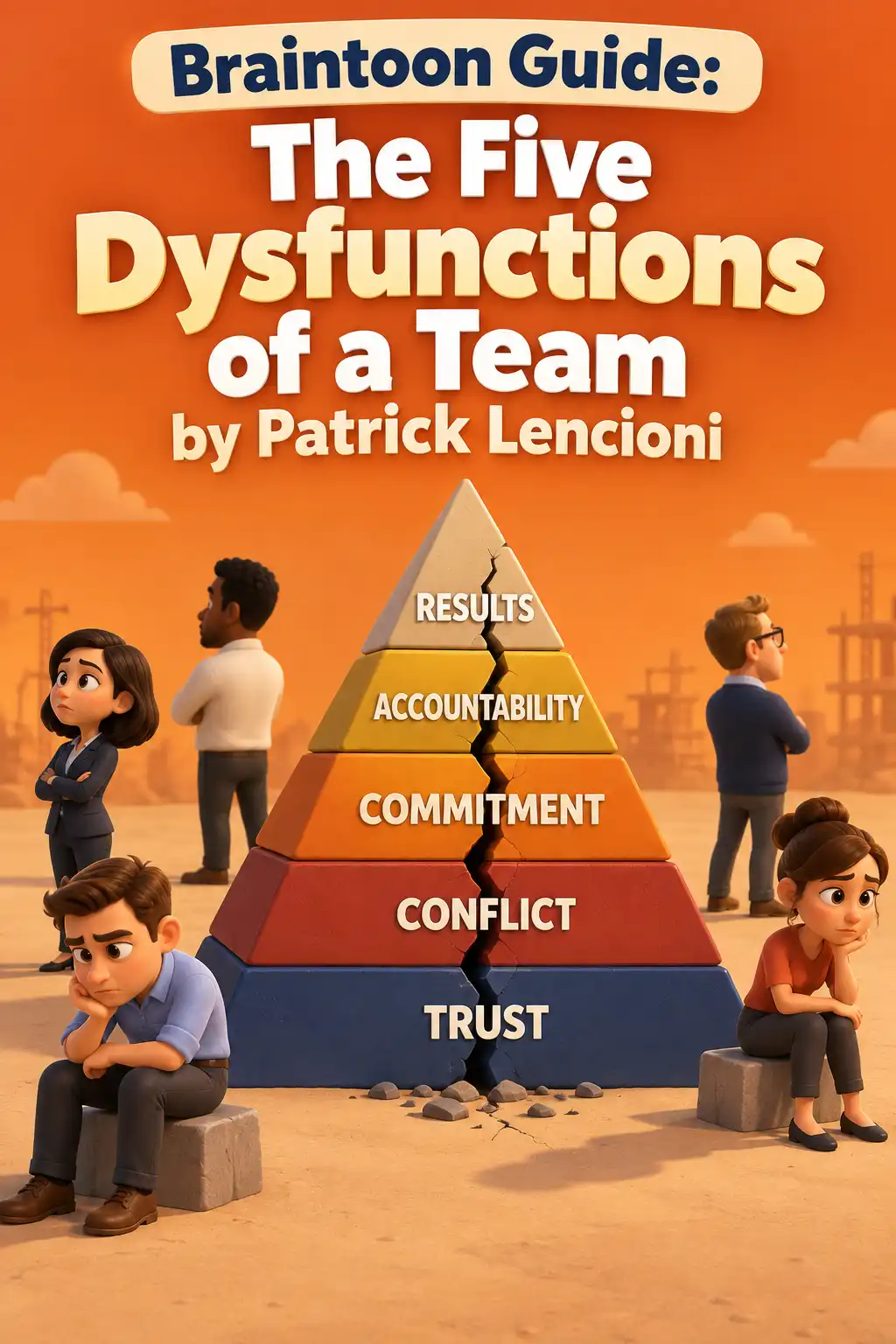
That's close to a point Patrick Lencioni makes in the book The Five Dysfunctions of a Team. He argues that a team that never argues isn't healthy, because the tension doesn't vanish. It goes underground into gossip and sarcasm.

So open debate matters, but it still has to end somewhere. How does Grove close it out?

And he offers a three-part shape for the decision itself: free discussion where everyone says what they really think, a clear decision stated plainly, then full support from everyone, including the people who argued against it.

4. Match your style to task-relevant maturity

Here's something I wonder about with all this. Grove warns against meddling, but some people genuinely need close guidance. How do you tell the difference?

That's exactly the question his concept of task-relevant maturity answers. He shortens it to TRM. It's how ready a person is for a specific task, based on their experience, training, and willingness to take responsibility. The key word is task. It is not a general trait.

So someone could be high TRM in one role and low in another?

He gives that exact case. A seasoned, capable manager moved into an unfamiliar job suddenly has low TRM there, even though they're the same mature adult. And the management style should follow the TRM, not the person's reputation. Low TRM calls for structure: what to do, when, how. As it grows, you shift to two-way conversation and support. At high TRM you mostly agree on objectives and then monitor results.

Monitor. So you never fully let go?

Never completely. He has a sharp line for it: delegation without follow-through is abdication. Monitoring isn't meddling. Meddling is taking the task back. Monitoring is checking in, ideally early, before a lot of effort has been poured into the wrong direction.

I'd guess most managers think they're more hands-off than they really are.

Grove says the opposite is just as common. Managers consistently rate themselves as more communicative and more delegating than their subordinates rate them. He also ties this to motivation. He borrows Maslow's hierarchy of needs, the idea that once a lower need is met, it stops driving you. The one he cares most about is self-actualization, the drive to get better for its own sake, because it never switches off. His example is an Intel facilities team whose performance jumped once buildings were scored and compared. No extra pay. Just a visible race.

So the manager is less a boss and more a coach setting up the track.

That's his image precisely. The coach takes no personal credit, applies honest pressure, and knows the work firsthand.

5. Reviews exist to improve future performance

Coaches also have to deliver hard news. How does Grove handle performance reviews? Because in my experience they're the thing everyone dreads, on both sides.

He starts there. He asked managers how they felt giving reviews and heard anxious, guilty, uncomfortable. Then subordinates said feedback was vague and full of surprises. His conclusion is that reviews are badly done almost everywhere, and yet they're the single most powerful piece of task-relevant feedback a manager gives. The purpose, he insists, is not to justify a raise or document the past. It's to improve the person's future performance.

What goes wrong in the assessment itself?

A few traps. One is confusing presentation with output. Someone who talks a good game gets rated on potential, but Grove's rule is that a manager's rating can't exceed the rating you'd give their group's results. Another is timing. He tells a story against himself, giving a glowing review to a manager whose numbers looked solid, then watching that group collapse later. The good numbers reflected old work, and he'd ignored the warning signs in front of him.

That's an honest admission. And the conversation itself?

He gives three principles he calls the three Ls. Level: be completely frank, including with praise. Listen: communication isn't done until the message has actually landed, so watch their reactions and keep going until you're sure. And leave yourself out: the review is for them, not for your anxiety about giving it.

That 'level' principle sounds like another book, Radical Candor. Kim Scott warns about caring so much that you stay silent, which she calls ruinous empathy.

Yes, and her fix is to care personally while challenging directly. Grove uses a different framework, but both treat vague, comfortable feedback as a failure to help the person. For Grove, the point is their future performance.

I'd think the hard reviews need the most care.

He'd partly push back. He observes that managers write detailed improvement plans for struggling people and hand top performers a pat on the back. He thinks that's backwards, because helping your best people get even better moves total output the most. For serious problems, he describes a predictable path: the person ignores it, denies it, blames others, then accepts responsibility. The manager's job is to move them along that path. And the goal isn't agreement. It's commitment to act.

What if they never agree?

Then he says you use your positional authority, require the change, and monitor it. Agreement is nice. Commitment is required.

6. Training is the manager's job

There's one thing I'd expected a book like this to say, and I'm curious if it does: that the manager's job is really hiring well and then getting out of the way.

Grove would say that's half the picture and misses the lever with the best return. He puts it bluntly: if someone isn't performing, they either can't or they don't want to. Motivation and training are the only two things a manager can do about that. And he argues training can't be handed off to a specialist department any more than motivation can.

Why not? Surely professional trainers are better at it.

His objection is that generic courses don't reflect how things are actually done in your organization, and when the course contradicts real practice, it demoralizes people. Then there's the arithmetic. Twelve hours preparing four short lectures for ten people. Those ten work roughly twenty thousand hours a year. A one percent improvement is two hundred hours gained from twelve invested. That's the leverage idea from lesson one, in its purest form.

Did he practice this himself?

He did. Intel had dozens of internal courses taught mostly by its own managers, and Grove personally taught the ones on performance reviews, running meetings, and company orientation, while he was running the company.

That's a high bar for someone just starting out.

He scales it down. Pick the one topic causing the most pain. Build one short course, lecture by lecture, with deadlines set in advance. Run it first for experienced people who'll give you blunt feedback, and treat that as a rehearsal. He also notes something people who try it tend to discover: explaining a skill clearly requires understanding it far more deeply than just doing it. The teacher often learns the most.

So the two cold examples he opens with, the restaurant without a liquor license and the ruined silicon wafers, those were both training failures.

Both. Somebody wasn't prepared, and the manager owned that.

Closing

If I step back, the whole book seems to turn on one shift in self-image. Stop measuring yourself by how busy you are, and start measuring yourself by what the people around you produce.

That's the core of it. And Grove's practical test follows directly: look at your calendar for next week and ask, for each block, what's the multiplier? An hour of real one-on-one, a short course, catching a problem early, those multiply. Rework, meddling, an undefined meeting, those can multiply in the wrong direction. He wrote this in the early eighties, and some details show their age, but that question hasn't aged at all. What's the one thing on your schedule this week that would change the most if you asked it?