


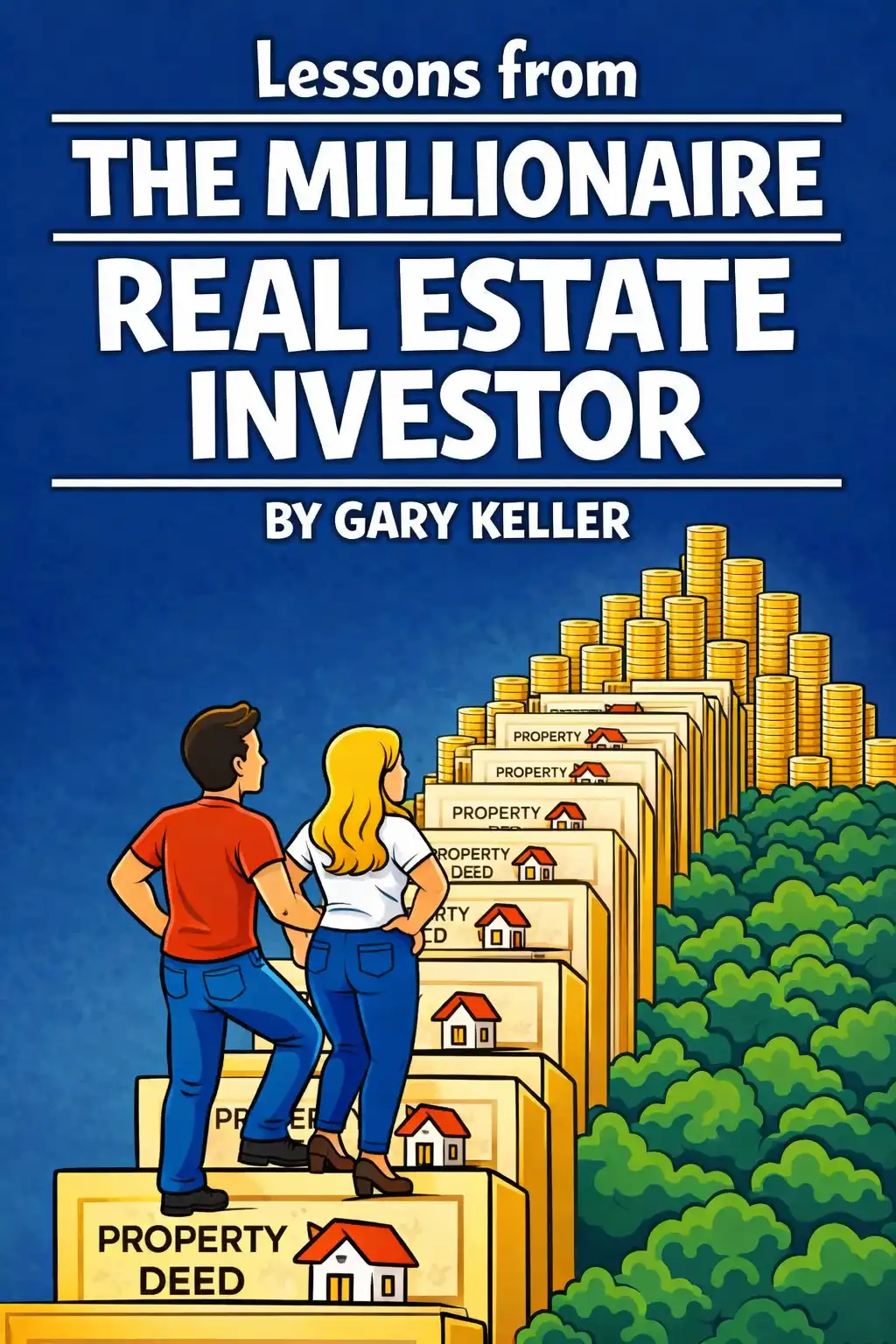










The Millionaire Real Estate Investor cover

Book summary: The Millionaire Real Estate Investor by Gary Keller

10 min read10 key lessonsText + animated summary

What if the biggest thing standing between you and real wealth isn't money or talent, but simply the way you think?

One-sentence summary

"The Millionaire Real Estate Investor" by Gary Keller is a step-by-step guide to building lasting wealth through real estate investing.

Reading about The Millionaire Real Estate Investor is one thing.

Watching it is faster, more fun, and you'll actually remember it.

Lesson 1: Ordinary People Can Build Extraordinary Wealth

Picture a nurse, a secretary, and a recent immigrant sitting across from each other. They seem to have almost nothing in common, except for one thing.

Each of them built a multimillion-dollar real estate portfolio, starting from almost nothing. Gary Keller discovered their stories and wanted to know exactly how they did it.

Keller, who co-founded Keller Williams Realty, one of the largest real estate companies in the world, interviewed over a hundred millionaire investors across the United States for this book.

What he found was surprisingly consistent. These investors didn't have special resources or secret advantages. They had readiness, patience, and a willingness to follow a proven plan.

Keller's book lays out that plan in four stages. Think a Million, Buy a Million, Own a Million, and Receive a Million.

The big idea is simple. Real estate wealth is available to anyone who is willing to think big, start small, and stay in the game long enough for the results to compound.

Lesson 2: Bust the Myths That Hold You Back

There's a fable that Keller opens with. The Devil's favorite tool isn't a pitchfork. It's a tiny, worn wedge called "doubt." That small wedge is all it takes to stop someone in their tracks.

Keller identified eight myths that quietly stop people from ever investing. Three of them are about yourself, like believing you're not smart enough. And five are about investing itself.

One common myth is that your job alone will make you wealthy. Keller points to Mike Tyson, who earned over four hundred million dollars in his career yet still went bankrupt.

Then there's Barbara Mattson. She was caring for a sick husband and two daughters, with almost no money and zero investing experience.

She used a twenty-thousand-dollar payment to buy her first rental properties. Over time, she built a portfolio worth over nine million dollars.

Keller's point is clear. Doubt and fear are the real barriers to wealth. Knowledge and action are what dissolve them, not luck, not privilege, not a high-paying job.

Lesson 3: Train Yourself to Think Like a Millionaire

Think about the last time you bought something you didn't really need. Now multiply that by years of small, careless decisions. You can start to see where your money actually went.

Keller outlines seven ways that millionaire investors think differently. It starts with having what he calls a "Big Why." That's a personal reason so deep and meaningful that it feels like a need, not just a want.

Next, think in Big Goals powered by Big Models. Small, cautious strategies create invisible ceilings on your growth. Instead, adopt millionaire-level models from the very start.

Then there's what Keller calls the "Money Matrix." Successful investors prioritize building capital first. That capital generates cash flow, and that cash flow gets reinvested to build even more capital.

Most consumers do the opposite. They spend first and invest whatever scraps remain. Keller calls this "Shadow Wealth," which means looking prosperous on the outside without any real financial foundation underneath.

Finally, track your net worth, not your salary. Net worth means your total assets minus your total liabilities. That single number is the truest measure of your financial health.

Lesson 4: Why Real Estate Wins Over Other Investments

Imagine putting just five percent down on a house, and that house appreciates six percent this year. Your actual return on the cash you invested isn't six percent. It's thirty percent. That's the power of leverage.

Leverage is just one of eight advantages Keller identifies. Real estate is accessible because financing exists for almost any buyer, even beginners.

It appreciates in value, having grown roughly six percent annually over three decades. It's rentable, meaning tenants pay your mortgage while you build equity.

It's improvable, meaning you can force the value up through upgrades and renovations. It also offers powerful tax advantages, like depreciation deductions and something called 1031 exchanges that let you defer capital gains taxes.

Real estate is more stable than stocks, with far less price volatility from year to year. And uniquely, it's livable. Your own home can be your very first investment.

Keller argues that no other asset class combines all of these benefits in one package. That's why real estate is the foundation of so many millionaire portfolios.

Lesson 5: Build a Powerful Network Around You

Picture yourself trying to renovate a house completely alone. No contractor, no inspector, no mentor. How far do you really think you'd get?

Keller is emphatic about this. No investor succeeds alone. He organizes your team into three circles. The Inner Circle includes mentors, partners, and your most trusted advisors.

The Support Circle includes real estate agents, lenders, and accountants, the people involved in nearly every deal. The Service Circle covers specialists like home inspectors and contractors.

Building this network starts simply. Ask your trusted contacts who else you should know. Ask experienced investors what they would do if they were in your position.

Keller also gives five rules for protecting your reputation in this network. Do deals, keep your word, avoid gossip, pay people fairly, and refer business to others within your circle.

Lesson 6: How to Find and Acquire Great Deals

Imagine fishing in a lake you know nothing about. You might get lucky, but probably not. Keller says finding investment properties works the exact same way.

It starts with writing down your "Criteria," which is a detailed description of your ideal property. That covers location, property type, price range, and condition. Pick one neighborhood and become the expert on it.

Keller shares a personal example. He knew a single zoning detail about a commercial lot that other buyers had missed. That knowledge turned his four-hundred-sixty-thousand-dollar purchase into a one-point-one-million-dollar sale.

Then you generate leads two ways. Prospecting, which means actively searching for properties. And marketing, which means putting yourself out there so that sellers come to you. Networking and agents produce about sixty percent of all leads.

Experienced investors look at roughly thirty properties to find ten serious prospects, make about three offers, and close just one deal. Volume is absolutely essential.

When it comes to acquisition strategy, Keller separates approaches into quick-cash flips and long-term buy-and-hold. His core advice? Buy and hold is the true wealth builder over time.

Lesson 7: Own a Million Dollars in Equity

Think about a labyrinth. From above, it looks impossibly complicated. But there's really only one path through it. Keller says building real estate equity works the same way. It's simpler than it looks.

Buying a property gets you market value. But truly owning it means growing that into real net worth over time through appreciation, paying down the mortgage, and increasing rents.

Keller models a twenty-year journey where an investor buys fifteen properties at median prices, each purchased at a twenty percent discount, with standard mortgages.

By year twenty, that investor has over one-point-six million dollars in equity and annual cash flow exceeding fifty thousand dollars. The math really works when you stay consistent.

The mantra is simple. Buy it right, pay it down, pay it off. And periodically, refinance to pull out equity and redeploy that money into new properties.

Keller warns against chasing novelty or the next hot trend. Many of the millionaire investors he interviewed said they wished they had simply stuck with what was already working instead of switching strategies.

Lesson 8: Protect Your Returns and Keep Your Money Growing

Imagine two bank accounts growing side by side. One earns three percent, the other earns eight percent. Over thirty years, the difference between them is absolutely staggering.

Keller describes four conditions your money can be in. Dead, safe, healthy, or wealthy. Money earning less than the rate of inflation is essentially dying. You need it working hard for you.

He says to track two numbers. Your return on investment, which is your profit compared to what you originally spent. And your return on equity, which is your profit compared to how much equity is sitting in the property. As equity builds up, return on equity naturally drops. That's a signal it's time to act.

That's when smart investors refinance, pull out equity tax-free, and redeploy it into new deals. You can also minimize taxes through depreciation deductions and 1031 exchanges.

Keller also stresses accountability. Having someone regularly review your progress and hold you to your commitments is actually more powerful than even having a great plan in the first place.

Lesson 9: Build Toward Receiving a Million Dollars a Year

What would it take to earn one million dollars a year without working? If you relied on a traditional investment earning two-and-a-half percent, you would need forty million dollars saved up.

Real estate offers a far more accessible path. Keller models how buying just one or two properties per year can build toward that million-dollar-a-year goal over time.

He shares the story of someone he calls "Investor Thirty-Four," a California investor who started with personal savings and credit cards, buying discounted properties and reinvesting every dollar of profit.

That investor now generates twelve million dollars a year in income and works only about twenty hours a week. The system essentially runs itself.

Keller calls this the "Seventh Level," the point where you step away from daily operations entirely. First you delegate administration, then management, and eventually, everything.

Lesson 10: Stay the Course and Build the Life You Want

Remember Derek Jeter's famous diving catch? He never took his eyes off the ball. Keller says building wealth demands that same kind of relentless focus.

He lays out a four-stage financial track. First, establish your base camp. That means living on a budget, tracking your net worth every week, and avoiding unnecessary personal debt.

Second, protect the future. Set up an emergency fund, own your home, get proper insurance, and create an estate plan. Third, fund the future by investing consistently, year after year.

Fourth, and most importantly, stay the course. Keller says this takes roughly ten hours a week and a deliberate energy plan that covers your spiritual, physical, emotional, and financial health.

Here's a truth Keller wants you to remember. Money has no feelings. It simply follows whatever rules you place on it. Learn those rules, stay disciplined, and you can build the life you want.

That's the promise Gary Keller makes. Real estate wealth isn't reserved for the lucky few. It's built one property, one habit, and one decision at a time.

You've read the summary. Now watch it.

The animated version covers the same ideas — faster, and in a format you'll actually remember.