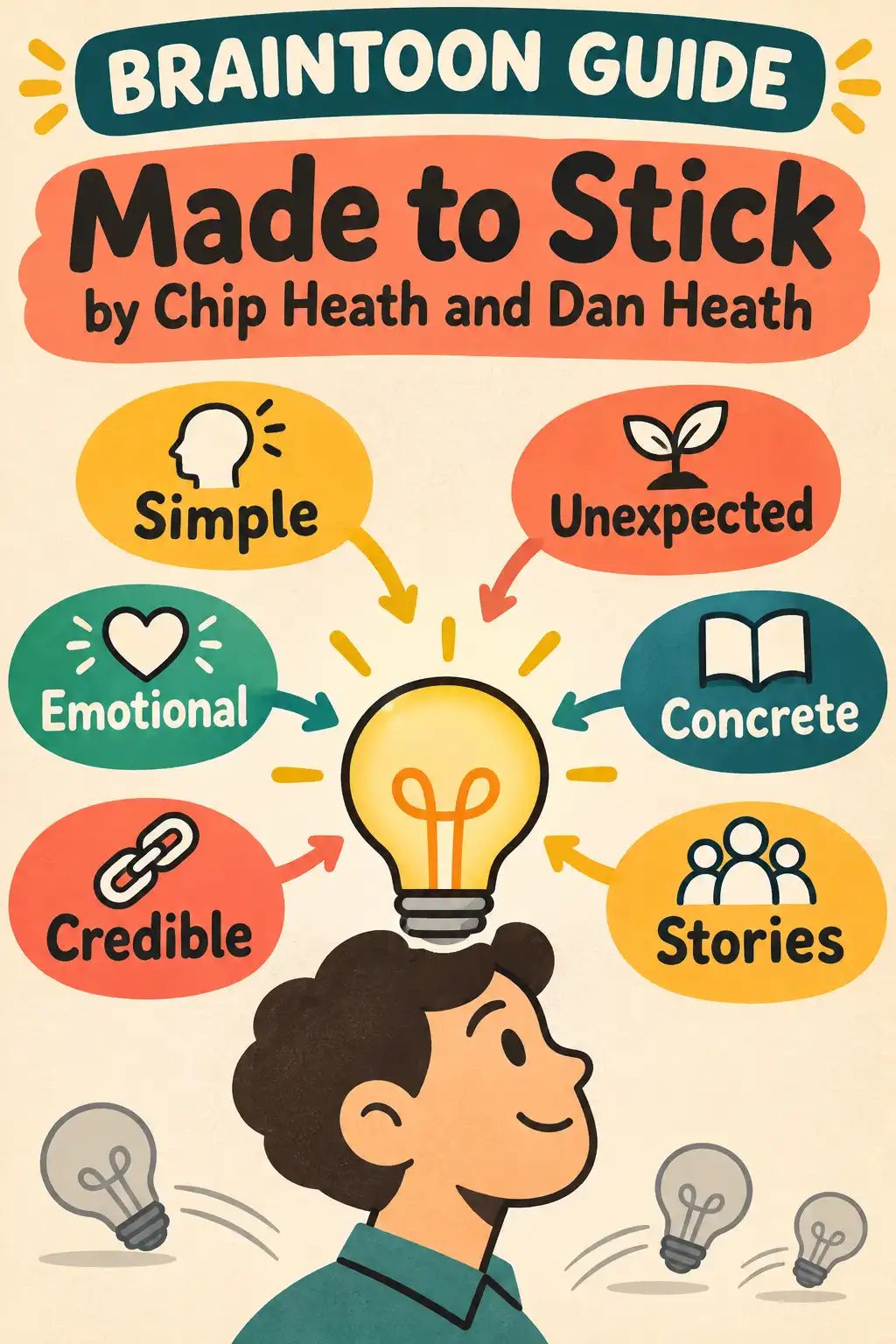
Made to Stick by Chip Heath and Dan Heath explains why some ideas are understood, remembered and acted on while others vanish. It argues that sticky ideas share six learnable traits: simple, unexpected, concrete, credible, emotional and told as stories.
Today's book is Made to Stick by Chip Heath and Dan Heath. It asks why some ideas get remembered and passed along, while others are forgotten in five minutes.
BrainToon
And their answer is that it isn't luck. Sticky ideas share six traits: simple, unexpected, concrete, credible, emotional, and told as stories. The Heaths say anyone can learn them. But one stubborn habit gets in the way first.
Part 1The Curse of Knowledge
BrainToon
That habit is what the Heaths call the Curse of Knowledge. Once you know something, it's very hard to remember what not knowing it felt like. So you explain things as if the listener already has what's in your head.
Learner
That sounds like every confusing meeting I've sat through. Is it really that strong?
BrainToon
A Stanford experiment suggests it is. People tapped the rhythm of a well-known song on a table. Listeners had to name the song. The tappers predicted listeners would get it about half the time. In reality, listeners got it less than three percent of the time.
Learner
That's a huge miss. Why were the tappers so confident?
BrainToon
Because the tapper hears the melody in their head while they tap. The listener only hears knocking. And the tapper can't switch the melody off to imagine that. The Heaths say experts are in the same spot. They hear the full song. Their audience hears knocks.
The tapper hears a song; the listener hears knocks: In the Stanford tapping study, tappers heard the melody while they tapped, but listeners heard only knocking: predicted success was about half, while actual success was under 3 percent.
Learner
So the six traits are ways to get the tune out of your head and into mine?
BrainToon
That's the idea. Each trait does a job: get attention, be understood, be believed, make people care, get them to act. And the Heaths insist it's a craft, not a gift.
Learner
Doesn't a checklist make everything sound the same, though?
BrainToon
They take that on. Israeli researchers found nearly ninety percent of award-winning ads fit just six templates. And beginners trained in those templates made ads rated fifty percent more creative than untrained beginners. The structure focused their creativity instead of killing it.
Learner
Fair enough. So where do the six start?
Part 2Simple means finding the core
BrainToon
They start with simple. That doesn't mean dumbed down. It means finding the single most important thing and saying it compactly, like a proverb. The Army does this with something called Commander's Intent.
Learner
What is that, exactly?
BrainToon
Battle plans rarely survive first contact with the enemy. So every order opens with a short, plain statement of the result the mission should achieve. When the detailed plan falls apart, soldiers still know the destination and can improvise toward it.
Learner
Does that travel outside the military?
BrainToon
The Heaths point to Southwest Airlines. Former CEO Herb Kelleher boiled the company down to one line: we are the low-fare airline. So when a marketing employee suggested adding chicken Caesar salads, the test was easy. Does it help us be the low-fare airline? No. Then it doesn't happen.
Southwest's one-line core as a decision filter: Herb Kelleher's one-line core gave every employee a quick test. A salad might be nice, but if it doesn't help Southwest be the low-fare airline, it doesn't happen.
Learner
But the salad might be a nice idea. Isn't it painful to throw out good things?
BrainToon
Yes, and the Heaths say that pain is why people avoid it. Smart people see value in many points, so they include them all. Journalists call that burying the lead. Research they cite also shows too many choices can freeze people. A clear core tells everyone what matters most.
Learner
That's close to another book, Building A StoryBrand. Donald Miller's rule for businesses is: if you confuse, you lose. He says people tune out messages they have to work to decode.
BrainToon
Same instinct. The Heaths add that a clear core guides the people inside, too, like the Southwest employee weighing that salad.
Learner
So simple is really about priority. One thing goes first, even when the rest is good.
BrainToon
And short alone isn't enough. A catchy line with nothing behind it fails. The Heaths want both: compact and core.
Part 3Unexpected: surprise and curiosity gaps
Learner
A simple message can still be boring, though. How do you get anyone to pay attention to it?
BrainToon
Break a pattern. The Heaths say our brains tune out the predictable and wake up when a guess fails. But the surprise has to serve the message. A Super Bowl ad with wolves attacking a marching band was memorable, and it had nothing to do with the product.
Learner
So what does useful surprise look like?
BrainToon
A journalism teacher gave his students a set of facts about an upcoming school event and asked them to write the lead, the opening line of the news story. Then he revealed the real lead: there will be no school next Thursday.
Learner
Oh. The lead wasn't sitting in the facts. It was what the facts meant for readers.
BrainToon
And it's surprising, yet obvious in hindsight. That's the Heaths' formula. Find what's counterintuitive in your core message, and break people's guesses right there.
Learner
Then how do you hold attention after the surprise?
Students who won't leave class. That's a strong test.
The curiosity gap: Following George Loewenstein, the Heaths treat curiosity as a gap between what we know and what we want to know. Open it first, then close it.
Part 4Concrete ideas give memory hooks
BrainToon
The third trait is concrete: things people can see, touch, or picture. The Heaths describe memory like Velcro. An idea with lots of hooks, like images, senses, and feelings, grips tight. An abstract idea has few hooks and slips away.
Learner
What's an example where concrete really made the difference?
BrainToon
Jane Elliott, a third-grade teacher. The day after Martin Luther King Jr. was assassinated, she wanted her class to understand prejudice. So she divided the children by eye color and told the brown-eyed kids they were superior. Within minutes, friendships fell apart and schoolwork changed.
Learner
That's intense. Did it last, or was it just one rough day?
BrainToon
The book says studies years later found those students were measurably less prejudiced than their peers. Elliott didn't explain prejudice as a concept. She made it physical and personal, so it stuck.
Learner
Then why do experts drift into abstract talk?
BrainToon
Because abstraction is what expertise feels like. That's the Curse of Knowledge again. The Heaths' fix isn't dumbing things down. It's finding the language everyone shares, and that's almost always concrete.
Learner
Does this work for dry facts too? Say, numbers?
BrainToon
It does. Art Silverman wanted to warn people that movie popcorn had 37 grams of saturated fat. That number meant nothing. So he said one bag had more artery-clogging fat than a bacon-and-eggs breakfast, a Big Mac and fries, and a steak dinner combined. Moviegoers stopped buying popcorn, and theater chains changed their oil.
Abstract number vs. concrete comparison: movie popcorn: Art Silverman's warning stuck once the number became a picture: one bag of movie popcorn had more artery-clogging fat than three heavy meals combined.
Part 5Credibility without an authority
Learner
Vivid is great, but why would I believe you? Especially if you're not a famous expert.
BrainToon
The Heaths say an idea can carry its own proof. One tool is the Sinatra Test, from the lyric, if I can make it there, I'll make it anywhere. You find one example so strong it settles the question.
Learner
What counts as strong enough?
BrainToon
Take Safexpress, an Indian shipping company. It wanted a contract with a Bollywood studio that was worried about piracy. The company pointed to two past jobs. It had delivered every Harry Potter book across India for a simultaneous release. And it had safely moved confidential university exam papers.
Learner
If they can guard Harry Potter and exam papers, they can guard a film. No chart needed.
BrainToon
Another tool is letting people test the claim themselves. Reagan asked voters, are you better off than you were four years ago? Nobody needed an expert. They checked their own lives.
Learner
That's almost the reverse of what Robert Cialdini describes in Influence. He shows people defer to symbols of authority, like titles and uniforms, even when they're fake.
BrainToon
Right. The Heaths' tools skip the costume. The proof sits in the idea itself, or in the listener's own life.
Learner
And statistics? Don't numbers make you believable?
BrainToon
Only when they show a relationship people can feel. To calm shark fears, the book compares sharks with deer. Deer are three hundred times more likely to kill you, mostly through car collisions. Since nobody fears deer, the point lands. The Heaths also warn that numbers are easy to twist, so share the honest ones.
Sharks vs. deer: a statistic people can feel: Comparing sharks with deer turns a statistic into a relationship people can feel, and the point lands because nobody fears deer.
Learner
So I believe you now. That still doesn't mean I'll do anything about it.
Part 6Emotion makes people care
BrainToon
That's the fifth trait. People act when they care, and caring comes from feeling.A Carnegie Mellon study showed this. People who read about one child, Rokia, gave more than twice as much to charity as people who read statistics about millions of suffering children.
Learner
What if you give people both, the story and the numbers?
BrainToon
Donations dropped back down. The explanation offered is that analytical thinking crowds out feeling. In a follow-up, just getting people to think in numbers first reduced what they gave for Rokia.
One child vs. statistics vs. both: In the Carnegie Mellon study, readers gave more than twice as much for one child, Rokia, as for statistics about millions. When both were combined, donations dropped back down.
Learner
That sounds like another book, Start With Why. Simon Sinek argues facts mostly help people justify what their gut already decided, and piling on features can breed doubt.
BrainToon
A similar spirit, though his brain science is a simplification. The Heaths' point here rests on these donation studies.
Learner
Is caring always about sympathy, though?
BrainToon
No. Sometimes it's identity. Texas wanted less litter. A researcher found the typical litterer was a proud, truck-driving Texan man who resisted authority. Guilt wouldn't move him. So the campaign used local heroes like Willie Nelson to say real Texans don't litter. Visible roadside litter fell 72 percent in five years.
Learner
So he wasn't asking what's in it for me. He was asking what someone like me does.
BrainToon
That's the model the Heaths borrow. They add that we tend to assume other people only care about money or security, while we ourselves care about meaning. So most messages aim too low.
Learner
Okay, that one stings a little.
Part 7Stories as flight simulators
BrainToon
The last trait is story, and it's what gets people to act. The Heaths call stories flight simulators for the brain. When you follow a story, you mentally rehearse it. They cite research that mental practice alone gives about two-thirds of the benefit of physical practice.
Learner
What does that look like at work?
BrainToon
Here's a story from researcher Gary Klein. In a newborn intensive care unit, a baby started turning blue-black. The team trusted the heart monitor and prepared to treat a collapsed lung. One nurse suspected a rare heart condition. She grabbed a stethoscope and found the heart had stopped. She steered the team to the right treatment, and the baby lived.
Learner
And every nurse who hears that has practiced a moment when the monitor is wrong.
BrainToon
That's why such stories circulate in high-stakes jobs. They carry context and cause and effect that a rule can't. A Stanford class exercise backs this up. After short speeches, about 63 percent of listeners remembered the stories. Only 5 percent remembered any single statistic.
What listeners remembered after short speeches: In a Stanford class exercise, about 63 percent of listeners remembered the stories, while only 5 percent remembered any single statistic.
Learner
Any catch with stories?
BrainToon
One. The Heaths say the hard part is making sure the story serves your core message. A great story about the wrong point is still off target.
Closing
Learner
So if I have something important to say tomorrow, what's the first move?
BrainToon
Assume the tune is only in your head. Then find the one core thing and give it a picture, a surprise, some proof, a reason to care, and a story. The Heaths add that you don't always have to invent these. Often you just need to spot a good story when it passes by.
Learner
So here's a question to leave with. What's one idea you need someone to remember this week, and which of the six is it missing?
 BrainToon