The Ultimate Summary ofThe Thinking Machine (on Nvidia and Jensen Huang)by Stephen Witt

Summary byBrainToonLast updated

The Thinking Machine (on Nvidia and Jensen Huang) cover

Loading summary

Share this with a friend or colleague

Email

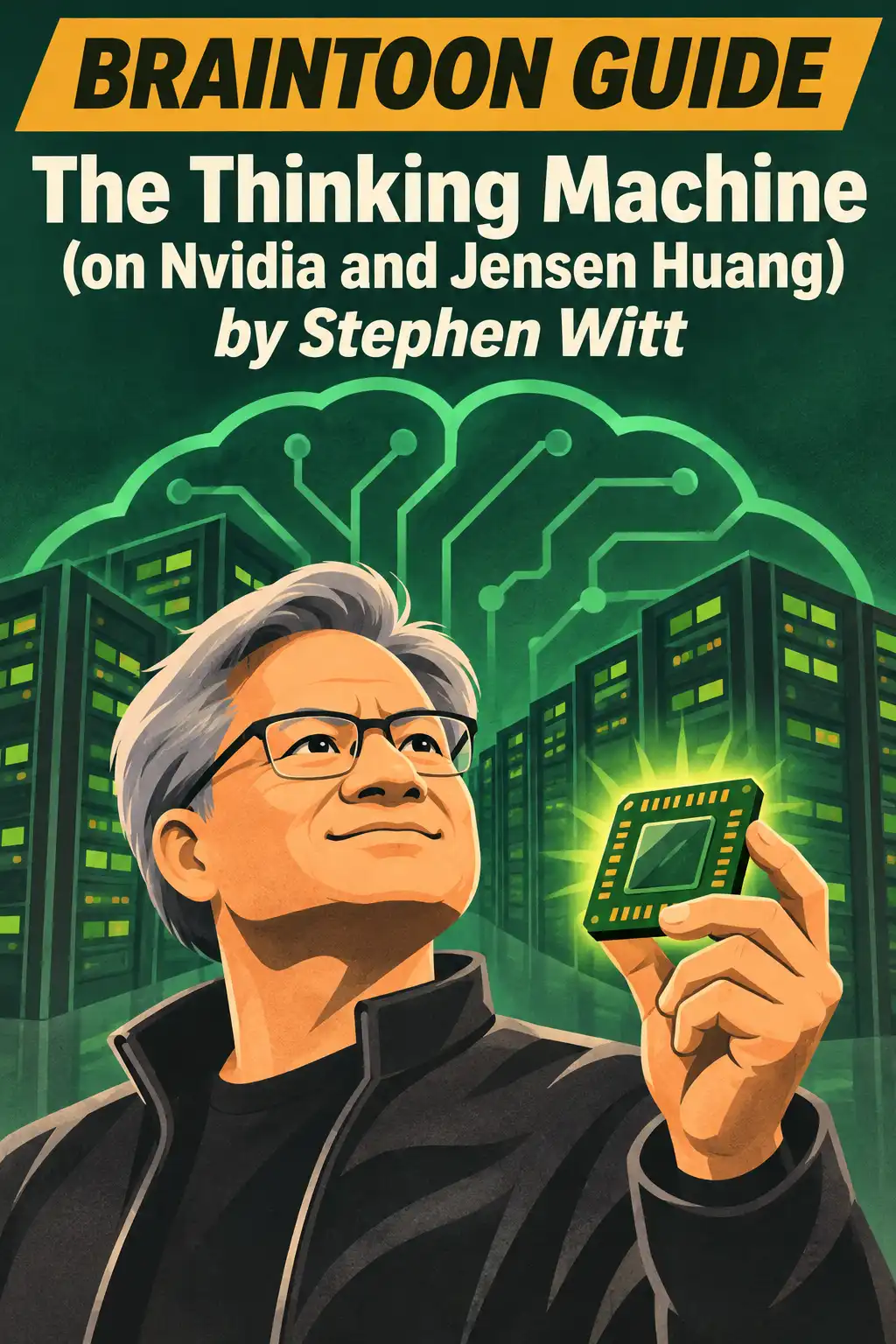
The Thinking Machine (on Nvidia and Jensen Huang) by Stephen Witt tells how a small video game chip maker became the world's most valuable company. It follows Jensen Huang's long, unpopular bet on parallel computing, which ended up powering modern AI.

Watch full summary

More books like The Thinking Machine (on Nvidia and Jensen Huang)

Browse all books

Explore related learning pathways

Browse all pathways →

The Thinking Machine (on Nvidia and Jensen Huang) Summary

Learner

I grew up thinking of Nvidia as the company that made graphics cards for gamers. Now it's worth more than three trillion dollars. How does that even happen?

BrainToon

That's the question behind The Thinking Machine by Stephen Witt. His answer is one very stubborn CEO, Jensen Huang, and a bet on a kind of computing that almost everyone thought was a dead end.

Part 1A tough start in Kentucky

Learner

Stubborn how? Where does that come from?

BrainToon

Witt goes back to 1973. Huang is ten. He was born in Taiwan and raised in Thailand. There's unrest in Bangkok, so his father sends him and his older brother to an uncle in the United States. The uncle enrolls them at a school in rural Kentucky, apparently thinking it's a fancy prep school. It's actually a reform school.

Learner

Wait. A reform school? For a ten-year-old who did nothing wrong?

BrainToon

Yes. He's the only Asian student, and he's bullied every day. His roommate is seventeen and has been stabbed multiple times. Huang teaches him to read. In exchange, the older boy teaches him to bench press. Huang starts a daily push-up routine he keeps for life.

Learner

That sounds like it should break a kid.

BrainToon

A friend from those years later said Huang almost seemed to enjoy the adversity. He got top grades and never backed down. Then the family reunites in Oregon. He joins the computer club, becomes a nationally ranked table tennis player, and works at Denny's, starting as a dishwasher.

Learner

And Denny's comes back later, right?

BrainToon

It does. By 1993 he's a chip designer, about to turn thirty. Two engineers, Curtis Priem and Chris Malachowsky, want him to lead a startup making graphics chips for PC games. They plan it at a Denny's in San Jose. The name, Nvidia, comes from the Latin word for envy.

The Thinking Machine (on Nvidia and Jensen Huang) Summary: Witt's arc: one stubborn CEO, one long bet, and an ending that stays open.

Part 2The first chip nearly sinks Nvidia

Learner

So did the first chip make anyone envious?

BrainToon

Briefly. The NV1 came out in 1995 and sold over a hundred thousand units. But it drew 3D images in an unusual way. Most game developers preferred triangles. Then Microsoft released a standard that only supported triangles. Games crashed. Customers returned the cards. Huang himself called it a disaster.

Learner

Okay, so one bad product. Companies survive that.

BrainToon

Except the next two chips were planned on the same flawed design. So Huang cut the company from over a hundred people to thirty-five engineers and started over. There was no time to build physical prototypes. He took a final million dollars from a deal with Sega and spent it on an emulator, a machine that tests a chip design in software.

Learner

That's a gamble stacked on top of a failure.

BrainToon

It was. Witt says no chip company had skipped prototyping before. They squeezed a year of work into about three months. The chips arrived in spring 1997 and worked on the first try. That chip sold a million units in four months.

Learner

That near-death stretch reminds me of another book, Shoe Dog, where Phil Knight describes his young company spending years one bad month of sales away from bankruptcy.

BrainToon

The difference is where the danger came from. Knight kept running at zero cash by choice, putting every loan into the next bigger order. Huang's crisis came from a flawed design, and his answer was to shrink to thirty-five engineers and start over.

Learner

So he finally relaxes?

BrainToon

The opposite. He started opening meetings with, "Our company is thirty days from going out of business." Witt says the phrase is still used today. And there was a human cost. Priem lost a power struggle with Huang and was demoted twice. Staff also learned to fear what they called the Wrath of Huang, loud public dressing-downs meant to teach everyone watching.

Learner

That sounds miserable to work under.

BrainToon

Witt doesn't hide it. He describes a mix of fear, guilt, and real personal warmth.

Part 3A long bet on parallel computing

BrainToon

The big idea arrives quietly in the late nineties. Game developers keep demanding more power. So Nvidia starts running several calculations side by side on one chip. That's parallel computing.

Learner

Meaning what, in plain terms?

BrainToon

Witt uses a kitchen picture. A normal processor is a chef's knife. Precise, but one cut at a time. A graphics chip is a food processor. Loud and blunt, but it chews through a huge pile at once.

Learner

Great for games. But why would anyone else care?

BrainToon

A Stanford student named Ian Buck chained thirty-two gaming cards together and realized he'd built a cheap supercomputer. Scientists began hijacking gaming hardware for physics and medical imaging. Huang hired Buck in 2004, and they built CUDA. It's software that lets scientists use these chips for any kind of heavy math.

Learner

And scientists rushed to use it?

BrainToon

Hardly anyone did. Thirteen thousand downloads in its first full year. Wall Street saw it as a drag. Then a manufacturing defect helped wipe out nearly ninety percent of the stock. By 2012 the share price had gone nowhere for a decade, and an activist investor was pushing Huang to cut the distractions.

Learner

Honestly, I'd have sided with the investor. Ten years with nothing to show?

BrainToon

Another book takes on exactly that question. In Thinking In Bets, Annie Duke warns against what poker players call resulting, which means judging a decision only by how it turned out rather than by how sound it was at the time.

Learner

So the investor's case shouldn't look foolish just because CUDA eventually paid off. And Huang's bet shouldn't look brilliant for that reason alone.

BrainToon

That's fair. Every earlier attempt to sell parallel computing had failed. Huang gave up a modem business but refused to drop CUDA. His reasoning came from a book he loved, The Innovator's Dilemma. Breakthroughs often start in neglected corners. He was betting some scientist or student would use his tool to change the world. He just didn't know who.

Parallel Computing: Huang's Long Bet: Parallel computing in one image: blunt, simultaneous power, and a tool that waited years for its moment.

Part 4Two gaming cards change AI

Learner

And somebody did?

BrainToon

In Toronto, in 2012. Geoffrey Hinton ran a lab working on neural networks. That's software loosely modeled on the brain, which learns from examples. Back then, most AI researchers looked down on the idea. Two of his students, Alex Krizhevsky and Ilya Sutskever, pooled their own money for two Nvidia gaming cards. About five hundred dollars each.

Learner

Their own money? Where did they even run it?

BrainToon

On the computer in Krizhevsky's bedroom, at his parents' house. His parents paid the electricity bill. The network trained for about a week on a huge collection of labeled images. Then he entered a major image-recognition contest and beat the previous best by ten percentage points.

Learner

That's a big jump.

BrainToon

So big that the contest's organizer, Fei-Fei Li, first suspected a bug. Within two years every contestant was using neural networks. The system became known as AlexNet.

Learner

The story I've heard is that Huang saw it and instantly went all in. Is that true?

BrainToon

It was fast, but someone had to push. An Nvidia researcher named Bryan Catanzaro was struggling to get support inside the company. So he took his case straight to Huang. Huang spent a whole weekend studying AI. By mid-2013 he called Catanzaro's AI software the most important project in Nvidia's history. He wrote "once in a lifetime opportunity" on his whiteboard as an acronym.

Learner

So was it foresight or luck?

BrainToon

Both, and Witt is honest about that. Huang didn't predict AI. He built a tool for an unknown future, then moved very quickly when it showed up. Even his colleagues list luck next to work ethic.

Part 5From gaming cards to AI factories

BrainToon

After that, the scale keeps growing. In 2016 Nvidia builds a hundred-and-twenty-nine-thousand-dollar computer made for training AI. Huang hand-delivers the first one to Elon Musk at a new nonprofit called OpenAI.

Learner

The ChatGPT people.

BrainToon

Right. In 2017, Google researchers publish a design called the transformer. It plays to the graphics chip's strength, which is huge numbers of simple calculations at once. OpenAI builds its GPT models on it. ChatGPT launches in November 2022 and reaches a hundred million users in two months.

Learner

And everyone needs Nvidia chips.

BrainToon

Desperately. Witt describes a sushi dinner where Larry Ellison and Elon Musk spend the whole meal begging Huang for more chips. On one day in May 2023, Nvidia's value rises by roughly two hundred billion dollars. The next year's profit is just under thirty billion. That's more than the company earned in its previous three decades.

Learner

But why can't a rival just build a faster chip?

BrainToon

Witt argues the real edge is software. Thousands of Nvidia engineers build free tools on top of CUDA for every field. Researchers get locked in. A Caltech administrator told him professors would rather wait eighteen months for an Nvidia chip than switch.

Learner

So the project Wall Street hated became the wall around the castle.

From Gaming Cards to AI Factories: The project Wall Street hated became the wall around the castle.

Part 6The risks Huang brushes aside

Learner

Here's what bugs me, though. Aren't some of the people who invented this stuff scared of it?

BrainToon

They are. Hinton quit Google to warn the public. Another pioneer, Yoshua Bengio, put the odds of catastrophe at fifty percent. A third, Yann LeCun, says zero. To him these are tools that serve human goals.

Learner

And Huang?

BrainToon

Firmly zero. He calls AI just a new way of making software. When Witt pressed him in their final interview, Huang erupted. For twenty minutes he lectured that every new technology sparked the same fears, from agriculture to electricity to the calculator.

Learner

Well, he sells the chips. He would say that. Though I guess he could still be right.

BrainToon

Another AI builder lands somewhere very different. In The Coming Wave, DeepMind co-founder Mustafa Suleyman calls containing AI perhaps the defining challenge of our lifetime. One of his proposed safeguards is to use choke points, like advanced chips, to buy society more time.

Learner

Which puts Nvidia's own product right at the center of that debate.

BrainToon

Witt doesn't settle it. He admits his own fear, as a writer, of being replaced. And he lists nearer problems. The chips keep getting hungrier for power. Nvidia depends on factories in Taiwan, and Witt was surprised to find essentially no backup plan for a conflict there. Some investors called the whole thing a bubble.

Learner

And the company itself? Is it stable?

BrainToon

Huang has fifty-five people reporting directly to him. No deputy. No named successor. He wakes at three-thirty to work and still worries about failing.

Learner

So three trillion dollars rests on one man in his sixties.

How Worried Should We Be About AI?: The experts disagree, Huang is certain, and Witt doesn't pretend to know who is right.

Closing

Learner

So where does Witt leave us?

BrainToon

With a strange double picture. The same stubbornness that carried Huang through a decade of ridicule made him right about parallel computing. Now it's pointed at the question of AI risk, and he's just as certain.

Learner

And this time nobody knows yet if he's right.

BrainToon

Exactly. Witt ends standing inside one of Nvidia's roaring supercomputers. He wonders whether the machine around him might one day surpass human thought. The book tells you how we got here. It doesn't pretend to know what comes next.