The Hard Thing About Hard Things by Ben Horowitz, a legendary Silicon Valley entrepreneur and investor, argues that the toughest parts of running a company have no formula. Drawing on his years as a CEO in crisis, he shares honest lessons on leading when everything goes wrong.
Most business books make running a company sound like cooking from a recipe. Follow the steps, get the result. But what do you do when there's no recipe at all?
BrainToon
That's Ben Horowitz's complaint in The Hard Thing About Hard Things. He says those books cover the easy parts. The truly hard parts, like laying people off or nearly running out of money, have no formula. So he tells what he actually lived through.
Part 1When there is no formula
Learner
So what did he live through? Every founder says it was hard.
BrainToon
His was close to fatal. In 1999 he started Loudcloud with Marc Andreessen. It was an early cloud computing company. An investor told him to run it as if capital were free, so they hired hundreds of people. Then the dot-com crash hit. Most of their customers were startups, and those startups were dying.
Learner
So the money dried up.
BrainToon
Completely. No private investor would touch them. The only option left was going public at the worst possible moment. They raised about 162 million dollars, and nobody celebrated. The banks even skipped the traditional closing dinner. Later their biggest customer went bankrupt, and his mentor Bill Campbell basically told him the company was already dead. Campbell wanted him to plan for bankruptcy.
Learner
Honestly, that sounds like sensible advice. If the odds are that bad, why not plan for the end?
BrainToon
Here's Horowitz's claim. A startup CEO shouldn't play the odds. The job is to find an answer, however slim the chance. And he found one. He sold the cloud business to EDS and kept the software his team had built to run it, called Opsware. Then he started over as a software company.
Loudcloud's split: sell the cloud, keep the software: Horowitz's way out: sell the cloud business to EDS and rebuild around the Opsware software.
Learner
It worked for him. But plenty of people refuse to quit and still lose.
BrainToon
He admits that. He calls this dark stretch the Struggle. Nearly every great founder goes through it, he says, but going through it guarantees nothing. His point is narrower. A complex business almost always has a next move. Stay in the game long enough, and luck has a chance to show up.
Part 2Why bad news must travel fast
Learner
While all this is happening, what does he tell his employees? I'd assume a leader stays upbeat to keep everyone calm.
BrainToon
That's what he did at first. He thought relentless positivity protected the team. He now says he was wrong. People already sensed the truth, so the cheerful spin just cost him their trust.
Learner
So he was being kind, just in a way that backfired.
BrainToon
Kim Scott has a name for that in her book Radical Candor. She calls it ruinous empathy: caring so much that you stay silent, which ends up causing more pain. Her answer is to care personally while challenging directly. Horowitz learned that the hard way.
Learner
So the fix is to share the scary stuff?
BrainToon
Yes, and he gives three reasons. Trust makes communication faster. More brains get to work on the hard problems. And bad news moves quickly enough for you to act before it kills you.
Learner
That's easy to say. What does it look like on a really bad day?
BrainToon
Layoffs. His company went through three rounds and still ended as a billion-dollar outcome. One veteran investor told him he'd never seen that happen. Horowitz credits how they did it. Say the real reason, which is that the company missed its plan. Don't dress it up as a performance clean-up. And managers tell their own people. They don't hand it to HR.
Learner
That part makes sense to me. People remember exactly who told them.
BrainToon
In vivid detail, he says. And one more thing. The CEO speaks to the whole company first, and the real audience is the people staying.
Learner
Huh. I'd have thought that speech was for the people leaving.
BrainToon
The ones who stay are watching how their friends get treated. That decides whether they trust you afterward. He's the same about bad numbers. When a forecast had to be cut, his controller's advice was to take all the pain at once. Don't nibble at it.
How to run a layoff honestly: The reason, the messenger, and the audience all shape whether the remaining team trusts you afterward.
Part 3Fix the real problem directly
Learner
Okay, so the company survives as Opsware. Does it finally get easier?
BrainToon
Not really. A competitor called BladeLogic started beating them in big deals. Employees flooded him with clever ideas. Pivot to a new market. Find a workaround. He rejected all of them.
Learner
Why? Some of those ideas might have been good.
BrainToon
Because the real problem was simple. Their product wasn't good enough. So he asked an exhausted engineering team for months of intense work to rebuild it. They did, and they won their edge back. He calls this using lead bullets. There's no silver bullet, just a lot of plain hard shots at the actual problem.
Learner
But hold on. He pivoted himself, from cloud to software. Isn't dodging sometimes the smart move?
BrainToon
Fair point. He doesn't give a neat rule, but the two cases look different. The cloud business was doomed once its customers vanished. With BladeLogic, the market was fine. They were just losing. Running from that would have been a way of lying to themselves.
Pivot or fix? Two different situations: Running made sense when the market vanished. When the market was fine and they were simply losing, only fixing the product would work.
Learner
Lying how?
BrainToon
He lists the stories struggling companies tell. The people who quit were ones we planned to fire anyway. We only lost that deal because the competitor gave their product away. He traces it to something Andy Grove of Intel told him. People act on good signs and explain away bad ones.
Learner
That's uncomfortably familiar.
BrainToon
Jim Collins describes the same pattern in another book, Good to Great. In his study, two grocery chains, A&P and Kroger, faced the same shift toward superstores. A&P defended comforting myths. Kroger confronted reality and rebuilt its whole system.
Learner
So the stories you tell yourself can decide which of those companies you turn into.
BrainToon
And he adds a blunt line of thinking. Nobody cares about the CEO's problems. Not the board, not the press, not employees. A great excuse saves no one. Energy spent feeling sorry for yourself is energy not spent finding a way out.
Part 4Hire for strengths, not polish
Learner
He keeps leaning on his team. How does he pick the people?
BrainToon
The best example is Mark Cranney, his head of sales. Horowitz ran sales himself for a while first, so he knew exactly what the job needed. Then he met Cranney, who didn't look or sound like the typical smooth sales executive. Nearly the whole board and executive team opposed hiring him.
Learner
So what did Horowitz see?
BrainToon
Depth. When he asked about sales training, Cranney pulled out a full manual he'd designed himself. Even a negative reference agreed he was great at hiring, managing, and closing big deals. The worry was cultural fit. Horowitz decided he was fighting a war and needed a wartime general. Sales later grew tenfold.
Learner
Cultural fit isn't nothing, though. One difficult person can sour a whole team.
BrainToon
He agrees, actually. He warns about smart people who hurt a company. One builds a case that management is incompetent. Another is brilliant but unreliable. Another is so aggressive that everyone else stops speaking up.
Learner
So why was Cranney different?
BrainToon
His ambition pointed at the company. In interviews he deflected credit and talked about how his team won. He cared more about strategy than his own pay. The mistake Horowitz warns against is choosing someone with no obvious weaknesses over someone with a real strength.
Real strength vs. no obvious weakness: Horowitz bet on depth and team-directed ambition over a smooth, safe profile.
Learner
And once they're in the door?
BrainToon
He borrows a motto from his old boss Jim Barksdale. Take care of the people, then the products, then the profits, in that order. For him that means clear jobs, honest feedback, and real training.
Part 5You get what you measure
Learner
Clear jobs and feedback sound easy enough. Where do managers go wrong?
BrainToon
Often with their own goals. Horowitz says managers get what they ask for, not what they want. He once offered bonuses for closing deals earlier in the quarter. He wanted smoother sales. All he got was the same deals, moved forward.
Learner
So people chased the number, not the point of it.
BrainToon
Right. At Netscape he measured an engineering team on features, schedule, and quality. They hit every number and still shipped a mediocre product. His claim is that a metric is an incentive. Before you set one, picture the behavior it will produce.
Learner
Is there any safeguard against that, or do you just have to guess?
BrainToon
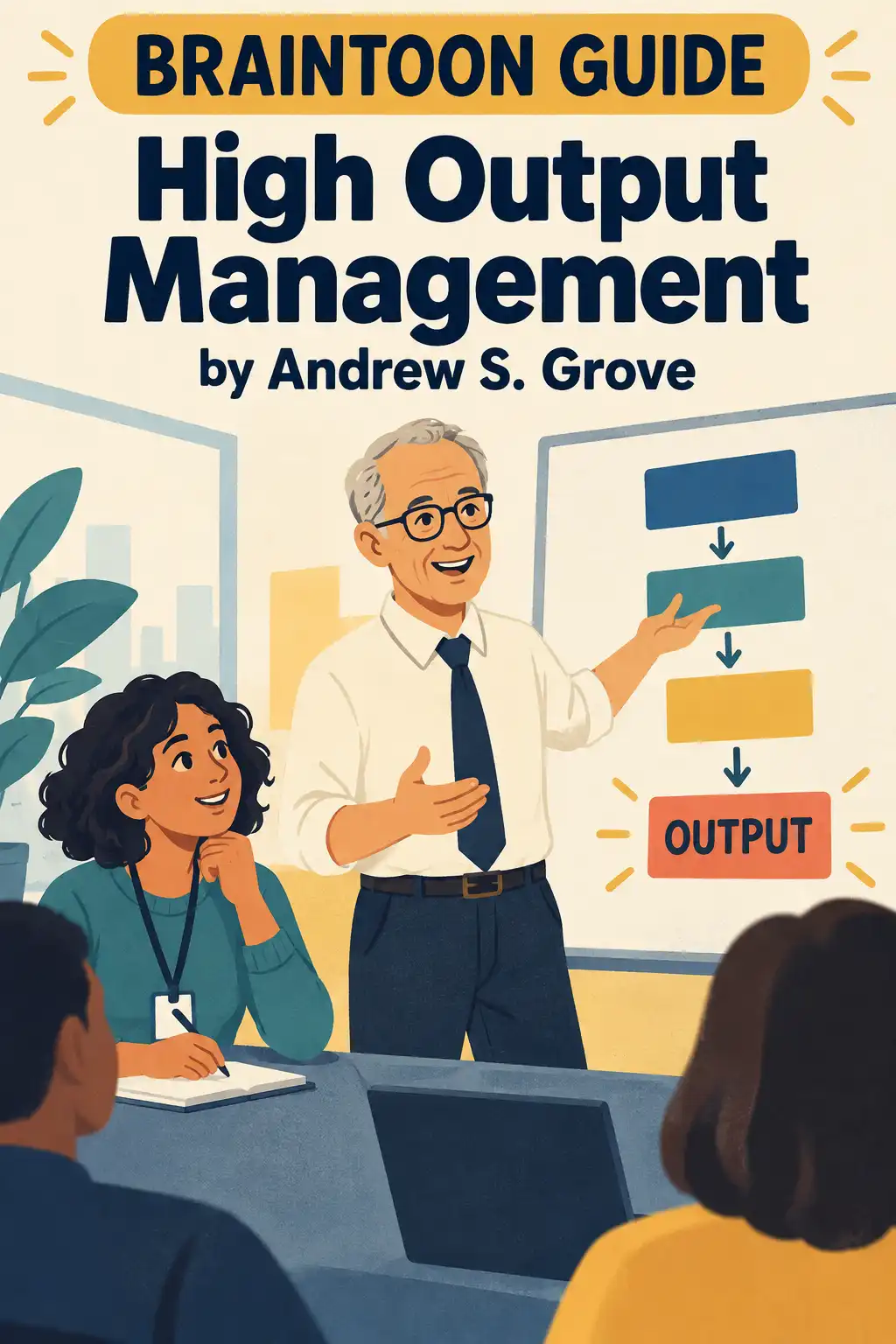
Andy Grove offers one in his book High Output Management. He warns that if you measure one thing in isolation, you'll get that thing, often at the expense of something you cared about more. So he pairs indicators, like tracking inventory alongside shortages, so each one keeps the other honest.
A metric is an incentive: Picture the behavior a number will produce, and pair it with another so neither can be gamed alone.
Learner
Does that apply to people decisions too?
BrainToon
Very much. He calls it management debt. You take a shortcut now and pay for it later. Say a key employee gets an outside offer, and you quietly raise their pay to match it. It feels easy in the moment. But word gets out, and everyone learns that threatening to leave is how you get a raise.
Learner
So the office politics start with the boss, without meaning to.
BrainToon
That's his view. His fix is consistent processes for pay, promotions, and reorganizations, so there's less room to lobby.
Learner
Process in a startup, though? That sounds like the bureaucracy people join startups to escape.
BrainToon
He uses a football picture. A lineman who refuses to give any ground gets beaten. A good one gives ground slowly, on purpose. Adding structure feels like a step back, but it keeps a growing company from collapsing.
Part 6Wartime leadership and courage
Learner
You've said wartime twice now. What does he mean by it?
BrainToon
Peacetime is when a company has a strong lead in a growing market. Wartime is when something threatens its survival. He says the two need very different leaders. In peacetime you build consensus and encourage creativity. In wartime you move fast, stay blunt, and allow no drift from the mission. By his count, he spent three days in peacetime and eight years at war.
Learner
I can see wartime becoming a handy excuse for being harsh.
BrainToon
It can be read that way, and he admits a wartime CEO can be confrontational. But his claim is about fitting the style to the situation. He also says most management books only teach the peacetime version.
Peacetime CEO vs. wartime CEO: Horowitz says the two situations need very different leaders, and he spent nearly all his time at war.
Learner
So what's the hardest part, in his view?
BrainToon
Managing your own mind. The role is lonely. You can't dump your doubts on employees, and the board doesn't know enough of the details. He sees CEOs fail two ways. They take everything so personally they freeze or lash out. Or they wave problems away with false optimism.
Learner
And the middle path?
BrainToon
Urgency without falling apart. He suggests talking to peers who've been there, and writing down your reasoning to separate logic from fear. He also says courage got tested more than intelligence. Often the right call was obvious. But if you follow the crowd and you're wrong, the blame is shared. Go alone and it's all yours.
Learner
So safety pulls you toward the wrong decision.
BrainToon
Yes. And when he asks great CEOs how they made it, he says they tend to give the same answer. They didn't quit.
Closing
Learner
What stays with me is how little of this is clever. Tell the truth. Fix the real problem. Stay in the game.
BrainToon
That's the book. Horowitz says the struggle is the journey itself, not something in the way of it. So here's a question to take with you. What's the hard thing in your own work that you've been softening or explaining away? And who needs to hear the honest version this week?
 BrainToon